Tuesday, February 8, 2022

Crying in H Mart - Michelle Zauner (2021)

We do not need to run through all of the so-called indie rock memoirs reviewed on Flying Houses. Suffice to say, there are many, and if I happen to do another in the near future, I will make a separate post compiling them for easy access, rather than needlessly clutter this review with links and comparisons. Because this is a very different type of memoir from those.

With Crying in H Mart, Michelle Zauner has established herself as one of the preeminent artists of today, probably because this book is not really about the music. I am sure many other musicians are hobbyists in some other discipline and possess redoubtable knowledge on certain topics--but they never choose to write about them at length. 

Zauner's material on Japanese Breakfast and her earlier band, Little Big League, comprise 10 or maybe 15 pages out of this 239-page narrative. This isn't a book about her travails in trying to "make it." It does, however, reflect upon her meteoric rise in beautiful fashion. And this was one of the many, many pages that brought tears to my eyes--of sadness, happiness (for others) and hope. This is to say, I often begrudge others their success, particularly when they are quite a bit younger than me. But Zauner isn't really that much younger than me, and one cannot help but see her success as hard-earned, beautiful and touching.

This book took me quite a long time to read--perhaps six weeks--owing as always to other life events, but also because, this is very heavy reading. It's not leavened with photographs (clearly, there could be many, as evidenced by one of its final episodes) or sprinkled with clever asides or footnotes. There clearly could have been footnotes in this, but they would have detracted from its overall power. There is levity in this book, but it is juxtaposed against heartbreaking anguish, and the overall mood is honorary and respectful towards its true subject, which is Zauner's mother. 

I cannot locate her proper name in this book, which probably is best written in Korean, though one of the many things Zauner does well is translate Korean into English as "Konglish." We know her mother's sisters are Eunmi and Nami. Michelle doesn't speak Korean particularly well, but she was born in Seoul; her mother was from there and her father was American. 

The book opens up like The Stranger, as it should:

"Ever since my mom died, I cry in H Mart." (3)

From there, she launches into a description of the H Mart franchise and the magic she feels upon stepping into one, tinged with nostalgia and sadness: she cries in several places in the store, and apparently does this often. The opening is kind of a delusive move, because it makes the book seem like it will be an exercise in dark humor, or irony--and while it has such moments, it is more closely about the absurdity of grief that many of us have endured or must endure, at some point. Really though, it's all about the food.

***

Our previous subject, Parker Posey, included several recipes in her memoir. These were kooky but not unwelcome. Here, Zauner could clearly justify an appendix of recipes. So why does she not? Perhaps it is to maintain the sanctity of the dishes, or perhaps because she doesn't want to cheapen it by offering facile instruction. The text itself should be sufficient for anyone seeking to replicate these recipes. 

We need more books like this, about food from other parts of the world. We have every kind of food imaginable in a big city, but there is nothing better than authentic cuisine, recipes passed down through generations, tied to homeland traditions and memories of being together, intrinsic to one's identity. I knew about H Mart but I haven't been in one. The first time I go, I might just cry. I'm actually feeling pretty emotional today. I finished this last night. Maybe I'll go today. 

***

Briefly, the book concerns the period between 2013 and 2014, in which Zauner lived in Philadelphia, playing smaller shows with her smaller band, Little Big League, for a few years after graduating from Bryn Mawr College.

Now then, she does write a bit about her high school years, and the bad relationship she had with her mother at the time, and how poorly she performed in school, and how it was a miracle she got into college at all, later graduating with honors--but she downplays Bryn Mawr's prestige. While there may have been personal issues, clearly her parents did something right with her education, and this book is proof that she contains multitudes and can do these things at a high level. She is the only person that can get a "Best New Music" designation on Pitchfork, publish a NY Times Bestseller, and make a proper bowl of nurungji, or galbi, or jatjuk, or authentic kimchi.

There are certainly moments of ridiculous "culture-specific" humor:

"I was afraid of my grandmother. She spoke harshly and loudly and knew maybe fifteen words in English, so it always seemed like she was angry. She never smiled in pictures and her laugh was like a cackle that ended in loud hacking and coughing. She was as hunched over as an umbrella handle and always wore plaid pajama pants and shirts with glittering, rough fabrics. But I was chiefly afraid of one particular weapon she brandished--the ddongchim. Ddongchim literally means poop needle. It involves clasping your hands in the shape of a gun, index fingers pressed together to create a needle used to penetrate an unsuspecting anus. As horrifying as it sounds, it's a common cultural thing, something akin to a Korean wedgie and not some unique form of sexual assault. Whenever she was near, I constantly hid behind my mother or Seong Young, or scooted by her furtively with my butt pressed against the wall, anxiously expecting my halmoni to prod her index fingers through my pants, cackling and then hacking at my surprise and terror." (28-29)

There is some material on indie rock, and it was heartening to read that the first song Zauner learned how to play on guitar was "Carry the Zero" by Built to Spill (an impressive start, especially if she could do the solo). She rhapsodizes about Modest Mouse as the keystone to the regional scene. She waxes poetic about seeing Karen O and the Yeah Yeah Yeahs, and how she gave her the confidence to believe that someone that looked like her could be in a band like that. But she was also ambivalent and cynical: maybe Karen O had fulfilled the demographic quota, and there was no space for another half-white, half-Korean indie rock icon:

"Back then, I didn't know what a scarcity mentality was. The dialogue surrounding representation in music was in its nascent stages, and because I didn't personally know any other girls who played music, I didn't know there were others like me struggling with the same feelings. I didn't have the analogical capacity to imagine a white boy in the same situation, watching a live DVD of say, the Stooges, and thinking, if there's already an Iggy Pop, how could there possibly be room for another white guy in music?" (55)

So, there is a little bit about music, but that's just her career, and she does not have many anxieties about deciding what she wants to do with her life, though she does later work at a pizza restaurant as a way of distracting herself from grief. I am not sure if the phrase "tiger mom" appears in print here, but a word need be said about this.

Now I do not know what it is like to grow up with an Asian or Asian-American mother, but they are apparently very tough on their kids and hold very high expectations for them. Some consider this brutal treatment, and this entered the cultural conversation when Amy Chua published her book The Battle Hymn of the Tiger Mother. But Chua's mother was Chinese and I wouldn't want to conflate the cultures.  Regardless, it's impossible to avoid that disambiguation in America, unless it's part of your own identity, or has become your adopted identity. I can try to be sensitive to these differences, but I will inevitably stick my foot in my mouth. 

Zauner's mother is harsh, but lovely in that harshness. She only wants to steel Michelle against the innumerable criticisms of the world, so that she may transcend them. She criticizes her extensively, and the relationship is so bad that at one point, in a fit of anger, she instigates physical abuse, asks her husband to overpower their daughter, and loses it:

"'Why are you doing this to us? After everything we have given you, how can you treat us this way?' she yelled, her tears and spit falling onto my face. She smelled like olive oil and citrus. Her hands felt soft and slick, greased with cream, as they pushed my wrists against the coarse carpet. The weight of her on me began to ache like a bruise. My father hovered over us, unsure of his place in it all, searching for a reason why a kid like me could wind up so miserable.
'I had an abortion after you because you were such a terrible child!'
Her grip went slack and she shifted her weight off me to leave the room. She let out a little cluck, the kind of sound let out when you think something is a real shame, like passing a dilapidated building with beautiful architecture." (65)

This is the major thread running through the book--Zauner's regret over the wasted years of her upbringing, when she couldn't properly appreciate her mother's form of love. She could appreciate the food, but little beyond that. By the end it is clear that she has made good, and they are about as close as a mother and daughter can be. 

***

There was one surprising element to this book, and I will not spoil it, but I will just say there is a kind of House of Broken Angels-vibe to it. Of course, as a grief memoir, there is plenty of material about hospitals, chemotherapy, hair loss, nausea, bodily fluids, humiliation, thankless caretaking, dreaded phone calls, and magical thinking. 

But there is more about love in here, and food. Zauner does not shy away from graphic details, and while she conveys the horror of the events in question, she prefers to remember her mother at the height of her powers, focusing on the knowledge and the memories that she hopes to preserve. 

But God, the crying. I am not sure this book will make you cry, but it definitely made me cry. Like, a lot. Like, I had tears welling up for maybe 15-20% of the pages I read. This is why it was a heavy read for me, because I felt that every time I picked it up, it would remind me of things, things that didn't even have to do with death, such as the trip to Seoul she takes with her husband Peter. The book is also an account of their relationship, from a certain remove, and it seems so effortless, we can only imagine how much more difficult the grieving process must be without a good, supportive partner. If anything, this thread shows all the elements that comprise a good relationship. Those of us with less impressive partners (or delusional crushes) may find deeper longing in it.

The true beauty of the book, however, comes at its end, and while it is something of a spoiler, I cannot help myself:

"I hadn't believed in a god since I was about ten, and still envisioned Mr. Rogers when I prayed, but the years that followed my mother's passing were suspiciously charmed. I had been playing in bands since I was sixteen, dreamt of succeeding as an artist practically my whole life, and as an American, I felt entitled to it in spite of my mother's aggrieved forewarnings. I had fought for that dream thanklessly for eight long years, and only after she died did things, as if magically, begin to happen.
If there was a god, it seemed my mother must have had her foot on his neck, demanding good things come my way. That if we had to be ripped apart right at our turning point, just when things were really starting to get good, the least god could do was make a few of her daughter's pipe dreams come true.
She would have been tickled to have seen the past few years, me dressed up and shot for a fashion magazine, watching the first South Korean director win an Academy Award, YouTube channels with millions of views dedicated to fifteen-step skin-care regimens. And though it felt contrary to my beliefs, I had to believe that she could. And that she was glad I had finally found a place where I belonged." (233)

Sometimes, success brings the unfortunate tragedy, and sometimes the unfortunate tragedy brings success. The only problem with this book is that it will make other writers want to give up. There's a span of a few pages towards the end, which I will not excerpt, where she puts some redoubtable vocabulary on display. There's poetry in the language, and she writes about taste sensations with such precise detail that she could easily moonlight as a restaurant critic. The book ultimately hits every nerve of the human experience and imbues it with truth. As such, it is one of the Best Books reviewed on this blog. 

Grade: A

****APPENDIX****

For my own personal perusing, I want to include one recipe. I won't do the kimchi (pp. 214-216), because that would be a long excerpt, but that may be the most instructional one in the book. She writes a bit about Maangchi, who does videos on YouTube and who seems almost like an avatar for her mother. She seems to consult the videos for verification purposes. Maangchi does do a video for jatjuk:

"The recipe was simple--pine nuts, rice, salt and water, all ingredients we already had on hand. Per Maangchi's instructions, I soaked a third of a cup of rice and set it aside for two hours. I measured out two tablespoons of pine nuts, and began removing the tips, then tossed the soft, picked kernels into the blender. When the rice was finished soaking, I rinsed it under the faucet and added it to the pine nuts with two cups of water. I closed the lid and ran the blender on high, then emptied the liquid into a small pot on the stove.

'You don't need many ingredients, but as you can see it takes time. That's why jatjuk is very precious. Like, for example, one of your family members is sick, nothing much you can do. When we visit the hospital we usually make this jatjuk because patients can't eat like normal food. Pine nuts has protein and good fat for body so this is perfect food for patients who are recovering from their illness,' Maangchi explained.

The mixture was a beautiful milky-white color. On medium heat I stirred it with a wooden spoon. At first, impatient for it to thicken, I was afraid I'd used too much water. Then, as its consistency turned from skim milk to peanut butter, I was afraid I hadn't added enough. I lowered the heat and continued to stir, hoping it would thin as Maangchi's had. When the pot began to sizzle, I took it off the heat and added salt, then poured it into a small bowl. 

I cut chonggak kimchi into small disks and ladled some of the brine over the radish pieces. The soup was creamy and nutty, and felt soft and soothing as I swallowed. I ate a few more spoonfuls before crunching into some kimchi to break up the rich flavor with something spicy and tart. That wasn't so hard, I thought to myselff, happy to have conquered the dish that Kye had mystified. 

This was all I wanted, I realized, after so many days of decadent filets and pricey crustaceans, potatoes slathered in the many glorious permutations that ratios of butter, cheese, and cream can take. This plain porridge was the first dish to make me feel full. Maangchi supplied the secrets to its composition step by step, like a digital guardian I could always turn to, delivering the knowledge that had been withheld from me, that was my birthright. I closed my eyes and spooned the last of the soup into my mouth, picturing the soft mixture coating my mother's blistered tongue, the warm liquid traveling slowly into my stomach as I tried to savor the aftertaste." (189-191)

Monday, January 17, 2022

You're on an Airplane - Parker Posey (2018)

This, along with our previous celebrity memoir, were picked up when I randomly browsed what was on the shelves of the local branch of the CPL in advance of a week-long trip to Palm Springs. I didn't realize Parker Posey had written a memoir (I would imagine most people also, did not know this) but I always liked her in anything I saw her in, and appreciated the niche she had carved out for herself in film. It also would be a good book to read on a trip such as this.

Actually, it was not, because I felt vaguely self-conscious whenever I opened it on one of the 4 different flights I took, irrationally concerned that a fellow passenger might see the cover and consider it too apropos and ironic, as if I was reading it for a reaction. Usually, when a person next to you remarks on your book, it is a welcome exchange (it is for me, at least, given this blog). I remember a particularly positive one, on a flight to New York in 2017, involving Elena Ferrante, so hip and "advanced" as New Yorkers continually prove themselves to be, that portended a meaningful return.  

People namecheck Elena Ferrante so they can sound "in the know" (Hollywood did come knocking, more than once, most recently with a film directed by Maggie Gyllenhaal that I liked, but which is apparently very divisive); and certainly, people that namecheck Parker Posey may not be "in the know" to the burgeoning cultural moment, but they are certainly "in the know" about independent film.

Yet some of us only know an actor's oeuvre in broad strokes, as each performance gets spit out immediately after it has coalesced into a vision. When an actor finishes a role, they are done with it--unless sequels are planned, or it is a TV show. 

My dad has gotten into a number of TV shows lately, and I have tried to watch them on his recommendation. We agreed on Fleabag and The Mandalorian. I enjoyed The Queen's Gambit, but not quite to the same degree (ditto for The Marvelous Ms. Maisel). I have not finished WandaVision, but I have liked what I have seen fine. His latest binge has been on Lost in Space and I had been meaning to start it. Shortly after I checked this out from the CPL, I found out that Parker Posey is the star of that show (or at least its biggest star), and now I will be starting it sooner. I will also get around to seeing Blade: Trinity (which I think also requires watching the first two), because I believe that she is good in everything she does. 

***

It is perhaps easiest to begin by forming a list of adjectives to describe the book: "quirky," "manic," "irreverent," "disorganized," "messy," "educational," "surprising," "humorous," "ironic," and "cute." It is pretty light reading, yet I found it somewhat difficult to engage with the material until I had locked in for a few pages and could follow the thread of each narrative episode. So, it was not a quick read. 

I was somewhat put-off by the first 50-100 pages, because it seemed like the book was going to be "padded," with all of the cutesy re-purposed photographs in the margins of its pages. By its end, that decision made a certain amount of sense: nearly every biography, and many memoirs, contains a section of pages near the middle (or perhaps several such sections), that consist exclusively of photographs with captions. Now, these are always welcome respites and feel like "shortcuts" through the book, yet they tend to deepen and enliven the material, particularly when the artists themselves are steeped in the art of photography (I am thinking of Patti Smith and Susan Sontag, here).

Posey need not do that, because her life's work is on film. Reproducing stills from the films would feel self-congratulatory and unnecessary, and while there might be a few candid photos with other celebrities, these are kept private, because Hollywood is a very dirty place, it seems.

***

Before I read this book, I knew Parker Posey to be an actress that did not hog the spotlight, that seemed comfortable being a "character actor." I had recently re-watched Best in Show shortly before I picked this up, and was reminded of her delirious performance in that, which has to be one of her best. I didn't remember her in much else, to be honest, except the film adaptation of the Dennis Cooper novelFrisk, because she was also the biggest star in it.  She was in Dazed and Confused, but sort of blended into the background with all the other famous actors in their breakout performances. She is in pretty much every Christopher Guest movie since Waiting for Guffman (and always a highlight in each). I am pretty sure I saw Broken English and Fay Grim, but I remember nothing about either. I enjoyed Irrational Man more than I was expecting, but I forgot she was in it. I also forgot she had a character arc on Louie. I don't remember her in Scream 3, but I think I am about to re-watch it, a Scream marathon, for the new one. I'm pretty sure I watched Party Girl (which for some reason, I believe is her "iconic" performance, and the one that gave her the vaguely acknowledged moniker as the "queen of independent cinema"), but I don't remember much about it. I liked Kicking and Screaming, but again, do not remember much about it 

That was Noah Baumbach's debut, which came out in 1995, and only now, in the past couple of years, probably after Greta Gerwig put out Ladybird, is he acknowledged as a marquee director. I could write about other directors referenced here that later "had their moment" (Richard Linklater, though he did that right out of the gates; Greg Mottola; Julian Schnabel; Hal Hartley and Greg Araki, though never major names, but major icons of independent film; Zoe Cassavetes, and it's surprising just how many "acclaimed artists" Netflix has managed to snag). I wanted to make a special note that I loved the movie subUrbia and also did not realize she was in it. I do not remember much at all about Superman Returns except that Kevin Spacey played Lex Luthor and that it failed to generate sequels. There was probably some sketchiness on the set with the director being Bryan Singer, but Posey is not interested in getting any artists "canceled." 

I could write about a lot of things in this review, because this book sort of encompasses everything about Hollywood over the past 30 years, and because Posey feels omnipresent and underappreciated within that, but we should stick to the text.

***

She was born at the tail-end of the 1960's with a fraternal twin brother (the first fact I did not know), and raised in or around Shreveport, Louisiana. And here we have to mention the single best part of this memoir, which is her writing about her father. 

Her father is, frankly, outrageous, and it feels vulnerable to admit this, but I have always been sort of ambivalent about having children (to say nothing of economic barriers) until reading this, because I would love to be the sort of dad that he was to her. In short, more human beings could stand to be like him:

"My dad brings the 'never met a stranger' phrase [she earlier described him as "a comedian without a venue"] to a whole other level. I've met people on sidewalks in New York who say they had a great time with my dad on a flight or in a restaurant somewhere--they go out of their way to tell me this. He's so charismatic and seductive that he once gave an impromptu chiropractic adjustment to someone he'd just met at a business party, in San Diego. No, he's not a professional chiropractor, he was a car salesman. He got that lady to lie on a table so he could crack her neck. When we saw her rubbing her neck, looking like she was in pain as she walked to her husband, we tiptoed, running, out of there. When he'd try to sell a new car to a potential buyer, he'd put a fake poopy diaper in the trunk to 'break the ice'--that kind of shit. He could sell ice to water." (116)

I just spent about 30 minutes trying to find the story about a road trip her family took where they stopped at a random convenience store along with the way and bought masks (one of them was Nixon) and how her parents drove with the masks on to freak out other drivers, and how they drank, less, in the car, but it was driving me nuts, so I just had to paraphrase it from memory. 

There are other stories with her dad, but you can see one problem with the text already: it's a blur. That said, flipping through these pages for 30 minutes leads to other things I want to write about, and reminds me that I did, actually, fly through the last 200 pages of the book (maybe because I was waiting around a hospital for hours last week) and cannot situate excerpts. It's a blur, and sometimes there are throwaway lines, throwaway paragraphs--there could have been finer editing, and it seems Posey had total creative control to write this maniacally--yet on the whole this is life in all of its glorious messiness. It is extremely difficult to remain focused when you have lived a storied life and have simply too many intriguing anecdotes to relate.  

***

There are many threads running throughout this book, but if there is one that sets it apart and make it unique, it is the attention Posey pays to the myriad ways that all of our lives are intertwined. There is some form of cosmic connection, it seems, and when we recognize certain coincidences as being too bizarre for belief, it generally merits mention. 

Like the anecdotes about her father, these would be difficult to locate, but one, at least, should be easy.

And it's not! What a surprise. The story I can't find involves Wiley Wiggins and Jason London, perhaps 15 or 20 years after co-starring in Dazed and Confused, and I really shouldn't spoil it, anyways.

Another story I could find involves Shirley MacLaine and Coneheads and UFOs, but that would basically involve copying the entire chapter "Shirley, the Coneheads, and Me," which yes, is one of the standout chapters. 

Posey is a lapsed Catholic, so I could relate to her form of spirituality, which also seems to involve a fair good bit of yoga. The chapter where she describes the entire series of a Sun Salutation ("Garbage on the Beach") was extremely familiar to me, as it likely is for many. The chapter on pottery, however, I did not like nearly as much. It has a moment or two, but felt too much like "inside baseball," despite writing from a beginner's perspective.

***

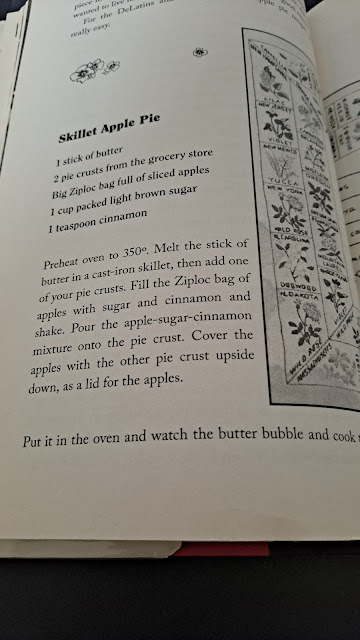
The book is useful for the recipes that Posey includes. Here, I will include the very rare photographic supplement to a review, for two simple recipes and one hard one:


"...the edge of the pie. I think this takes about 45 minutes. May God bless America." is the missing end to the sentence.

And this one is easy, too:


And this last one sounds tedious and expensive, but also amazing: 


I am not including the recipe for Cheese Crisps by Lynda Posey, but the anecdote is quite amusing.

***

Posey does not trash anyone in this memoir. It was published in 2018, and so the #metoo movement must have had an impact on its writing. Posey details no meeting with Harvey Weinstein, and while it does not seem he had any impact on her career (in the Paltrow sense), he may have indirectly supported it by Making Independent Films Big, and I would imagine they had to have met, at some point. 

If you don't have something nice to say, don't say anything at all, and in Hollywood, when you do, you don't use their names. She does this at a few points in the memoir, and one could probably do a little research and figure out who she meant, but again, such anecdotes would be difficult to locate. 

The chapter "Louie" is a turning point for the book, and it comes fairly early on (around page 100). Posey knows that people want to know what the real Louis C.K. is like, and this chapter should give a fair impression, though there is only a line or two that suggest any latent understandings. Ditto for the chapter "Master of Storms" on her experience working with Woody Allen on Irrational Man. It seems clear, she has serious respect for Allen (refers to him as the greatest living film director) and would not disown her work on his films. 

She also talks a bit (yes, it should be "writes a bit," but the book is written as a long monologue on an airplane to a seatmate, though the device is not followed religiously) about her dog Gracie and how she got him when she was with her boyfriend Ryan, whose last name is later divulged as Adams. This may have been at the height of his career, or right when it was "taking off," and there are a couple light jabs, but nothing incendiary. 

Basically, for the time this book is published--a book about being a Hollywood actress since the 90's--there is little, if any, reference to #metoo. It was published July 24, 2018, and #metoo became a thing in October 2017. Perhaps nothing bad happened to her, and she felt she couldn't write responsibly on the topic, but I can hardly believe this was the case. We should not expect memoirists to explore all of their deepest, darkest and most painful experiences--and this is certainly not that type of book--and perhaps she felt it was unnecessary and distracting. Whatever the case, it is pointless to conjecture as to her motives or the realities of writing and publishing; just know that when she dishes, it is usually more innocuous than damning. She is not out to get anyone canceled. And perhaps, in a way, because of this, the book does not come off as phony. Some might consider it somewhat superficial (a great deal of space is dedicated to a wrist injury and the perils of home renovation), but there is nothing phony about it. These elements do, unfortunately, make it feel somewhat like a tease, but if a reader is hoping for "dirt," that may say more about them than the author that chooses to make their memoir un-sensational. 

***

I had mixed feelings as I waded through the text, but I never felt Posey to be anything less than charming, perhaps most so when she knew she was being annoying by writing an entire chapter about the mechanics of pottery-making. Upon completion, my feelings are more positive than not. The ending, while somewhat appropriate, is a totally random place to finish, and it's clear Posey was trying to do something different with this book. She is not a comedian, but clearly her father's love for comedy was passed down, and it reads more like a comedian's memoir than an actor's memoir. Her writing is effortless, and several rules are broken, but people say you need to learn all of the rules in order to break them, and this book probably would not exist if Posey had focused her efforts on writing rather than acting. It could have used better editing, but I also understand the choice was made to keep it weird. I appreciate that, and this book made me appreciate Parker Posey more than I already did, deepened the pseudo-crush I always had on her, and made me hope that perhaps one day our lives will also intersect. Arguably, they already did when she lived in Janeane Garafalo's building, and I lived across the street at 5th and 10th in 2001 (a dorm--former abode to Mark Twain and apparently Edith Wharton, which I didn't know until reading this); but no "on point" anecdote exists that merits mention, not yet. 

Friday, January 7, 2022

Silver Screen Fiend: Learning about Life from an Addiction to Film - Patton Oswalt (2015)


This was Patton Oswalt's second book, and I haven't read Zombie Spaceship Wasteland, which was also a memoir. I believe that one is more about stand-up comedy and this one is, obviously, more about cinema. That said, there is a pretty good amount of material on stand-up comedy in it. I would say it is actually about 50/50. 

I don't want to go into an exegesis of Oswalt as a cultural figure, but it is inevitable. He is most famous for giving the voice to Remy in Ratatouille and perhaps his role on "King of Queens." However, he is a very good actor in his own right (Big Fan and Young Adult are both excellent). In 2011, he was given the Vanguard Award at the Palm Springs International Film Festival. And of course, as a stand-up comedian, he would be considered A-list. 

He did contribute to a third book, which was started by his wife Michelle McNamara before her untimely passing, and I'll Be Gone in the Dark seems like it might be better than Silver Screen Fiend, primarily due to the heaviness of the subject matter and context of its publication. (It was also adapted into a documentary for HBO.) It's not ironic that Patton Oswalt went to see Pulp Fiction with Marc Maron (and a third friend, Blaine Capatch), but it feels like it should be. Sometimes things happen and life is just unfair. Sometimes people become successful and get paid, and they pay for it in other ways. No lessons can be learned from such tragedies. Great art, however, can be made as a sort of salve for anyone in the audience whose lives have similarly been devastated by the cruel and arbitrary nature of the universe.

But back in the good ol' days of 2015, life was better than we appreciated it being, and Oswalt put out this book about self-education in cinema, which was undertaken in the hopes that it would magically transform him into a film director. 

***

Immediately, the concept is appealing to me. I did a similar thing when I was 18, but it was with Blockbuster's $30 for 30 days deal, and I did a new movie every night. When I was about to start NYU, I wanted to be a film director (or a critic, secondarily). I probably watched most of the Woody Allen catalog, perhaps to prepare for the move to NYC. And while my interest in making films soon waned, after appearing in one and experiencing the enormous obligations and extent of collaboration with tech personnel, I wanted to work on my own, because I didn't have the confidence to say, "this story is good enough to film, and good enough to ask you all to give me a huge chunk of your time to work on it with me." As an older person now, I recognize that spirit of collaboration as a beautiful thing, and that if tech personnel are actually being paid for their time, it is less daunting to ask for it. 

But I was young and dumb for many years (that continue to this day...), and I would not abandon wanting to make movies, such that six years after those first forays into cinema, I would move to California to try to insinuate myself into Hollywood. When I went to the movies, it was mostly to the bigger chains to see bigger films (Into the Wild, No Country for Old Men, There Will be Blood, Wall-E, The Dark Knight) but one night, I went by myself to see the new movie about Joy Division, Control, at the NuArt Theatre in Santa Monica.

***

It feels appropriate to mention Peter Bogdanovich, as I just finished listening to his WTF Interview in memoriam. One of his films must be referenced here. It does not feel as appropriate to mention Roman Polanski, who is definitely referenced at least once or twice (Knife in the Water and Repulsion). Bogdanovich was very close with Orson Welles. As I listened, I followed along on his Wikipedia page. I haven't seen The Last Picture Show, Paper Moon, or pretty much any of his other films (actually I have not seen any of them and now I feel like a fraud for thinking I had a decent education). The best parts of the interview were anecdotes about Welles, who is certainly one of the greatest filmmakers of all time, though ended his career in rather sad fashion (his final performance, five days before his death, was in Transformers: the Movie, one of my early favorites, as the voice of the super-villain Unicron, which is pretty perfect in a way).  

There is no index to Silver Screen Fiend, perhaps because this is not an academic volume, but there is an Appendix which lists all of the films Oswalt saw over the four years of his "addiction," from 1995 to 1999. The period starts with a double feature of Sunset Boulevard and Ace in the Hole at the New Beverly Cinema, which was an institution, until its owner, Sherman Torgan, passed away; Quentin Tarantino (an offspring of Bogdanovich, in a way) has recently restored it and taken over management. It ends with Star Wars Episode I: The Phantom Menace, which is quite fitting.

In those four years, he saw 51 movies at the NuArt; I think I saw 2 in my one year nearby (Smiley Face after Control). But I went to the NuArt on my own, by myself, and it felt sort of special to me because nobody had ever really mentioned it and I had never really thought about it until I saw it written about in here. So that part of the book is personal to me, also. 

***

One could not do much better than starting off an education in cinema with Billy Wilder. I've seen Sunset Boulevard a handful of times, and Ace in the Hole once, fairly recently (it didn't move me nearly as much as Sunset, The Apartment, The Lost Weekend, Witness for the Prosecution, or what I consider his ultimate masterpiece, Double Indemnity--but it was on par with Some Like it Hot; I probably need to see it again, along with many others of his yet unseen). Donald Trump's most redeeming quality was his appreciation for Sunset, as he felt a kinship with Norma Desmond (his results bore more fruit, rotten as it may have been). It is an essential film, and perhaps the greatest on the subject of Hollywood. I don't think I have ever seen a silent film (further fraudulence) but at least I have seen Buster Keaton in that. William Holden and I are birthday buddies, so I felt connected to his element as well. It's beautifully shot, amusing and moving; one could not do better than start their education here. 

Oswalt weaves in and out of anecdotes from the actual moviegoing experiences. One of the best is a story about watching Citizen Kane at the New Beverly with Lawrence Tierney in the audience:

"For about fifteen minutes he sat there, talking to the screen as if he were just out of view to the other characters, admonishing Kane. 'Don't clap for that squawking bitch, she can't sing. Siddown, ya chump!' 'Aw Jesus, what's he staring at? You gonna cry, fancy man?' It was the best DVD commentary I've ever heard." (96)

He weaves in and out, talking about his burgeoning career in stand-up, television and film (I never had any desire to see Down Periscope, but now, I think I will). He primarily does this through his "Night Cafe" motif. 

Briefly, "The Night Cafe" is a painting by Vincent van Gogh, which came out of a moment of inspiration where he sort of locked in and figured out what he was trying to do with his art. The idea of the Night Cafe is a place where you go, and having been there, your life is changed forever. Oswalt goes through six such venues, one of which is the New Beverly Cinema (a few other comedy clubs mostly fill out the six). This is not a bad framing mechanism for the memoir and seems like a truism for anyone in the arts: there will always be certain spaces where a particular person will enter, find inspiration, and start from a new beginning. 

So, a lot of this is about working out a stand-up routine, and making the transition between regional comic on the Mid-Atlantic Coast to featured act on the West Coast. I do not do stand-up comedy (though I have wanted to try, against my better instincts) and so writing about it may expose further fraudulence. And frankly, even though none of this material is bad (probably the most beautiful writing comes out of these sections), I felt it detracted from the exercise that is this book, perhaps in the name of readability or entertainment. I would rather read an arch, academic, scholarly text on cinema by Patton Oswalt than a hybrid stand-up/film memoir. Clearly, with all of the knowledge Oswalt displays at random moments in the text, along with the intellectual pedigree he also exhibits, he is capable of writing that book. But it probably would not sell as well. And perhaps, there is the comedian's impulse, to turn every observation or anecdote or explanation into a punchline, and so a more serious book is improbable (I have not read his section of I'll Be Gone in the Dark, and I would imagine there are not many punchlines, but I would not be surprised if there are a couple). 

He starts his education, after seeing Sunset Boulevard and Ace in the Hole, by going through five of his books on film and reading up on those he has seen: The Film Noir Encyclopedia, Cult Movies (three volumes), and Psychotronic Encyclopedia of Film. He then decides to see as many of the movies in these books as he can, marking an asterisk next to each, and the dates and places he saw them. That is the "plot." 

***

I'm not sure what else to say, except that the book is very good and anyone who appreciates cinema or stand-up comedy should find something to admire in it. It made me laugh out loud at several points. It will probably refer you to a film or two that you haven't seen. 

For me, this was La Jetee, which I had seen in Paris while studying abroad as part of a course on film, but which I had forgotten about completely. This reminded me that it provides some inspiration for 12 Monkeys

"Chris Marker's moody, near-motionless meditation on the costs of time travel and nostalgia--barely half an hour long but leaving you feeling like you'd just been dragged through a lifetime's worth of emotion and loss. This must have been showing with other movies--Sans Soleil? Maybe a Tarkovsky? But all I wrote down was La Jetee." (103)

I remember feeling sort of bored and confused when I saw it the first time, so now I feel like I need to again. It's not a huge investment of time. Just now I have reserved the DVD at CPL, and yes, it is packaged together with Sans Soleil.  

Sure, I would have liked for Silver Screen Fiend to be more Against Interpretation than Bossypants, but I also probably enjoyed the experience of reading the latter more than I enjoyed the experience of pretending like I understood the former. So overall, Oswalt did well with this. With these two under his belt, it is inevitable there must be a third. He is in the very rare category of artist that can do pretty much whatever he wants, now; he is one of those people that is pretty much great in everything he's done, and I don't doubt it would be compelling.  

Writing this review though, I am dismayed. Having written the word "Oswalt" this many times, with Batman on my mind (which is frequently the case), it is enormously sad that he will not be playing The Penguin in The Batman. Jonah Hill would have made a pretty good Penguin, and I am sure that Colin Farrell will do a totally decent Penguin, but a Patton Oswalt Penguin (where Robert Pattinson is Batman)....perhaps that would be too close to a Jim Carrey Riddler (a movie that does show up in the text)....but it would be brilliant casting, nonetheless. It's too bad there are no time machines. Yet.  

Tuesday, January 4, 2022

As Summer's Mask Slips and other Disruptions - Gordon B. White (2020)

Full disclosure: I have known Gordon White for about 18 years. We met in our dorm and shared many friends and acquaintances. Towards the end of our time, I heard he was pretty serious about his writing, but I had no occasion to peruse his work. Then, about six years ago, I think, he invited me to be part of his friend's writing workshop, which was conducted online via Google Hangouts. I wrote a long 2-part story about my experiences in city government that I will probably never unearth again. I was trying to find old edits from that workshop on files saved from old computers, but I cannot at the moment. However, I am relatively sure that I saw early versions of two, or maybe three stories in this volume. Those are: the story that opens the collection, "Hair Shirt Drag;" the title story; and "Birds of Passage." (Note that I am only positive on the middle one.) 

A note on genre: if anything, this review should be an exploration of the divide between so-called "speculative fiction" and so-called "literary fiction." Because I almost never read "speculative fiction." When I entered the writing workshop, I thought I might try my hand at one story in that genre, but I couldn't. Certainly, there are many inexplicable things that happen in the world that inspire awe and possibility; however, as I've gotten older and more cynical, I am less apt to believe in things such as aliens, to say nothing of witches, vampires and ghosts*. There are no aliens here; this is not science fiction. These are horror stories, but some of them are not supposed to be scary at all, but rather, wide-eyed at the mysteries of the unseen world. 

This is put to greatest effect in the story that closes the collection, which I have to believe most people think is the best, "Birds of Passage." The story is a memory of an overnight camping trip a 10-year-old boy takes with his father, canoeing through a stream of shifting features, ending up in a sort of otherworldly place that is completely silent and subsumed totally by nature, without a shred of humanity in view. Something happens over the course of the night that changes the way both feel about the world (though it seems as though the father is not very surprised, and has experienced something similar in his past, camping in the same spot with an old friend). The story is written as a remembrance, after the father has recently passed away, and it is hard to see this as anything but an elegy. It's extremely powerful. The problem I have with "speculative fiction" is the unbelievability factor, but this piece has to be autobiographical, to one degree or another.  It's written with such a convincing sense of reality, portraying the way strange alien things can only be glimpsed for a moment, obscured by a veiling effect to dissemble the truth that there is more to the world than it seems. It is also a heartwarming story of bonding with one's father. I believe it won an award or two, and it is, if anything, the real beginning of his career as a serious writer of fiction.

Or a serious writer of speculative fiction? There is a great deal of snobbery around genre fiction, and I am well aware because I am one of those snobs. Romance novels? Please. Science-fiction? I've enjoyed it in the past, it's probably my favorite "genre," but I don't ever reach for new ones (certainly I loved H.G. Wells and Kurt Vonnegut when I was younger; but never really read Isaac Asimov or Douglas Adams, or Octavia Butler, for that matter). Mystery novels, whodunits or true crime? Just this, from another friend. Horror? Maybe when I was younger. My mom used to say that the book of The Exorcist was quite good, and that the scariest book she ever read was Ghost Story by Peter Straub. Yes, I read a fair amount of Stephen King growing up, too. But also, Scary Stories to Tell in the Dark, which probably had the biggest effect on me, and which feels closer to some of the stories in this collection (albeit less "adult," though these stories are not especially lurid or exploitative, despite often gruesome subject matter). 

A few of the other stories worked for me. After "Birds of Passage," "The Buchanan Boys Ride Again" is probably my favorite, because it feels like a true "blockbuster" that could easily be made into a movie, or at the very least a short film in some one-off Black Mirror-like anthology series. It concerns a son and a father fighting off monsters coming out of plumbing fixtures in an old, cheap motel. It sounds ridiculous, but the pacing and descriptive language of the action made it both very frightening and compelling.  

***

Two of the stories feel more ambitious: "Mise en Abyme" and "Eight Affirmations for the Revolting Body Confiscated from the Prisoners of Bunk 17." The former is more interesting than the latter. The latter reminded me of The Power, except the sequel to it where the woman-ruled world is invaded and overtaken by aliens that seemingly resemble humans and have a taste for flesh. "Mise en Abyme" is a deeper sketch of a dystopian society wherein several citizens are executed live on television each night, and the editor assigned the task of "censoring" the videos, which involves putting a black box over their eyes, deals with a rogue agent that is broadcasting the videos uncensored. She is also involved with (married to?) the Overseer, who seems to be the dictator of the society. 

Ultimately, she is summoned into a world of infinite reflection, with a small dot of light at the very far end; she has some kind of special purpose, and I will not spoil the plot, but I did not really understand it, either. 

There is also a smattering of flash fiction here, with several stories weighing in at 2-3 pages. I have zero issues with flash fiction except that it more closely approximates poetry than fiction. One of those very short stories ("The Hollow," which opens up with a lawyer being summoned for testamentary purposes by two sisters who may be drug addicts and/or close to dying and have to do something with the family home, I think) shows a lot of promise, before quickly devolving into the grotesque. These sorts of things tend to happen frequently in this collection, there is some form of terrible transformation.

"Open Fight Night at the Dirtbag Casino" is the last story to highlight, because it also seems to be set up as part of a longer piece. This is a type of "Groundhog Day" story, except it's not the same day, just the same place and the same opponent in a fight to the death, with the main character fighting as different bodies they have overtaken each night. It's a satisfying story on its own, but I think it encapsulates the way I feel about most of the others: these characters are blank slates. They seem to represent "everymen" or "everywomen" and do not seem to have idiosyncratic personal backgrounds/experiences--the lived-in feel, that is present in the best of them. I skimmed around some of the stories when I felt I sensed the general vibe of what was happening, or perhaps because I wasn't being grabbed by the neck. 

It is a lot to ask of an author for their first publication to be a masterpiece, particularly when working in this genre, without major funding from an institutional patron. This is a passion project, and for the most part, it is a successful one. There is great promise in it, and talents such as Gordon's (and his "fraternal writing twin" Rebecca Allred, who was also part of that online workshop) seemed destined to blossom into genius, particularly when they are capable of beautiful passages such as this:

"'I feel it,' I said, although the description of it wouldn't come to me for years. But the way I said it, my dad knew. He nodded.
'I don't know what you'd call it,' he finally said. With a slender stick, he prodded the embers on our low fire and sent the shadows skipping like water bugs. 'Maybe the bigness of nature, or a great spirituality. Something, though, you don't feel at home.'
He looked out for a moment at the darkness, at the stars above. 'Sometimes,' he said, 'I think about all the possible worlds we could have lived in, but that we're in the one that makes you my son and me your father and brings us here. It sounds stupid'--he paused--'but sometimes I look at you and I think, 'Are you real?'
'Yeah,' I said. He laughed and I smiled, even though I don't know if he saw me do it, there in the shadow just beyond the fire's light. For a while, we just sat and listened to the world.
'Do you feel it everywhere?' I eventually asked, meaning the thing he had talked about and meaning everywhere outdoors; but even though I didn't clarify, my father knew. He and I shared a wavelength like that.
'Maybe if you try real hard, but I've never felt it quite like I feel it here.' He leaned back, caught between the orange light below and the silver light above. 'Just think,' he went on, 'that outside of our fire light, it's miles to the nearest town. Straight up and out above us, for millions of miles, is nothing but empty space. Beneath our skin, hidden deeper from sight, run rivers of blood and cells and atoms and, deeper still, the empty spaces between them. You and I and everything else are just thin layers between space and distances, just skins between mysteries we could never know.'
He stopped, probably wondering if he'd gone too far or said too much. Then he looked at me and asked, 'Are you scared?'
'No,' I said, 'but it is a little scary.'
'Yeah,' he nodded as he spoke, 'but it's also kind of awesome.'" (160-161)

This is also sort of the way I feel about this collection: a little scary, and kind of awesome. At the very least, it is a portent of greater things to come. And I do believe Gordon has just published his second book, which I hope to check out soon.


*It is possible that aliens exist, and sometimes I think I might believe in ghosts, but I find it hard to believe that witches or vampires are real--though obviously witches could be.  

Monday, December 20, 2021

A Calling for Charlie Barnes - Joshua Ferris (2021)

Oeuvre rule: Joshua Ferris has a manageable bibliography. He has 5 books, and I have now read 2 of them. Whether I read the other three (two novels--To Rise Again at a Decent Hour and The Unnamed--and a short story collection--The Dinner Party) is an open question. Of course, his debut, Then We Came to End, was a borderline selection for the Best Books list here, and while it is still his most famous book, his other work has also been honored, to varying degrees.

For some reason, I didn't hear as much about those other books (maybe their plotlines or themes defied easier categorization) as I did about A Calling for Charlie Barnes, or his debut. I could point specifically to an article I read on my phone, in the lobby of a hotel in Rome, on or around August 14th, waiting for a driver to take us back to the airport, which also listed The Magician and I Wished as novels to anticipate in the Fall of 2021. I added those to my Holds list at CPL, along with this book, which I imagined was getting more publicity because it was a "comeback" of sorts for Ferris. As for a final assessment, it is not as good as either of those books (though it was brisker than The Magician, it took me almost twice as long, perhaps due to other distressing elements in my life, which made me care less about literature), nor is it better than Then We Came to the End. It is, however, a very interesting book "philosophically" that turns into a certain puzzle for the reader, and legitimately surprised me. I cannot say I loved it, but it did cause me to reflect upon the nature of art, truth, storytelling, and how we choose our subjects.

***

The first thing to mention is the opening, because it shoots out of the gates like a rocket. The first 30 pages set an impossibly high bar for comedy, and what follows is a convoluted history of a man and his various wives and the family that springs up around.

It feels telling when the book uses, as its epigraph, the acknowledgements page from The Glass Castle. Now I have not read that book, but I know it was very popular many years ago and is about a crazy family with an abusive (alcoholic?) father. Of course, the acknowledgements thank everyone in the family except the father, and so one may conclude this, too, will be a story about a bad father. 

The father in question is Charlie Barnes, who is 68 years old in the Fall of 2008, where the novel begins. Once again, because a thorough examination of the book requires a discussion of spoilers, that section of the review will be denoted below. There are, in fact, 68 chapters in this book. The "turn" of the book happens around page 200, chapter 43, and the "second turn" comes at the very end, around page 329 and Chapter 67. Thus, everything after page 200 should be withheld from the reader. But the first part of the book feels less interesting to discuss.  

Because this is a character study, and it seems to be about Charlie Barnes, and Charlie Barnes alone. But then we realize that his family is rather expansive and confusing, owing to the five wives, and the narrator soon becomes slightly cheeky, until we find that this is a book being written by Jake Barnes, youngest son of Charlie Barnes, and something of a foster kid, which continued to confuse me (perhaps the child of an ex-wife with a different father, that Charlie treats as his own). 

Charlie believes he has cancer and is something a hypochondriac. Bear Stearns has recently declared bankruptcy, and because he worked there in the 1980s, he tries to contact an old colleague, while railing against their former boss. He tells everyone he has pancreatic cancer and that it is basically a death sentence, and excruciatingly painful, so he sets out to put his affairs in order, it seems. Charle is a very disillusioned figure who has come up with half a dozen business ideas, all of which are enormous failures, and who cannot not stick with a job for more than a few months or a year at best. His career is a mish-mash of failed dreams, and he has settled into a sort of niche as a financial advisor and fiduciary for the investments of a small number of clients, one of which has just died, whose son wants $10,000 of unpaid proceeds from the account. 

He makes these phone calls, and yes, the beginning of the book is fantastic, broadly comic and charismatic. But soon Charlie learns that he does not, in fact, have cancer, and he has told his children that he does, and then has to consider telling them he was wrong, and they consider him a liar, and then he does, actually, have cancer (certainly The Royal Tenenbaums cannot be the only story to utilize this trope, but it is the first thing that comes to mind--but Charlie is no Royal). 

***

Really, it is just the phone calls at the beginning that set the tone, such as when he tries to call his daughter Marcy, finds her unavailable at the office, and talks to her colleague Bethany, asking if she knew anything about pancreatic cancer:

"'I don't know anything about it,' she said.
'Well, I can tell you this: it's not good. People with pancreatic cancer go to their graves as if shot out of a cannon, okay? Hospital personnel can hardly collect a gurney quickly enough to send that particular patient off to hospice care before he keels over right there in the lobby of the hospital. You want to know what it's like?'
There was a long pause.
'I'm sorry, are you asking--'
'It's like priority mail,' he said. 'It gets you where you're going faster than the other methods, but you have to pay extra--in fear, I mean, and the surprise factor, and physical devastation. There's no time to make amends or settle your accounts. You just die.'
'I will be sure to give Marcy this message right away,' Bethany said." (19)

This is in "Farce, or 105 Rust Road," which is what we expect the novel to be--that is, this plot of "I have cancer, I don't have cancer, I have cancer,"--and is 175 pages long. From there, it goes to "While Under," which is relatively short, about 20 pages, and then there is "Fiction, or 906 Harmony Drive," which is about 125 pages, and then "The Facts," which is about 20 pages. So, there are 4 big chapters, basically, and the opening is very good, and while there is a real payoff at the ending, I cannot say it ends on a high note. The ending "redeems" the book and renders it much more meaningful, though it doesn't transform the book into a masterpiece, necessarily, just a very strong "position statement" of sorts, an unveiling of a r'aison d'etre, and I see I am becoming vague and unmoored, so we should just talk about the ending and segregate that section of the review with double asterisks, so you are doubly aware not to read below, unless that sort of thing doesn't bother you

***
***

So, there is obviously a big twist in this book that happens somewhere around the surgery scene of "While Under," and what happens in "Fiction, or 906 Harmony Drive." So right there, Ferris is basically telling the reader what he is doing, but they probably will not be aware until "The Facts." This is probably the deftest move in the book, where even a seemingly impossible turnaround is rendered totally believable. Maybe I am naive or stupid, but I believed it was real. I'm curious about other people, and I feel like I am not alone, here. Basically, the reader does not yet realize the book is something of a puzzle until the end, and that was not apparent to me (the only "puzzle" was assembling their family tree).

By the time of "The Facts," the truth is something of a letdown, but it elevates the book into the "noteworthy" category (better than merely "enjoyable," yet not a "masterpiece."). Because the issues the ending addresses are absolutely essential to the nature of literature, they are worth considering. 

In short, we find that the "Fiction" chapter is, in fact, fiction. Charlie does not live long past the procedure known as the "Whipple" (an emergency last minute measure to physically remove cancer that may have already metastasized), maybe a number of hours, whereas "Fiction" shows him in a long recovery period, then finally being reinvigorated by his business idea "Chippin' In," which is a kind of Kickstarter-esque venture, while his wife Barbara the nurse starts medical school in her late 40's, jumping ahead to 2016 when Charles is in his late 70's and now rich and successful, and by this point Jake has also finished a draft of this book, and an electronic version has been leaked to members of the family who question his adherence to reality. 

While this is certainly an incredible chain of events, and an odd way of invoking metafiction, I was not incredulous, I bought it. There is even a reference to 2020, with Charlie's older brother Rudy dying of Covid-19, and Charlie still alive at 81, but then all of that is decimated, and Ferris plays with his own persona:

"Then we came to the end of another dull and lurid book. Time to wrap things up, give thanks, move on. Important to move on. Fail to move on, you die. Wouldn't want that. Wouldn't want to linger or dwell. No living in the past, either. That's right, let it go. if the past is full of bitterness, the future is always bright. Right? How good does this feel? Eh? Feels pretty good, am I right?" (329)

"The Facts" serves as a true acknowledgments section as well as an author's note--but is it, in fact, true? There is probably some fact to it (on his wikipedia page, it does say that Ferris was born in Danville, IL, which is one of the major settings over the course of the book) but just as much twisting of reality. 

So, we don't quite know how much stock to put into passages such as the following, which is on the second-to-last page of the book: 

"I began writing this book in 2009, in the thick of grief. A year later, I'd taken the facts as far as they would go--up to the day of his surgery. For the next ten years, I banged my head bloody against a wall of truth, searching for a way out. There was none--unless I defied his request that I stick to the facts and got a little fancy, gave him the ending he deserved. If he was not the angel Barbara believed him to be, he was a better man than most people knew. Suddenly, the color came back to me, the music resumed. It was the end of grief. I could play again. He's right: it's a silly occupation for a grown man. I had bowed out of an impossible situation, but without losing my mind. Turns out, he was my calling." (341-342)

But it seems pretty clear this book is an exercise in grief. We do not know if Charlie Barnes, or Steady Boy, was really Ferris's father. Excuse me, he is the father of Jake Barnes, which is also the main character from a famous novel by Ernest Hemingway, an author with an award named for him that Ferris has received. Hemingway is invoked at one other point in the narrative, but there is nothing of his literary style here. No, but Hemingway was born in Oak Park, IL, and this novel lives in the western suburbs of Chicago. It reminded me of my father too, born not far from there and not much younger than Charlie Barnes, working in the financial industry, similarly re-inventing himself (but not with the "Doolander" or "Clown in Your Town," or four additional marriages). There is something in the character of that locale in that era that felt shared. Invoking that deeper truth about humanity--through this sort of very specific psychological profile--is one of the greatest successes an author can attain.   

So yes, this book is flawed, and so is the character of Charlie Barnes. If Ferris is truly writing a tribute to his father, it is about as fine as one could expect. It's not a hagiography, and plenty of people seem only to see the flaws in Charlie, but Jake sees him as a whole person, and one that had an almost uniformly positive effect on him. Perhaps he was not the greatest husband, or the greatest father or role model, but still at the end of the day, he was a good father when it mattered. And so it is with this book, when the ending finally comes.  

Tuesday, November 16, 2021

The Contrarian: Peter Thiel and Silicon Valley's Pursuit of Power - Max Chafkin (2021)


Peter Thiel founded PayPal, invested early in Facebook and sits on their Board of Directors, and also started Palantir, to say nothing of his other companies (AbCellera Biologics, anyone?). I had heard the name, I knew he had something to do with Gawker, that he was responsible for its demise, I knew he was very rich, but I didn't particularly care to inquire more deeply because he didn't affect my life. Until I bought Palantir stock. 

SO I read this book to determine if I should retain my PLTR stock. Yesterday, shortly before I finished reading The Contrarian, I sold it all at a loss of $311.69. This was shortly after I learned that PLTR had won multiple ICE contracts, realizing that a former client of mine, who protested renewal of the ICE contract for a detention center in McHenry, IL, would be disappointed in me for supporting their company. Then I read that Palantir's software was very helpful (though it could have been better utilized, it seems) for COVID-19 contact-tracing. It's a weird technology but it was used to locate terrorist targets in combat zones; I'm probably off but I think it serves as a kind of geo-location device for individuals that do not already have a GPS signal on them that can be hacked, using data analytics--and it's very precise. PLTR may, or may not, have played any role in the capture and execution of Osama Bin Laden; it seems more likely they did not, but it played to say they did.

***

It seems this book mostly gets negative reviews for being a kind of "liberal hack job," but I strongly disagree. For as much as it demonizes Thiel, it also glorifies him. The Contrarian in the 2020's could be what Wall Street was in the 1980s, if only kids today read more; Gordon Gekko is a villain in the film, but also a cultural hero, as a fictional archetype. Peter Thiel is kind of like a real-life version of him--but he is also so much more, and that is why he should not burn this book, but put it in a prominent place on his bookshelf: we should all be so lucky to be the subject of such an excellent book, even if much of it is critical. 

Because as much as Chafkin does criticize Thiel as inconsistent, befuddling, xenophobic, misogynistic, vindictive, etc., not all of those are bad, and he acknowledges him as a brilliant maneuverer. In fact, when Thiel is vindictive, it is more humorous than not (against Google, for one). Perhaps that is not funny to the many Gawker employees who had to find new jobs, but Chafkin fairly portrays Gawker as the trashy institute of tabloid journalism it was. Perhaps Bloomberg has better morals, or integrity. (I do not fault paparazzi for their life choices, but one must know that making a living by breaking into people's private lives is a risky proposition.)

And maybe it is interesting that Chafkin works for Bloomberg. We have Bloomberg and Stacey Abrams to thank for the Biden administration, but one could not call Michael Bloomberg the antithesis of Peter Thiel; their politics may differ, but Bloomberg is older now, he may have shifted in his political beliefs (I don't know enough about him, even though he was my Mayor for many years), and he generally seems more "hands off" than other media moguls, i.e. Rupert Murdoch or Jeff Bezos. It would behoove Bloomberg to be on Thiel's good side, and it would behoove most people in general: you do not want to fuck with this man, and I think Chafkin walks a fine line where Thiel could still be on speaking terms with him after this book, because its clear--though he has retreated more recently from the public-eye--he will continue to hold our country in his vice grip, and Chafkin respects that power.

Of course, that's overstated. Peter Thiel is not Donald Trump--he is an actual billionaire that went to Stanford and Stanford Law, that rejected the practice of law after failing to secure a Supreme Court clerkship, that loves to read The Prince and other classics, and has written several books that are inflammatory to liberals. He is not a technologist, but he has controlled a large swathe of Silicon Valley for the past two decades. 

There are too many things to discuss in this book, suffice to say it should be dissected theme-by-theme, for Chafkin's book reads like a streaming-network television series: Season 1 is in Germany, South Africa, Ohio, California, and New York, and ends with Thiel quitting his white-shoe firm job at Sullivan & Cromwell, but that's only 40 pages; Season 2 has Thiel making his first moves in Silicon Valley, eventually starting PayPal with support from X.com guest-star Elon Musk--it ends with 9/11; Season 3 would include the sale of PayPal to eBay, Palantir's origins, Thiel's ascendance as a member of the moneyed elite and embracing his burgeoning eccentricities--it ends with Gawker outing him as gay; Season 4 would be comprised of the entire timeline of that case, along with the Thiel fellows ("20 under 20"), sea-steading, increasing embrace of alt-right radicals, investments in life extension, etc., ending with Trump's campaign announcement; Season 5 would cover Thiel's role in the administration, and end with the pandemic, which proved Thiel right when he often wrote that the apocalypse was upon us. Maybe my timelines are screwed up, but that seems like a pretty good show to me, and it would not be unheard of because Thiel has already turned up as himself in The Social Network and as a parody in Silicon Valley

***

Thiel is often portrayed as cold, calculating and humorless, a person with few friends, many enemies, and scores of sycophants. His work on The Stanford Review, a conservative newspaper he founded while in undergrad, is unearthed in this book (not for the first time), and it is apparent that many of the ideas of the alt-right (though Thiel was not nearly as extreme, he later sees value in such alliances) are nothing new; it is important to recall the "PC" movement in the 1990s to see that the "woke movement" in the late 2010's is simply a more virulent version of the same. The mobs may have descended in the 90's if Twitter had been available but back then they needed to put themselves out there in person with their real name. One of Thiel's proteges, Keith Rabois, two years younger and a writer on the Review, once shouted "Faggot, you are going to die of AIDS. You're going to get what's coming to you, damn faggot!" (34) as a stunt in order to try to get kicked out of student housing so he could say the school did not protect freedom of speech. This is the type of trolling that still goes on today, just online where people have no guts. Thiel would not be nearly as crass, but he would couch similar ideas in his polemics. He's not quite a troll himself (at least not an "in-your-face" one, unlike his co-founder), but he doesn't denounce any of this because it plays into his agenda. 

Though his politics may be odious to many, his business-sense was spot-on, if somewhat nefarious and manipulative. For example, PayPal marketed itself to eBay sellers as a more efficient way of being paid, enticing them to open accounts with a complimentary $10 balance, so that sellers would encourage the buyers to also use PayPal:

"In November [1999], PayPal's user count was a few thousand. By January, the World Domination Index [a software app the company used to track new sign-ups] had risen to 100,000, and just three months later, it was up to 1 million. That was a more or less unprecedented rate of growth, even in Silicon Valley, but it meant that PayPal had spent something like $20 million on referral fees out of the $28 million raised so far. Early employees tell stories of walking in and seeing that thousands of users had signed up overnight--and feeling a sense of awe and terror." (60)

Around this time, eBay begins courting PayPal for an acquisition, first offering $300 million for the company in late 2000, then $900 million in 2002. By July, the deal was done, and Thiel owned 4% of the company after its IPO (the first after 9/11), which meant he was due stock "worth more than $50 million." (90) Now, I believe that Chafkin means $50 million in 2002, when PayPal was trading around $20. Today it's at $214. 

But Thiel had been lucky:

"As PayPal was preparing to file to go public, Thiel traveled to New York with chief financial officer Roelof Botha for a meeting with banks from Morgan Stanley. It was September 10, 2001. The meeting that afternoon was a total failure. PayPal confused the bankers--was it a technology company or an unlicensed bank, they wanted to know--and neither man cut an especially impressive figure. Thiel was a thirty-three-year-old conservative political wannabe; Botha was, at twenty-seven, absurdly young and inexperienced for a public company CFO. 
The Morgan Stanley bankers indicated they weren't interested, and Thiel and Botha took a car to John F. Kennedy International Airport in the rain, feeling dejected. Their sense of misery grew when their plane, the last United flight of the day, was delayed for hours on the tarmac. Eventually, the crew offered passengers the option to disembark and take a morning flight, but Thiel and Botha opted to sit, grimly, and wait while several passengers elected to get off.
They eventually made it home to San Francisco very early the next morning. Hours later, Thiel learned that a San Francisco-bound United aircraft from Newark airport--flight number UA 93--had been hijacked and had crashed in a field in Pennsylvania. It seemed possible that at least some of the people they'd been with the night before were now dead." (87-88)

***

The subject of death in Thiel's mind is simple: it is evil, and we should do everything we can to fight against it, and eliminate it. The descriptions of his interest in the life-extension industry comprise some of the most amusing sections of the book. I love one passage in particular so much that it is necessary to excerpt:

"In 2008, Founders Fund had invested around $500,000 into Halcyon Molecular, a startup founded by William Andregg, who'd started the company with his brother Michael when he was just nineteen, with a modest plan of developing inexpensive genomic sequencing technology in order to cure aging. In 2009, during his freak-flag stage, Thiel met with the Andreggs and was almost instantly enamored with their enthusiasm and approach. Thiel is not normally emotive, but was on this occasion. 'He actually jumped up and down,' William Andregg recalled. 'He was like, "We have to solve this or we're all gonna die." That was the first conversation.'
Thiel would personally invest $5 million in the live-forever company and was a constant presence at the company's offices, with Founders Fund kicking in another $5 million on top of that. 'He was spending so much, it was like, 'Okay there's only so much advice you can give,' Andregg said. 'We had to start doing actual work.'" (138)

There is also some discussion of parabiosis, which is the procedure of transferring blood from a younger person to an older person for a rejuvenating effect, and Thiel was asked, "true or not true?" by Andrew Ross Sorkin, in the last interview he gave before the pandemic, and he responded, "I want to publicly tell you I am not a vampire." 

And there are other cheeky moments throughout the book. When Palantir went public, one of the requirements of California law included at least one female board member, and Palantir settled on Alexandra Wolfe Schiff, a longtime friend and author of a flattering book about the Thiel fellowship:

"To those who knew Thiel well, the nomination of Wolfe Schiff seemed particularly brazen. Wolfe Schiff, who lives in New York, had often stayed at Thiel's house during visits to the West Coast, and during the mid-2000s, before Thiel was fully out, she'd posed as Thiel's girlfriend at Davos, according to the journalist Felix Salmon. Shortly after the announcement, an associate sent Thiel a text asking if he'd intended the Wolfe Schiff appointment as a troll. After all, offering Wolfe Schiff as the first woman on the Palantir board was quite the fuck-you to the PC police. Thiel's response: a winking emoji with its tongue sticking out." (312)

***

It's very difficult to know how to end this review. Whenever I flip back through the book to find an excerpt, I find myself wanting to include the paragraph before, and the one before that, etc. Most of this book is gold. My only criticism is that it sometimes gets repetitive: we can only hear that Peter Thiel is a contrarian so many times. Chafkin asserts this in several different formulations, but perhaps most potently near the end:

"The contrast between Thiel's professed hatred of death and his apparent indifference to the many hundreds of thousands of deaths from COVID was one of the many examples that I encountered in the reporting of this book where Thiel's most deeply held beliefs seemed at odds with his Machiavellian actions. That these inconsistencies have mostly gone unnoticed, and that Thiel is regarded as a contrarian free-thinker rather than a calculating operator, is a testament to his singular facility for personal branding. He is self-created, a Silicon Valley Oz, who has, through networking and a capacity for storytelling, constructed an image so compelling that it has come to obscure the man behind it....
The Thiel mythology contains a good deal of truth: He has created companies that have defined our culture and economy over the past quarter century. The industry that Thiel helped build is responsible for trillions of dollars of wealth creation and hundreds of thousands of jobs. He has been the rare futurist who actually managed to accelerate the future--and for that, at least, he deserves history's respect.
And yet this is only half the story because Thiel has also contributed to a reactionary turn in our politics and society that has left the United States in a much more uncertain place than he found it when he went into business for himself in the mid-1990s. He is a critic of big tech who has done more to increase the dominance of big tech than perhaps any living person. He is a self-proclaimed privacy advocate who founded one of the world's largest surveillance companies. He is a champion of meritocracy and intellectual diversity who has surrounded himself with a self-proclaimed mafia of loyalists. And he is a champion of free speech who secretly killed a major U.S. media outlet. 'He's a nihilist, a really smart nihilist,' said Matt Stoller, the anti-monopoly activist and author of Goliath: The 100-Year War Between Monopoly Power and Democracy. 'He's entirely about power--it's the law of the jungle. "I'm a predator and the predators win."' That, more than anything, may be the lesson that Thiel's followers have learned--the real meaning of "move fast and break things." (329-330)

So in a way, The Contrarian could be seen as a much shorter modern day Power Broker (a comparison I probably should not make without having read the latter, but one that feels accurate). It is probably not destined to be a timeless classic, but it's an engaging text and gets to the heart of Thiel's success, which is not unlike the success stories of many other people in power today: surround yourself with the "Right" people (lame pun intended). Play into people's insecurities and fears. Disdain democracy and regard America as a corporation in need of a CEO-Dictator. Have wild ideas and get people's attention. Take things personally and vow revenge. Reject progressive immigration policies. Donate to Super PACs and get friendly Senators elected. Deny, downplay or minimize climate change. Respect the right to freedom of speech and look away when it veers closer to "hate speech." Read Ayn Rand and be an Individual. Value yourself above all others.

Chafkin acknowledges that Thiel has created hundreds of thousands of jobs. Unlike Trump, he did not control the American response to the pandemic, and did not contribute to hundreds of thousands of deaths. Trump may be evil, but certainly does not see himself as such. Thiel may be evil, but really not very evil, and probably sees himself as such. That self-awareness is his strength, and the depiction of how he turned various personal weaknesses into advantages makes The Contrarian an important book for any would-be entrepreneurs with outsized ambitions. We are often counseled to Think Big and this book shows one way--perhaps the way in our present era--to do that. 

Grade: A

Thursday, October 28, 2021

I Wished - Dennis Cooper (2021)


I Wished is like a "greatest hits" collection of Dennis Cooper's novels. It is a meta-commentary on the entirety of his work, but mostly it is about the so-called George Miles Cycle (five novels). Beyond those five novels, however, his entire oeuvre may also be about George Miles, and I Wished is Cooper's most confessional work. I am not sure it is his most accessible, but it appears that he wanted that to be the case, judging from the opening, "Overture (2021)":

"I guess because I want someone who knew my friend to read this book and find me. I want this book to be more public than my others so it will find people who don't normally read novels or who don't give a shit about some weird cult writer's books because it seems like everyone who either knew him or used to know me doesn't.
I want to know that all my love for him is worth it or find someone who'll convince me he was no one much, or who'll say, 'He never mentioned you,' or that he referenced me offhandedly enough that it's clear I didn't mean that much to him, and that's the hope, and that's the fear, and I know that's only semi-interesting to read, but it's very hard for me to even do this." (6)

In short, a masterful opening. However, from there it goes into "Torn From Something," which is vintage Cooper, and will probably make a lot of people (who aren't familiar with his work) throw the book away. In short, if there was a question of banning Thomas Mann or the book about him, there is no question this would be banned. It's as sick and gross as anything he's ever written, at least the first part of it. But it feels like a delusive move because after that rough first part, which is either a twisted reality or fantasy, it goes into a rather conventional "novel" about George Miles, the actual person--for certain stretches, at least. 

Cooper's work is easy to read and difficult to understand. Certainly, there is nothing else like it (as far as mainstream options go). But finally in I Wished, he pulls back the curtain, he writes as himself, he is completely confessional about his r'aison d'etre, and as a result his work seems less sketchy as a whole. Like the early readers of Lolita, if you read his work out of prurience, it may say more about you than it does about him--but there's no judging here. Because Cooper is a modern-day Marquis de Sade, or at least an adherent of his philosophy. 

There is a certain genre that Cooper fits into--indeed, he may have created his own genre, his own style of writing, of which there are now many admirers and imitators--and it is time that he is recognized for his contributions to American literature (though it is likely he'd rather be associated with the movement of the nouveau roman in mid-20th century France). He is almost pushing 70 but there's no pretense about "being a mature adult," practicing moderation, growing wise with age; he flatly admits that he can't really get over events that happened 30-55 years ago. Maybe it's all part of an act, but it feels way too real to be that. 

***

Many of Cooper's books are essentially plotless, but they tend to follow a single narrative thread. That is not the case here. While there is a callback later on to scenes the reader may perceive as "reality," this comprises about 1/3 of the book; another 1/3 of it is also "reality," but the one inside of Cooper's mind, his "wishes" and fantasies; the remaining 1/3 of the book is rather impressionistic and abstract, sometimes humorous, and mostly inspiring a reader-response of "WTF?" These parts did not work as well for me, but they also need to be in the book, because they add another dimension to the work and further expands character development and enlivens the search for meaning in the loss of his friend.

Obviously I am talking about the "chapters" of "X-Mas (1970)" and "The Crater" (the first of the two), which feature Santa Claus, or the idea of him, and a talking natural landscape in Arizona that is being ravaged as part of an ambitious art project (The Roden Crater, which I now want to visit). Later there is another inanimate "crater" that speaks and it's questionable how interrelated these two chapters really are. 

Apart from the two variations of craters, there are two variations of "The Heart is a Lonely Hunter" (the movie, not the book). The former ("Thialh") is a kind of longer-form review of the movie, or a distillation of its story, whose main character may be Dennis (on IMDB, the character's name is John Singer), who is deaf-mute and serves as a "confessor" for a number of friends that he helps. One of these is a younger woman whom he falls madly in love with, and she serves as a kind of avatar for George Miles. The description of the eternal hope for and impossibility of real love with her is particularly affecting:

"He fell in love with her. It was so stupid. He was agonized and embarrassed by this love since he knew he was unworthy, but he tried to let himself believe she visited so often because she cared or even loved him or, at the very least, had missed him. He knew this theory made no sense, and that their closeness was a technicality, and that she'd never fall in love with someone whose body sucked, but he wanted her to love him so badly, and he understood that love, at least in theories proffered by the church, etc., was supposed to be extremely flexible.
Sometimes, he thought, She wouldn't let me be so kind and giving and devoted if she didn't love me. He thought, She has to know I wouldn't be so giving and devoted to her unless I was in love. He thought, She wouldn't let me be so obviously in love with her unless she was in love with me in some way. He thought, If she didn't love me, she would tell me to stop doing all these things for her because the fact that she gives nothing but her presence in return would make her feel uncomfortable.
He loved her so incredibly much. When she needed something, no matter how peripherally or trivial, he would spend days on the phone [This seems impossible for a deaf-mute-Ed.] or negotiating streets and local stores with great difficulty, trying to find someone to help him give her what she needed. When she needed money, he lied to her and said he had a lot of money and went deeply into debt so he could give her everything that anyone could ever give another person." (34-35)

Later, "The Heart is a Lonely Hunter" details Dennis's first meeting with George, who is 12 and freaking out on an acid trip. This is a very brief chapter that then leads into "I Wished," which is the closest bit of self-examination in the book. It's only about 21 pages--I'm not sure if it's the longest chapter--but it feels like the center of the book. The book ends with "Finale (1976)," which is also very short, and along this timeline, it seems that this is the period when Dennis actually had something approaching an actual romantic relationship with George, for a brief window of time when the latter gets on a medication that curtails his manic-depression. Yet there is nothing distinct about that (that period is referenced earlier), and it feels more like "Overture (2021)" in that it seems to come from a present-day perspective.

***

The "Cycle" consists of Closer, Frisk, Try, Guide, and Period. Is this the 6th? I don't think so; this is more memoir than novel. The Marbled Swarm was Cooper's previous novel and came out 10 years ago. This is probably better than that, because it's more concise, and as confusing as it is at points, makes a great deal more sense. Having read the five novels in the Cycle, and now reading this, I want to revisit the other three that have not been reviewed here yet. I remember Period making almost no sense at all and I feel like this book contextualizes it. Guide is not as good as Frisk but I remember getting through it quickly, also in Paris about 18 years ago, after Try. Frisk was made into an average film at best, mostly notable for an excellent performance by the always-good Parker Posey; I mention this because adapting Cooper's work seems very difficult, but Frisk is a pretty straightforward serial killer narrative that is mostly engaging and served as proof that he was not a flash-in-the-pan after Closer

I am not sure where Cooper's career goes from here. One imagines he could write a magnum opus yet, that would be even more "public" than this one, but it seems hard to imagine that he has much more to say on this topic. Perhaps it could be an exploration of his later life, with Miles in the back of his mind, post-1987 or so, and how he has supported himself through his writing, and other artistic endeavors, which have more recently included stage and screen. But that seems rather basic. In any case, his oeuvre is a testament to the love that he fully examines in I Wished. If there were a way that Miles could know the books that he had inspired, I imagine that he would be flattered and enamored with the idea that his abbreviated life could have spawned such a mythology. One hopes that Cooper's "wish" with this book comes true, and that someone may contact him; one also hopes that he found some measure of happiness and satisfaction with this life where he spent so much time ruminating on the hopelessness of loving someone that he could only bring back into existence on the page. This book should be good for anyone that can relate. 

Grade: A-