(I included some other pictures because I thought more of those two magnificent Basilicas should be seen for context.)
I am the Lord God omnipotent, who have descended into
Man. [...] neither an angel, nor an ambassador, but I, the Lord,
"Who will laugh last?! Who will laugh last?!"
We do not need to run through all of the so-called indie rock memoirs reviewed on Flying Houses. Suffice to say, there are many, and if I happen to do another in the near future, I will make a separate post compiling them for easy access, rather than needlessly clutter this review with links and comparisons. Because this is a very different type of memoir from those.
With Crying in H Mart, Michelle Zauner has established herself as one of the preeminent artists of today, probably because this book is not really about the music. I am sure many other musicians are hobbyists in some other discipline and possess redoubtable knowledge on certain topics--but they never choose to write about them at length.
Zauner's material on Japanese Breakfast and her earlier band, Little Big League, comprise 10 or maybe 15 pages out of this 239-page narrative. This isn't a book about her travails in trying to "make it." It does, however, reflect upon her meteoric rise in beautiful fashion. And this was one of the many, many pages that brought tears to my eyes--of sadness, happiness (for others) and hope. This is to say, I often begrudge others their success, particularly when they are quite a bit younger than me. But Zauner isn't really that much younger than me, and one cannot help but see her success as hard-earned, beautiful and touching.
This book took me quite a long time to read--perhaps six weeks--owing as always to other life events, but also because, this is very heavy reading. It's not leavened with photographs (clearly, there could be many, as evidenced by one of its final episodes) or sprinkled with clever asides or footnotes. There clearly could have been footnotes in this, but they would have detracted from its overall power. There is levity in this book, but it is juxtaposed against heartbreaking anguish, and the overall mood is honorary and respectful towards its true subject, which is Zauner's mother.
I cannot locate her proper name in this book, which probably is best written in Korean, though one of the many things Zauner does well is translate Korean into English as "Konglish." We know her mother's sisters are Eunmi and Nami. Michelle doesn't speak Korean particularly well, but she was born in Seoul; her mother was from there and her father was American.
The book opens up like The Stranger, as it should:
"Ever since my mom died, I cry in H Mart." (3)
From there, she launches into a description of the H Mart franchise and the magic she feels upon stepping into one, tinged with nostalgia and sadness: she cries in several places in the store, and apparently does this often. The opening is kind of a delusive move, because it makes the book seem like it will be an exercise in dark humor, or irony--and while it has such moments, it is more closely about the absurdity of grief that many of us have endured or must endure, at some point. Really though, it's all about the food.
***
Our previous subject, Parker Posey, included several recipes in her memoir. These were kooky but not unwelcome. Here, Zauner could clearly justify an appendix of recipes. So why does she not? Perhaps it is to maintain the sanctity of the dishes, or perhaps because she doesn't want to cheapen it by offering facile instruction. The text itself should be sufficient for anyone seeking to replicate these recipes.
We need more books like this, about food from other parts of the world. We have every kind of food imaginable in a big city, but there is nothing better than authentic cuisine, recipes passed down through generations, tied to homeland traditions and memories of being together, intrinsic to one's identity. I knew about H Mart but I haven't been in one. The first time I go, I might just cry. I'm actually feeling pretty emotional today. I finished this last night. Maybe I'll go today.
***
Briefly, the book concerns the period between 2013 and 2014, in which Zauner lived in Philadelphia, playing smaller shows with her smaller band, Little Big League, for a few years after graduating from Bryn Mawr College.
Now then, she does write a bit about her high school years, and the bad relationship she had with her mother at the time, and how poorly she performed in school, and how it was a miracle she got into college at all, later graduating with honors--but she downplays Bryn Mawr's prestige. While there may have been personal issues, clearly her parents did something right with her education, and this book is proof that she contains multitudes and can do these things at a high level. She is the only person that can get a "Best New Music" designation on Pitchfork, publish a NY Times Bestseller, and make a proper bowl of nurungji, or galbi, or jatjuk, or authentic kimchi.
There are certainly moments of ridiculous "culture-specific" humor:
"I was afraid of my grandmother. She spoke harshly and loudly and knew maybe fifteen words in English, so it always seemed like she was angry. She never smiled in pictures and her laugh was like a cackle that ended in loud hacking and coughing. She was as hunched over as an umbrella handle and always wore plaid pajama pants and shirts with glittering, rough fabrics. But I was chiefly afraid of one particular weapon she brandished--the ddongchim. Ddongchim literally means poop needle. It involves clasping your hands in the shape of a gun, index fingers pressed together to create a needle used to penetrate an unsuspecting anus. As horrifying as it sounds, it's a common cultural thing, something akin to a Korean wedgie and not some unique form of sexual assault. Whenever she was near, I constantly hid behind my mother or Seong Young, or scooted by her furtively with my butt pressed against the wall, anxiously expecting my halmoni to prod her index fingers through my pants, cackling and then hacking at my surprise and terror." (28-29)
There is some material on indie rock, and it was heartening to read that the first song Zauner learned how to play on guitar was "Carry the Zero" by Built to Spill (an impressive start, especially if she could do the solo). She rhapsodizes about Modest Mouse as the keystone to the regional scene. She waxes poetic about seeing Karen O and the Yeah Yeah Yeahs, and how she gave her the confidence to believe that someone that looked like her could be in a band like that. But she was also ambivalent and cynical: maybe Karen O had fulfilled the demographic quota, and there was no space for another half-white, half-Korean indie rock icon:
"Back then, I didn't know what a scarcity mentality was. The dialogue surrounding representation in music was in its nascent stages, and because I didn't personally know any other girls who played music, I didn't know there were others like me struggling with the same feelings. I didn't have the analogical capacity to imagine a white boy in the same situation, watching a live DVD of say, the Stooges, and thinking, if there's already an Iggy Pop, how could there possibly be room for another white guy in music?" (55)
So, there is a little bit about music, but that's just her career, and she does not have many anxieties about deciding what she wants to do with her life, though she does later work at a pizza restaurant as a way of distracting herself from grief. I am not sure if the phrase "tiger mom" appears in print here, but a word need be said about this.
Now I do not know what it is like to grow up with an Asian or Asian-American mother, but they are apparently very tough on their kids and hold very high expectations for them. Some consider this brutal treatment, and this entered the cultural conversation when Amy Chua published her book The Battle Hymn of the Tiger Mother. But Chua's mother was Chinese and I wouldn't want to conflate the cultures. Regardless, it's impossible to avoid that disambiguation in America, unless it's part of your own identity, or has become your adopted identity. I can try to be sensitive to these differences, but I will inevitably stick my foot in my mouth.
Zauner's mother is harsh, but lovely in that harshness. She only wants to steel Michelle against the innumerable criticisms of the world, so that she may transcend them. She criticizes her extensively, and the relationship is so bad that at one point, in a fit of anger, she instigates physical abuse, asks her husband to overpower their daughter, and loses it:
"'Why are you doing this to us? After everything we have given you, how can you treat us this way?' she yelled, her tears and spit falling onto my face. She smelled like olive oil and citrus. Her hands felt soft and slick, greased with cream, as they pushed my wrists against the coarse carpet. The weight of her on me began to ache like a bruise. My father hovered over us, unsure of his place in it all, searching for a reason why a kid like me could wind up so miserable.
'I had an abortion after you because you were such a terrible child!'
Her grip went slack and she shifted her weight off me to leave the room. She let out a little cluck, the kind of sound let out when you think something is a real shame, like passing a dilapidated building with beautiful architecture." (65)
This is the major thread running through the book--Zauner's regret over the wasted years of her upbringing, when she couldn't properly appreciate her mother's form of love. She could appreciate the food, but little beyond that. By the end it is clear that she has made good, and they are about as close as a mother and daughter can be.
***
There was one surprising element to this book, and I will not spoil it, but I will just say there is a kind of House of Broken Angels-vibe to it. Of course, as a grief memoir, there is plenty of material about hospitals, chemotherapy, hair loss, nausea, bodily fluids, humiliation, thankless caretaking, dreaded phone calls, and magical thinking.
But there is more about love in here, and food. Zauner does not shy away from graphic details, and while she conveys the horror of the events in question, she prefers to remember her mother at the height of her powers, focusing on the knowledge and the memories that she hopes to preserve.
But God, the crying. I am not sure this book will make you cry, but it definitely made me cry. Like, a lot. Like, I had tears welling up for maybe 15-20% of the pages I read. This is why it was a heavy read for me, because I felt that every time I picked it up, it would remind me of things, things that didn't even have to do with death, such as the trip to Seoul she takes with her husband Peter. The book is also an account of their relationship, from a certain remove, and it seems so effortless, we can only imagine how much more difficult the grieving process must be without a good, supportive partner. If anything, this thread shows all the elements that comprise a good relationship. Those of us with less impressive partners (or delusional crushes) may find deeper longing in it.
The true beauty of the book, however, comes at its end, and while it is something of a spoiler, I cannot help myself:
"I hadn't believed in a god since I was about ten, and still envisioned Mr. Rogers when I prayed, but the years that followed my mother's passing were suspiciously charmed. I had been playing in bands since I was sixteen, dreamt of succeeding as an artist practically my whole life, and as an American, I felt entitled to it in spite of my mother's aggrieved forewarnings. I had fought for that dream thanklessly for eight long years, and only after she died did things, as if magically, begin to happen.
If there was a god, it seemed my mother must have had her foot on his neck, demanding good things come my way. That if we had to be ripped apart right at our turning point, just when things were really starting to get good, the least god could do was make a few of her daughter's pipe dreams come true.
She would have been tickled to have seen the past few years, me dressed up and shot for a fashion magazine, watching the first South Korean director win an Academy Award, YouTube channels with millions of views dedicated to fifteen-step skin-care regimens. And though it felt contrary to my beliefs, I had to believe that she could. And that she was glad I had finally found a place where I belonged." (233)
Sometimes, success brings the unfortunate tragedy, and sometimes the unfortunate tragedy brings success. The only problem with this book is that it will make other writers want to give up. There's a span of a few pages towards the end, which I will not excerpt, where she puts some redoubtable vocabulary on display. There's poetry in the language, and she writes about taste sensations with such precise detail that she could easily moonlight as a restaurant critic. The book ultimately hits every nerve of the human experience and imbues it with truth. As such, it is one of the Best Books reviewed on this blog.
Grade: A
****APPENDIX****
For my own personal perusing, I want to include one recipe. I won't do the kimchi (pp. 214-216), because that would be a long excerpt, but that may be the most instructional one in the book. She writes a bit about Maangchi, who does videos on YouTube and who seems almost like an avatar for her mother. She seems to consult the videos for verification purposes. Maangchi does do a video for jatjuk:
"The recipe was simple--pine nuts, rice, salt and water, all ingredients we already had on hand. Per Maangchi's instructions, I soaked a third of a cup of rice and set it aside for two hours. I measured out two tablespoons of pine nuts, and began removing the tips, then tossed the soft, picked kernels into the blender. When the rice was finished soaking, I rinsed it under the faucet and added it to the pine nuts with two cups of water. I closed the lid and ran the blender on high, then emptied the liquid into a small pot on the stove.
'You don't need many ingredients, but as you can see it takes time. That's why jatjuk is very precious. Like, for example, one of your family members is sick, nothing much you can do. When we visit the hospital we usually make this jatjuk because patients can't eat like normal food. Pine nuts has protein and good fat for body so this is perfect food for patients who are recovering from their illness,' Maangchi explained.
The mixture was a beautiful milky-white color. On medium heat I stirred it with a wooden spoon. At first, impatient for it to thicken, I was afraid I'd used too much water. Then, as its consistency turned from skim milk to peanut butter, I was afraid I hadn't added enough. I lowered the heat and continued to stir, hoping it would thin as Maangchi's had. When the pot began to sizzle, I took it off the heat and added salt, then poured it into a small bowl.
I cut chonggak kimchi into small disks and ladled some of the brine over the radish pieces. The soup was creamy and nutty, and felt soft and soothing as I swallowed. I ate a few more spoonfuls before crunching into some kimchi to break up the rich flavor with something spicy and tart. That wasn't so hard, I thought to myselff, happy to have conquered the dish that Kye had mystified.
This was all I wanted, I realized, after so many days of decadent filets and pricey crustaceans, potatoes slathered in the many glorious permutations that ratios of butter, cheese, and cream can take. This plain porridge was the first dish to make me feel full. Maangchi supplied the secrets to its composition step by step, like a digital guardian I could always turn to, delivering the knowledge that had been withheld from me, that was my birthright. I closed my eyes and spooned the last of the soup into my mouth, picturing the soft mixture coating my mother's blistered tongue, the warm liquid traveling slowly into my stomach as I tried to savor the aftertaste." (189-191)
This, along with our previous celebrity memoir, were picked up when I randomly browsed what was on the shelves of the local branch of the CPL in advance of a week-long trip to Palm Springs. I didn't realize Parker Posey had written a memoir (I would imagine most people also, did not know this) but I always liked her in anything I saw her in, and appreciated the niche she had carved out for herself in film. It also would be a good book to read on a trip such as this.
Actually, it was not, because I felt vaguely self-conscious whenever I opened it on one of the 4 different flights I took, irrationally concerned that a fellow passenger might see the cover and consider it too apropos and ironic, as if I was reading it for a reaction. Usually, when a person next to you remarks on your book, it is a welcome exchange (it is for me, at least, given this blog). I remember a particularly positive one, on a flight to New York in 2017, involving Elena Ferrante, so hip and "advanced" as New Yorkers continually prove themselves to be, that portended a meaningful return.
People namecheck Elena Ferrante so they can sound "in the know" (Hollywood did come knocking, more than once, most recently with a film directed by Maggie Gyllenhaal that I liked, but which is apparently very divisive); and certainly, people that namecheck Parker Posey may not be "in the know" to the burgeoning cultural moment, but they are certainly "in the know" about independent film.
Yet some of us only know an actor's oeuvre in broad strokes, as each performance gets spit out immediately after it has coalesced into a vision. When an actor finishes a role, they are done with it--unless sequels are planned, or it is a TV show.
My dad has gotten into a number of TV shows lately, and I have tried to watch them on his recommendation. We agreed on Fleabag and The Mandalorian. I enjoyed The Queen's Gambit, but not quite to the same degree (ditto for The Marvelous Ms. Maisel). I have not finished WandaVision, but I have liked what I have seen fine. His latest binge has been on Lost in Space and I had been meaning to start it. Shortly after I checked this out from the CPL, I found out that Parker Posey is the star of that show (or at least its biggest star), and now I will be starting it sooner. I will also get around to seeing Blade: Trinity (which I think also requires watching the first two), because I believe that she is good in everything she does.
***
It is perhaps easiest to begin by forming a list of adjectives to describe the book: "quirky," "manic," "irreverent," "disorganized," "messy," "educational," "surprising," "humorous," "ironic," and "cute." It is pretty light reading, yet I found it somewhat difficult to engage with the material until I had locked in for a few pages and could follow the thread of each narrative episode. So, it was not a quick read.
I was somewhat put-off by the first 50-100 pages, because it seemed like the book was going to be "padded," with all of the cutesy re-purposed photographs in the margins of its pages. By its end, that decision made a certain amount of sense: nearly every biography, and many memoirs, contains a section of pages near the middle (or perhaps several such sections), that consist exclusively of photographs with captions. Now, these are always welcome respites and feel like "shortcuts" through the book, yet they tend to deepen and enliven the material, particularly when the artists themselves are steeped in the art of photography (I am thinking of Patti Smith and Susan Sontag, here).
Posey need not do that, because her life's work is on film. Reproducing stills from the films would feel self-congratulatory and unnecessary, and while there might be a few candid photos with other celebrities, these are kept private, because Hollywood is a very dirty place, it seems.
***
Before I read this book, I knew Parker Posey to be an actress that did not hog the spotlight, that seemed comfortable being a "character actor." I had recently re-watched Best in Show shortly before I picked this up, and was reminded of her delirious performance in that, which has to be one of her best. I didn't remember her in much else, to be honest, except the film adaptation of the Dennis Cooper novel, Frisk, because she was also the biggest star in it. She was in Dazed and Confused, but sort of blended into the background with all the other famous actors in their breakout performances. She is in pretty much every Christopher Guest movie since Waiting for Guffman (and always a highlight in each). I am pretty sure I saw Broken English and Fay Grim, but I remember nothing about either. I enjoyed Irrational Man more than I was expecting, but I forgot she was in it. I also forgot she had a character arc on Louie. I don't remember her in Scream 3, but I think I am about to re-watch it, a Scream marathon, for the new one. I'm pretty sure I watched Party Girl (which for some reason, I believe is her "iconic" performance, and the one that gave her the vaguely acknowledged moniker as the "queen of independent cinema"), but I don't remember much about it. I liked Kicking and Screaming, but again, do not remember much about it
That was Noah Baumbach's debut, which came out in 1995, and only now, in the past couple of years, probably after Greta Gerwig put out Ladybird, is he acknowledged as a marquee director. I could write about other directors referenced here that later "had their moment" (Richard Linklater, though he did that right out of the gates; Greg Mottola; Julian Schnabel; Hal Hartley and Greg Araki, though never major names, but major icons of independent film; Zoe Cassavetes, and it's surprising just how many "acclaimed artists" Netflix has managed to snag). I wanted to make a special note that I loved the movie subUrbia and also did not realize she was in it. I do not remember much at all about Superman Returns except that Kevin Spacey played Lex Luthor and that it failed to generate sequels. There was probably some sketchiness on the set with the director being Bryan Singer, but Posey is not interested in getting any artists "canceled."
I could write about a lot of things in this review, because this book sort of encompasses everything about Hollywood over the past 30 years, and because Posey feels omnipresent and underappreciated within that, but we should stick to the text.
***
She was born at the tail-end of the 1960's with a fraternal twin brother (the first fact I did not know), and raised in or around Shreveport, Louisiana. And here we have to mention the single best part of this memoir, which is her writing about her father.
Her father is, frankly, outrageous, and it feels vulnerable to admit this, but I have always been sort of ambivalent about having children (to say nothing of economic barriers) until reading this, because I would love to be the sort of dad that he was to her. In short, more human beings could stand to be like him:
"My dad brings the 'never met a stranger' phrase [she earlier described him as "a comedian without a venue"] to a whole other level. I've met people on sidewalks in New York who say they had a great time with my dad on a flight or in a restaurant somewhere--they go out of their way to tell me this. He's so charismatic and seductive that he once gave an impromptu chiropractic adjustment to someone he'd just met at a business party, in San Diego. No, he's not a professional chiropractor, he was a car salesman. He got that lady to lie on a table so he could crack her neck. When we saw her rubbing her neck, looking like she was in pain as she walked to her husband, we tiptoed, running, out of there. When he'd try to sell a new car to a potential buyer, he'd put a fake poopy diaper in the trunk to 'break the ice'--that kind of shit. He could sell ice to water." (116)
I just spent about 30 minutes trying to find the story about a road trip her family took where they stopped at a random convenience store along with the way and bought masks (one of them was Nixon) and how her parents drove with the masks on to freak out other drivers, and how they drank, less, in the car, but it was driving me nuts, so I just had to paraphrase it from memory.
There are other stories with her dad, but you can see one problem with the text already: it's a blur. That said, flipping through these pages for 30 minutes leads to other things I want to write about, and reminds me that I did, actually, fly through the last 200 pages of the book (maybe because I was waiting around a hospital for hours last week) and cannot situate excerpts. It's a blur, and sometimes there are throwaway lines, throwaway paragraphs--there could have been finer editing, and it seems Posey had total creative control to write this maniacally--yet on the whole this is life in all of its glorious messiness. It is extremely difficult to remain focused when you have lived a storied life and have simply too many intriguing anecdotes to relate.
***
There are many threads running throughout this book, but if there is one that sets it apart and make it unique, it is the attention Posey pays to the myriad ways that all of our lives are intertwined. There is some form of cosmic connection, it seems, and when we recognize certain coincidences as being too bizarre for belief, it generally merits mention.
Like the anecdotes about her father, these would be difficult to locate, but one, at least, should be easy.
And it's not! What a surprise. The story I can't find involves Wiley Wiggins and Jason London, perhaps 15 or 20 years after co-starring in Dazed and Confused, and I really shouldn't spoil it, anyways.
Another story I could find involves Shirley MacLaine and Coneheads and UFOs, but that would basically involve copying the entire chapter "Shirley, the Coneheads, and Me," which yes, is one of the standout chapters.
Posey is a lapsed Catholic, so I could relate to her form of spirituality, which also seems to involve a fair good bit of yoga. The chapter where she describes the entire series of a Sun Salutation ("Garbage on the Beach") was extremely familiar to me, as it likely is for many. The chapter on pottery, however, I did not like nearly as much. It has a moment or two, but felt too much like "inside baseball," despite writing from a beginner's perspective.
***
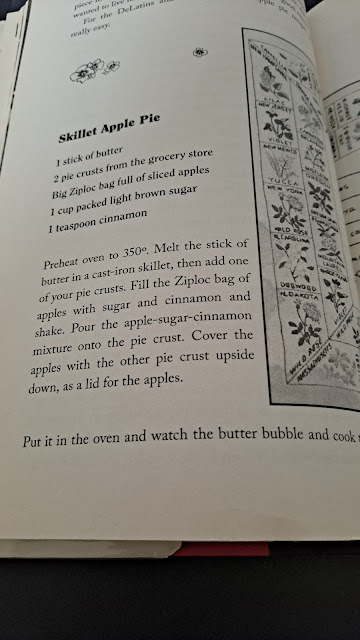
The book is useful for the recipes that Posey includes. Here, I will include the very rare photographic supplement to a review, for two simple recipes and one hard one:
"...the edge of the pie. I think this takes about 45 minutes. May God bless America." is the missing end to the sentence.
And this one is easy, too:
And this last one sounds tedious and expensive, but also amazing:
I am not including the recipe for Cheese Crisps by Lynda Posey, but the anecdote is quite amusing.
***
Posey does not trash anyone in this memoir. It was published in 2018, and so the #metoo movement must have had an impact on its writing. Posey details no meeting with Harvey Weinstein, and while it does not seem he had any impact on her career (in the Paltrow sense), he may have indirectly supported it by Making Independent Films Big, and I would imagine they had to have met, at some point.
If you don't have something nice to say, don't say anything at all, and in Hollywood, when you do, you don't use their names. She does this at a few points in the memoir, and one could probably do a little research and figure out who she meant, but again, such anecdotes would be difficult to locate.
The chapter "Louie" is a turning point for the book, and it comes fairly early on (around page 100). Posey knows that people want to know what the real Louis C.K. is like, and this chapter should give a fair impression, though there is only a line or two that suggest any latent understandings. Ditto for the chapter "Master of Storms" on her experience working with Woody Allen on Irrational Man. It seems clear, she has serious respect for Allen (refers to him as the greatest living film director) and would not disown her work on his films.
She also talks a bit (yes, it should be "writes a bit," but the book is written as a long monologue on an airplane to a seatmate, though the device is not followed religiously) about her dog Gracie and how she got him when she was with her boyfriend Ryan, whose last name is later divulged as Adams. This may have been at the height of his career, or right when it was "taking off," and there are a couple light jabs, but nothing incendiary.
Basically, for the time this book is published--a book about being a Hollywood actress since the 90's--there is little, if any, reference to #metoo. It was published July 24, 2018, and #metoo became a thing in October 2017. Perhaps nothing bad happened to her, and she felt she couldn't write responsibly on the topic, but I can hardly believe this was the case. We should not expect memoirists to explore all of their deepest, darkest and most painful experiences--and this is certainly not that type of book--and perhaps she felt it was unnecessary and distracting. Whatever the case, it is pointless to conjecture as to her motives or the realities of writing and publishing; just know that when she dishes, it is usually more innocuous than damning. She is not out to get anyone canceled. And perhaps, in a way, because of this, the book does not come off as phony. Some might consider it somewhat superficial (a great deal of space is dedicated to a wrist injury and the perils of home renovation), but there is nothing phony about it. These elements do, unfortunately, make it feel somewhat like a tease, but if a reader is hoping for "dirt," that may say more about them than the author that chooses to make their memoir un-sensational.
***
I had mixed feelings as I waded through the text, but I never felt Posey to be anything less than charming, perhaps most so when she knew she was being annoying by writing an entire chapter about the mechanics of pottery-making. Upon completion, my feelings are more positive than not. The ending, while somewhat appropriate, is a totally random place to finish, and it's clear Posey was trying to do something different with this book. She is not a comedian, but clearly her father's love for comedy was passed down, and it reads more like a comedian's memoir than an actor's memoir. Her writing is effortless, and several rules are broken, but people say you need to learn all of the rules in order to break them, and this book probably would not exist if Posey had focused her efforts on writing rather than acting. It could have used better editing, but I also understand the choice was made to keep it weird. I appreciate that, and this book made me appreciate Parker Posey more than I already did, deepened the pseudo-crush I always had on her, and made me hope that perhaps one day our lives will also intersect. Arguably, they already did when she lived in Janeane Garafalo's building, and I lived across the street at 5th and 10th in 2001 (a dorm--former abode to Mark Twain and apparently Edith Wharton, which I didn't know until reading this); but no "on point" anecdote exists that merits mention, not yet.
Full disclosure: I have known Gordon White for about 18 years. We met in our dorm and shared many friends and acquaintances. Towards the end of our time, I heard he was pretty serious about his writing, but I had no occasion to peruse his work. Then, about six years ago, I think, he invited me to be part of his friend's writing workshop, which was conducted online via Google Hangouts. I wrote a long 2-part story about my experiences in city government that I will probably never unearth again. I was trying to find old edits from that workshop on files saved from old computers, but I cannot at the moment. However, I am relatively sure that I saw early versions of two, or maybe three stories in this volume. Those are: the story that opens the collection, "Hair Shirt Drag;" the title story; and "Birds of Passage." (Note that I am only positive on the middle one.)
A note on genre: if anything, this review should be an exploration of the divide between so-called "speculative fiction" and so-called "literary fiction." Because I almost never read "speculative fiction." When I entered the writing workshop, I thought I might try my hand at one story in that genre, but I couldn't. Certainly, there are many inexplicable things that happen in the world that inspire awe and possibility; however, as I've gotten older and more cynical, I am less apt to believe in things such as aliens, to say nothing of witches, vampires and ghosts*. There are no aliens here; this is not science fiction. These are horror stories, but some of them are not supposed to be scary at all, but rather, wide-eyed at the mysteries of the unseen world.
This is put to greatest effect in the story that closes the collection, which I have to believe most people think is the best, "Birds of Passage." The story is a memory of an overnight camping trip a 10-year-old boy takes with his father, canoeing through a stream of shifting features, ending up in a sort of otherworldly place that is completely silent and subsumed totally by nature, without a shred of humanity in view. Something happens over the course of the night that changes the way both feel about the world (though it seems as though the father is not very surprised, and has experienced something similar in his past, camping in the same spot with an old friend). The story is written as a remembrance, after the father has recently passed away, and it is hard to see this as anything but an elegy. It's extremely powerful. The problem I have with "speculative fiction" is the unbelievability factor, but this piece has to be autobiographical, to one degree or another. It's written with such a convincing sense of reality, portraying the way strange alien things can only be glimpsed for a moment, obscured by a veiling effect to dissemble the truth that there is more to the world than it seems. It is also a heartwarming story of bonding with one's father. I believe it won an award or two, and it is, if anything, the real beginning of his career as a serious writer of fiction.
Or a serious writer of speculative fiction? There is a great deal of snobbery around genre fiction, and I am well aware because I am one of those snobs. Romance novels? Please. Science-fiction? I've enjoyed it in the past, it's probably my favorite "genre," but I don't ever reach for new ones (certainly I loved H.G. Wells and Kurt Vonnegut when I was younger; but never really read Isaac Asimov or Douglas Adams, or Octavia Butler, for that matter). Mystery novels, whodunits or true crime? Just this, from another friend. Horror? Maybe when I was younger. My mom used to say that the book of The Exorcist was quite good, and that the scariest book she ever read was Ghost Story by Peter Straub. Yes, I read a fair amount of Stephen King growing up, too. But also, Scary Stories to Tell in the Dark, which probably had the biggest effect on me, and which feels closer to some of the stories in this collection (albeit less "adult," though these stories are not especially lurid or exploitative, despite often gruesome subject matter).
A few of the other stories worked for me. After "Birds of Passage," "The Buchanan Boys Ride Again" is probably my favorite, because it feels like a true "blockbuster" that could easily be made into a movie, or at the very least a short film in some one-off Black Mirror-like anthology series. It concerns a son and a father fighting off monsters coming out of plumbing fixtures in an old, cheap motel. It sounds ridiculous, but the pacing and descriptive language of the action made it both very frightening and compelling.
***
Two of the stories feel more ambitious: "Mise en Abyme" and "Eight Affirmations for the Revolting Body Confiscated from the Prisoners of Bunk 17." The former is more interesting than the latter. The latter reminded me of The Power, except the sequel to it where the woman-ruled world is invaded and overtaken by aliens that seemingly resemble humans and have a taste for flesh. "Mise en Abyme" is a deeper sketch of a dystopian society wherein several citizens are executed live on television each night, and the editor assigned the task of "censoring" the videos, which involves putting a black box over their eyes, deals with a rogue agent that is broadcasting the videos uncensored. She is also involved with (married to?) the Overseer, who seems to be the dictator of the society.
Ultimately, she is summoned into a world of infinite reflection, with a small dot of light at the very far end; she has some kind of special purpose, and I will not spoil the plot, but I did not really understand it, either.
There is also a smattering of flash fiction here, with several stories weighing in at 2-3 pages. I have zero issues with flash fiction except that it more closely approximates poetry than fiction. One of those very short stories ("The Hollow," which opens up with a lawyer being summoned for testamentary purposes by two sisters who may be drug addicts and/or close to dying and have to do something with the family home, I think) shows a lot of promise, before quickly devolving into the grotesque. These sorts of things tend to happen frequently in this collection, there is some form of terrible transformation.
"Open Fight Night at the Dirtbag Casino" is the last story to highlight, because it also seems to be set up as part of a longer piece. This is a type of "Groundhog Day" story, except it's not the same day, just the same place and the same opponent in a fight to the death, with the main character fighting as different bodies they have overtaken each night. It's a satisfying story on its own, but I think it encapsulates the way I feel about most of the others: these characters are blank slates. They seem to represent "everymen" or "everywomen" and do not seem to have idiosyncratic personal backgrounds/experiences--the lived-in feel, that is present in the best of them. I skimmed around some of the stories when I felt I sensed the general vibe of what was happening, or perhaps because I wasn't being grabbed by the neck.
It is a lot to ask of an author for their first publication to be a masterpiece, particularly when working in this genre, without major funding from an institutional patron. This is a passion project, and for the most part, it is a successful one. There is great promise in it, and talents such as Gordon's (and his "fraternal writing twin" Rebecca Allred, who was also part of that online workshop) seemed destined to blossom into genius, particularly when they are capable of beautiful passages such as this:
"'I feel it,' I said, although the description of it wouldn't come to me for years. But the way I said it, my dad knew. He nodded.
'I don't know what you'd call it,' he finally said. With a slender stick, he prodded the embers on our low fire and sent the shadows skipping like water bugs. 'Maybe the bigness of nature, or a great spirituality. Something, though, you don't feel at home.'
He looked out for a moment at the darkness, at the stars above. 'Sometimes,' he said, 'I think about all the possible worlds we could have lived in, but that we're in the one that makes you my son and me your father and brings us here. It sounds stupid'--he paused--'but sometimes I look at you and I think, 'Are you real?'
'Yeah,' I said. He laughed and I smiled, even though I don't know if he saw me do it, there in the shadow just beyond the fire's light. For a while, we just sat and listened to the world.
'Do you feel it everywhere?' I eventually asked, meaning the thing he had talked about and meaning everywhere outdoors; but even though I didn't clarify, my father knew. He and I shared a wavelength like that.
'Maybe if you try real hard, but I've never felt it quite like I feel it here.' He leaned back, caught between the orange light below and the silver light above. 'Just think,' he went on, 'that outside of our fire light, it's miles to the nearest town. Straight up and out above us, for millions of miles, is nothing but empty space. Beneath our skin, hidden deeper from sight, run rivers of blood and cells and atoms and, deeper still, the empty spaces between them. You and I and everything else are just thin layers between space and distances, just skins between mysteries we could never know.'
He stopped, probably wondering if he'd gone too far or said too much. Then he looked at me and asked, 'Are you scared?'
'No,' I said, 'but it is a little scary.'
'Yeah,' he nodded as he spoke, 'but it's also kind of awesome.'" (160-161)
This is also sort of the way I feel about this collection: a little scary, and kind of awesome. At the very least, it is a portent of greater things to come. And I do believe Gordon has just published his second book, which I hope to check out soon.
*It is possible that aliens exist, and sometimes I think I might believe in ghosts, but I find it hard to believe that witches or vampires are real--though obviously witches could be.
Oeuvre rule: Joshua Ferris has a manageable bibliography. He has 5 books, and I have now read 2 of them. Whether I read the other three (two novels--To Rise Again at a Decent Hour and The Unnamed--and a short story collection--The Dinner Party) is an open question. Of course, his debut, Then We Came to End, was a borderline selection for the Best Books list here, and while it is still his most famous book, his other work has also been honored, to varying degrees.
For some reason, I didn't hear as much about those other books (maybe their plotlines or themes defied easier categorization) as I did about A Calling for Charlie Barnes, or his debut. I could point specifically to an article I read on my phone, in the lobby of a hotel in Rome, on or around August 14th, waiting for a driver to take us back to the airport, which also listed The Magician and I Wished as novels to anticipate in the Fall of 2021. I added those to my Holds list at CPL, along with this book, which I imagined was getting more publicity because it was a "comeback" of sorts for Ferris. As for a final assessment, it is not as good as either of those books (though it was brisker than The Magician, it took me almost twice as long, perhaps due to other distressing elements in my life, which made me care less about literature), nor is it better than Then We Came to the End. It is, however, a very interesting book "philosophically" that turns into a certain puzzle for the reader, and legitimately surprised me. I cannot say I loved it, but it did cause me to reflect upon the nature of art, truth, storytelling, and how we choose our subjects.
***
The first thing to mention is the opening, because it shoots out of the gates like a rocket. The first 30 pages set an impossibly high bar for comedy, and what follows is a convoluted history of a man and his various wives and the family that springs up around.
It feels telling when the book uses, as its epigraph, the acknowledgements page from The Glass Castle. Now I have not read that book, but I know it was very popular many years ago and is about a crazy family with an abusive (alcoholic?) father. Of course, the acknowledgements thank everyone in the family except the father, and so one may conclude this, too, will be a story about a bad father.
The father in question is Charlie Barnes, who is 68 years old in the Fall of 2008, where the novel begins. Once again, because a thorough examination of the book requires a discussion of spoilers, that section of the review will be denoted below. There are, in fact, 68 chapters in this book. The "turn" of the book happens around page 200, chapter 43, and the "second turn" comes at the very end, around page 329 and Chapter 67. Thus, everything after page 200 should be withheld from the reader. But the first part of the book feels less interesting to discuss.
Because this is a character study, and it seems to be about Charlie Barnes, and Charlie Barnes alone. But then we realize that his family is rather expansive and confusing, owing to the five wives, and the narrator soon becomes slightly cheeky, until we find that this is a book being written by Jake Barnes, youngest son of Charlie Barnes, and something of a foster kid, which continued to confuse me (perhaps the child of an ex-wife with a different father, that Charlie treats as his own).
Charlie believes he has cancer and is something a hypochondriac. Bear Stearns has recently declared bankruptcy, and because he worked there in the 1980s, he tries to contact an old colleague, while railing against their former boss. He tells everyone he has pancreatic cancer and that it is basically a death sentence, and excruciatingly painful, so he sets out to put his affairs in order, it seems. Charle is a very disillusioned figure who has come up with half a dozen business ideas, all of which are enormous failures, and who cannot not stick with a job for more than a few months or a year at best. His career is a mish-mash of failed dreams, and he has settled into a sort of niche as a financial advisor and fiduciary for the investments of a small number of clients, one of which has just died, whose son wants $10,000 of unpaid proceeds from the account.
He makes these phone calls, and yes, the beginning of the book is fantastic, broadly comic and charismatic. But soon Charlie learns that he does not, in fact, have cancer, and he has told his children that he does, and then has to consider telling them he was wrong, and they consider him a liar, and then he does, actually, have cancer (certainly The Royal Tenenbaums cannot be the only story to utilize this trope, but it is the first thing that comes to mind--but Charlie is no Royal).
***
Really, it is just the phone calls at the beginning that set the tone, such as when he tries to call his daughter Marcy, finds her unavailable at the office, and talks to her colleague Bethany, asking if she knew anything about pancreatic cancer:
"'I don't know anything about it,' she said.
'Well, I can tell you this: it's not good. People with pancreatic cancer go to their graves as if shot out of a cannon, okay? Hospital personnel can hardly collect a gurney quickly enough to send that particular patient off to hospice care before he keels over right there in the lobby of the hospital. You want to know what it's like?'
There was a long pause.
'I'm sorry, are you asking--'
'It's like priority mail,' he said. 'It gets you where you're going faster than the other methods, but you have to pay extra--in fear, I mean, and the surprise factor, and physical devastation. There's no time to make amends or settle your accounts. You just die.'
'I will be sure to give Marcy this message right away,' Bethany said." (19)
This is in "Farce, or 105 Rust Road," which is what we expect the novel to be--that is, this plot of "I have cancer, I don't have cancer, I have cancer,"--and is 175 pages long. From there, it goes to "While Under," which is relatively short, about 20 pages, and then there is "Fiction, or 906 Harmony Drive," which is about 125 pages, and then "The Facts," which is about 20 pages. So, there are 4 big chapters, basically, and the opening is very good, and while there is a real payoff at the ending, I cannot say it ends on a high note. The ending "redeems" the book and renders it much more meaningful, though it doesn't transform the book into a masterpiece, necessarily, just a very strong "position statement" of sorts, an unveiling of a r'aison d'etre, and I see I am becoming vague and unmoored, so we should just talk about the ending and segregate that section of the review with double asterisks, so you are doubly aware not to read below, unless that sort of thing doesn't bother you
***
***
So, there is obviously a big twist in this book that happens somewhere around the surgery scene of "While Under," and what happens in "Fiction, or 906 Harmony Drive." So right there, Ferris is basically telling the reader what he is doing, but they probably will not be aware until "The Facts." This is probably the deftest move in the book, where even a seemingly impossible turnaround is rendered totally believable. Maybe I am naive or stupid, but I believed it was real. I'm curious about other people, and I feel like I am not alone, here. Basically, the reader does not yet realize the book is something of a puzzle until the end, and that was not apparent to me (the only "puzzle" was assembling their family tree).
By the time of "The Facts," the truth is something of a letdown, but it elevates the book into the "noteworthy" category (better than merely "enjoyable," yet not a "masterpiece."). Because the issues the ending addresses are absolutely essential to the nature of literature, they are worth considering.
In short, we find that the "Fiction" chapter is, in fact, fiction. Charlie does not live long past the procedure known as the "Whipple" (an emergency last minute measure to physically remove cancer that may have already metastasized), maybe a number of hours, whereas "Fiction" shows him in a long recovery period, then finally being reinvigorated by his business idea "Chippin' In," which is a kind of Kickstarter-esque venture, while his wife Barbara the nurse starts medical school in her late 40's, jumping ahead to 2016 when Charles is in his late 70's and now rich and successful, and by this point Jake has also finished a draft of this book, and an electronic version has been leaked to members of the family who question his adherence to reality.
While this is certainly an incredible chain of events, and an odd way of invoking metafiction, I was not incredulous, I bought it. There is even a reference to 2020, with Charlie's older brother Rudy dying of Covid-19, and Charlie still alive at 81, but then all of that is decimated, and Ferris plays with his own persona:
"Then we came to the end of another dull and lurid book. Time to wrap things up, give thanks, move on. Important to move on. Fail to move on, you die. Wouldn't want that. Wouldn't want to linger or dwell. No living in the past, either. That's right, let it go. if the past is full of bitterness, the future is always bright. Right? How good does this feel? Eh? Feels pretty good, am I right?" (329)
"The Facts" serves as a true acknowledgments section as well as an author's note--but is it, in fact, true? There is probably some fact to it (on his wikipedia page, it does say that Ferris was born in Danville, IL, which is one of the major settings over the course of the book) but just as much twisting of reality.
So, we don't quite know how much stock to put into passages such as the following, which is on the second-to-last page of the book:
"I began writing this book in 2009, in the thick of grief. A year later, I'd taken the facts as far as they would go--up to the day of his surgery. For the next ten years, I banged my head bloody against a wall of truth, searching for a way out. There was none--unless I defied his request that I stick to the facts and got a little fancy, gave him the ending he deserved. If he was not the angel Barbara believed him to be, he was a better man than most people knew. Suddenly, the color came back to me, the music resumed. It was the end of grief. I could play again. He's right: it's a silly occupation for a grown man. I had bowed out of an impossible situation, but without losing my mind. Turns out, he was my calling." (341-342)
But it seems pretty clear this book is an exercise in grief. We do not know if Charlie Barnes, or Steady Boy, was really Ferris's father. Excuse me, he is the father of Jake Barnes, which is also the main character from a famous novel by Ernest Hemingway, an author with an award named for him that Ferris has received. Hemingway is invoked at one other point in the narrative, but there is nothing of his literary style here. No, but Hemingway was born in Oak Park, IL, and this novel lives in the western suburbs of Chicago. It reminded me of my father too, born not far from there and not much younger than Charlie Barnes, working in the financial industry, similarly re-inventing himself (but not with the "Doolander" or "Clown in Your Town," or four additional marriages). There is something in the character of that locale in that era that felt shared. Invoking that deeper truth about humanity--through this sort of very specific psychological profile--is one of the greatest successes an author can attain.
So yes, this book is flawed, and so is the character of Charlie Barnes. If Ferris is truly writing a tribute to his father, it is about as fine as one could expect. It's not a hagiography, and plenty of people seem only to see the flaws in Charlie, but Jake sees him as a whole person, and one that had an almost uniformly positive effect on him. Perhaps he was not the greatest husband, or the greatest father or role model, but still at the end of the day, he was a good father when it mattered. And so it is with this book, when the ending finally comes.