Showing posts with label Death in Venice. Show all posts

Sunday, January 18, 2015

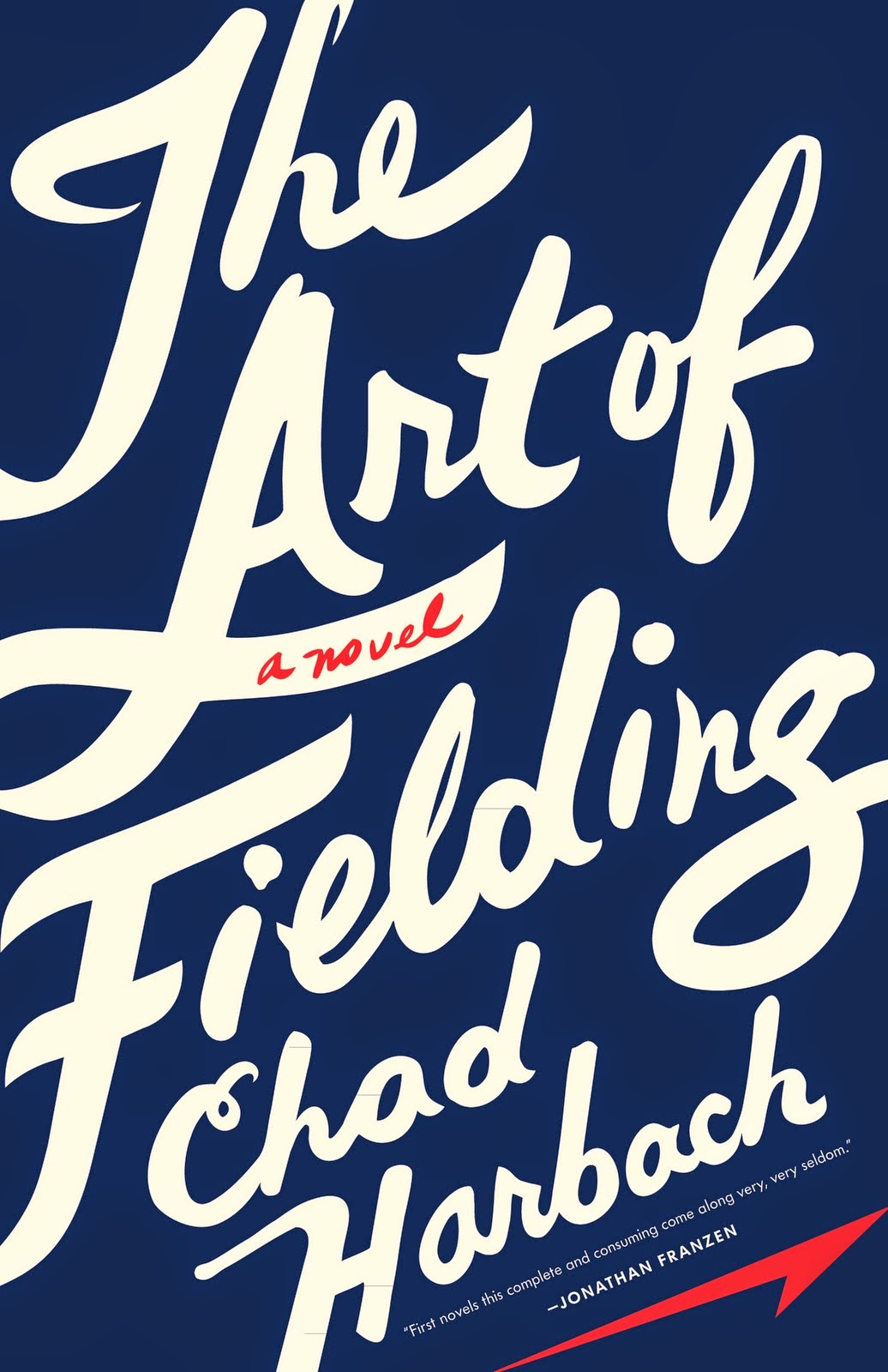
The Art of Fielding - Chad Harbach (2011)


I decided to read The Art of Fielding after it was recommended to me by the same anonymous poster that suggested The Love Affairs of Nathaniel P.  The comments are worth reading, but I will not re-post them in the body of this review.

Did I find this book truly amazing?  It may not surprise you, but, as is often the case: yes and no.  During the first 150-200 pages, I was flirting with adding it to the "best books" list (which can be found here) at the time, but then I foolishly checked what Entertainment Weekly had to say with its nifty letter grade.  They gave it a B+.  They said it was great, totally great--but the characters were a bit undeveloped.  I totally agree--but I would personally give it an A- because it is close to being a great book.

I am wary of spoiling this book by providing deeper detail to my criticisms, but I feel that I must.  Do not read below the asterisks if you don't like spoilers (I do know at least one person that actively seeks out spoilers).

This book is about a lot of things, but it's mainly about baseball.  It's the quintessential campus novel.  There are probably tons of references to Moby Dick, but I can't really be sure since I haven't read it yet.  The different themes in the novel work very well together, and nothing exactly feels out of place.  But after a couple hundred pages it's almost as if Harbach is content to finish the book on auto-pilot.  There are still wonderful, beautifully written passages, and some truly off the wall happenings, but the characters oddly seem less believable at the end than they do at the beginning.  It's almost as if their decisions are random, that Harbach outlined the plot of the novel and forced the characters to do things that feel unnatural.  Again this will be gotten into beneath the asterisks.

It's pretty easy to describe the plot.  Henry Skrimshander is an antisocial baseball nut who has obsessively read The Art of Fielding by Aparicio Rodriguez, a former shortstop for the St. Louis Cardinals who took a very philosophical approach to his profession and nearly became the President of Venezuela.  Henry is "discovered" by Mike Schwartz, who is one year older than him, and catches for the Westish Harpooners.  Mike recruits Henry for the college, and a "beautiful friendship" develops.

Westish is a small liberal arts college in Wisconsin not far off the shores of Lake Michigan.  At first I thought it was going to be a stand-in for Northwestern, but it's probably closer to Beloit College (though that is further from the lake).  The novel contains a series of unlikely events, and it starts with the school: the recruiting for the baseball team is all over the place.  They do find Henry, and a couple other players destined for big league franchises (*cough*cubsandcardinals*cough*), but then they have a bunch of random players that just seem to be on the team because they feel like it.

Obviously this is where I need to start in on Owen, who casually owns a copy of Henry's favorite niche-specific book and doesn't seem to care at all about the coincidence.

But quickly: the novel is not about Henry.  This is one of the more pleasant surprises of The Art of Fielding: it's not content to just sit with one or two characters, and sports a more classic approach to the novel.  There are five main characters, and their stories dovetail with one another up until the final scene.  They are Henry, Mike Schwartz, Owen Dunne, Guert Affenlight (the 60-year-old college president) and Pella Affenlight (his 23-year-old soon-to-be-divorced daughter).  Now I have said above that this is a great book, and that it should make the list of best books reviewed on Flying Houses, but really considering these characters I have to say that only the Affenlights are well-developed characters--and Pella should be qualified by a "barely."

Before we get to the spoilers (and my specific criticisms), I want to reiterate that I do recommend this book and cannot recall reading a better book about baseball.  It appears popular for authors to blurb that, while they don't love baseball, Harbach got them into it.  Baseball is an endlessly mythological game that has unfortunately been overshadowed by flashier athletic competitions in recent years, along with frequently being derided as "boring."  Personally, I have been watching and following baseball since roughly 1991, and I love the recent history that has defined the last couple generations.  Unfortunately again, today the words "baseball" and "steroids" will almost always be found together, and some of the more outlandish accomplishments (*cough*barrybondsrogerclemens*cough*) can't be celebrated like the 1998 home run race.  This is significant for Harbach's focus.  The star player of the Harpooners is not a power hitter, but an Ozzie Smith-esque shortstop whose landmark accomplishment is consecutive error-less games.

Another thing: why isn't Aparicio Rodriguez just called Ozzie Smith instead of being some pretend amalgam of Luis Aparicio and Ozzie Smith?  I understand if Smith hasn't written a book like Aparicio's Art of Fielding, but he played shortstop for the St. Louis Cardinals for his entire career, bolstered by flawless fielding--and I even think there is a reference somewhere to Aparicio performing a full flip on the field, as Smith once famously did.  Then again, there are bigger problems with the book than this.

***

The Art of Fielding has a terrific opening, and is relatively engrossing.  However, it becomes a "novel" when Affenlight betrays his inappropriate gay crush on Owen--and this is not very deep into it, maybe fifty pages or sixty pages.  It really comes out of nowhere and catches the reader off-guard (unless they like spoilers).  And to me, a reader that has gushed about Death in Venice, the references to that work are either eerily coincidental, or intentional.  I prefer to think they are intentional, the most obvious of which is Guert Affenlight's initials mirroring those of Gustav Aschenbach, not to mention their literary pedigrees, deceased wives, and middled-ages.  Even more noteworthy is the way Harbach describes the "silent crush"--until the novel makes its first of several missteps.

I understand, okay.  Unless Affenlight and Owen become an "item," the book lacks a certain profluence.  I don't think that's a problem, though, because there are three other characters that are pushing the action forward.  And I don't think I'm wrong, either, that this relationship is the most engrossing aspect of the novel.  Anyone that wants can come pick on me and say, oh, of course you would think that, but I truly believe that is the case for everyone.  The rest of the characters are pretty ordinary, but these two characters break out of the comfort zone of collective consciousness.

So when they kissed, I was like, okay, this is one-upping Thomas Mann, but it felt like a cop-out.  I personally think this novel would have been way more interesting if no consummation had ever happened.  And if at one moment it seems as if the book will also take a Lolita-like turn, then it is all the more impressive for awakening such references.  This is of course, the scene with Genevieve, Owen's mother, who seems to be overtly flirting with Affenlight, who even suggests that Owen might get turned straight by Pella, who also joins them for an informal dinner party.  This was one of the most memorable scenes in the novel for me, and made me think this could actually make a really entertaining, humorous film, but then again maybe not.

There are nice moments though that I think would be stronger if Affenlight kept constantly trying to think of ways to get Owen's attention, which maybe might not work until page 500 rather than page 200.  I would have liked that ending better than the actual one.  Some nice details emerge before both characters know exactly what is what:

"'Oh, I'm sure you do,' Owen said coyly.  'He was much better-looking than I am  He might even have been better-looking than you.' Owen scratched his chin, his tone evaluative and probably slightly teasing.  Affenlight blanched.  If Owen though Jason was slightly better-looking than Affenlight but much better looking than Owen, then Owen thought that Affenlight was better-looking than Owen.  Which was a compliment.  But to be compared unfavorably to an ex-boyfriend: that was a slight.  But the conditional had been used: might even have been.  It was like an SAT for gay flirting.  Not that gay flirting differed from straight flirting.  But if it didn't differ, why was Affenlight so bad at it? Genevieve had returned and was perusing Affenlight's bookshelves, her back turned, sipping her wine." (185)

I'm trying to find "beautiful" passages, but I can't seem to find them from pure memory.  They're all over the place, though I seem to remember at least a couple taking place during a game.  The sports sequences are well-written, as is the entire novel.  I've already expressed my displeasure to the "consummation" of the relationship above, but it's not that bad of a miscue compared to the relationship between Pella and Mike, then between Pella and Henry.  It feels cliched that Henry would hook up with his teammate/mentor/best friend's girlfriend, as it does when there is much commotion about it in the locker room.  Given the way the novel ends, I think it's unnecessary, except to show Pella as a "nurturer," which I don't really believe anyways.

Pella was married to David who was like ten years older than her and he comes back to visit at one part of the novel that was memorable but seemed sort of anticlimactic in relation to its build-up.  I found Pella the least interesting of the characters--though probably more interesting than Mike.  Mike's story is only notable in that he only applies to six law schools and gets rejected by them all.  It arouses suspicion that he didn't apply to any more realistic options, but I think his thought process is right on the money.  It feels unintentional, but this novel also offers helpful guidance on whether to attend law school.

Eventually, Henry develops an anxiety about throwing the ball:

"'Do you know who Steve Blass is?' Sarah asked.
'Never heard of him,' Henry lied.  Steve Blass was an all-star pitcher on the Pirates in the early 70's.  In the spring of 1973 he suddenly, inexplicably, became unable to throw the ball over the plate.  He struggled for two years to regain his control and then, defeated, retired.
'What about Mackey Sasser?'
'Never heard of him.' Sasser was a catcher for the Mets who'd developed a paralyzing fear of tossing the ball back to the pitcher.  He would double-, triple-, quadruple-, quintuple-pump, unable to believe it was okay to let go.  Opposing fans would loudly, gleefully count the number of pumps.  Opposing players would run around the bases.  Total humiliation.  When it happened to Sasser, they said he had Steve Blass disease.
'Steve Sax?  Chuck Knoblauch?  Mark Wohlers?  Rick Ankiel?'
If Sarah X. Pessel hadn't been a girl, Henry might have socked her in the face.  Her middle name probably didn't even start with X; she probably just liked the way it looked in her byline.  'None of those guys were shortstops,' he said." (215)

I remember Mark Wohlers being one of the great closers of his day, one of the guys who could throw really hard, like high 90's.  Then I remember him pitching against the Cubs one day after being injured for a while and how he could not throw a strike to save his life, and everyone knew it, and the Cubs just stood in the batter's box and waited to get walked.  Two or three runs were walked in before the manager pulled him.  He retired not long after.  I didn't know about the other guys, though.

I think the amount that Henry works out is unrealistic, as is his scene of jumping into Lake Michigan.  It just seems kind of counter-productive--when you work out as hard as he does, I think you enter territory where toning it down yields the same gains.  And then there is the matter of the ending.  I think it's a pretty cliched ending, the way Henry gets to go to the game, and join the team.  The manner in which he helps the team is not cliched in itself, however, so the last scene is good.  It's everything that comes after that stinks.  I mean, part of me is angry that, when asked to interpret a poem ("The Relic") by John Donne, for a British Literature I final exam, I wrote that Donne wanted the reader to go physically dig up his grave to see if he had really been buried in the same coffin as his wife.  I received an F.  So it seems incredible that at least this famous figure might have known where I was coming from:

"'I can't believe Affenlight's your dad,' he mused.  'That guy gives a hell of a speech.'
'I know.'
'He's the reason I came to school here.  Not that I had a lot of options.  But I drove up here for prefrosh weekend, and he gave a speech I'll never forget.  About Emerson.'
Pella nodded.  She knew the Emerson riff by heart, but Mike clearly wanted to tell it, and if that would cheer him up she was willing to listen.
'His first wife died young, of tuberculosis.  Emerson was shattered.  Months later, he went to the cemetery, alone, and dug up her grave.  Opened the coffin and looked inside, at what was left of this woman he loved.  Can you imagine?  It must have been terrible.  Just a terrible thing to do.  But the thing is, Emerson had to do it.  He needed to see for himself.  To understand death.  To make death real.  Your dad said that the need to see for yourself, even  in the most difficult circumstances, was what educa--'
'Ellen was nineteen,' Pella interruped to say.  She hated the namelessness of women in stories, as if they lived and died so that men could have metaphysical insights.  'One of the cures the doctors prescribed for tuberculosis back then was 'jolting.' Which meant going for high-speed carriage rides on deeply rutted roads.  Months, weeks before she died.  Coughing up blood all the way.'" (118)

This probably isn't everything I wanted to say about this book, but I think I've written enough.  You should know by now whether you want to check it out or not.  Just don't blame me if I spoiled it for you.  I warned you!

Wednesday, September 18, 2013

The Confessions of Felix Krull, Confidence Man: The Early Years - Thomas Mann (Transl. Denver Lindley) (1954)


For the past few years I looked forward to the day when I could return to my work here and review the last novel by Thomas Mann that I was truly excited to experience.  Of course, Royal Highness, The Holy Sinner, and The Black Swan remain out there--to say nothing of Joseph and his Brothers--but I believed that The Confessions of Felix Krull was the last work I had yet to read that could stand shoulder-to-shoulder with the previous classics that had been reviewed on this blog.

Oeuvre Rule: the first-ever review on Flying Houses was Doctor Faustus; Buddenbrooks was reviewed twice (owing to a faulty internet connection and my mistaken belief that phrases from drafts would be intriguing to readers); The Magic Mountain contains no shortage of brilliance; and Death in Venice is every bit as troubling and beautiful as when it was published 101 years ago. Where then, to rank Felix Krull?


[The bottom?] (!)

Of course, Felix Krull is not a bad book.  But it is an unfinished one.  Unfortunately it suffers from the same problem as Fitzgerald's would-be late-era masterpiece The Love of the Last Tycoon--the untimely passing of its author.  Of course Mann lived a much longer life than Fitzgerald.  He died at age 80 rather than 44.  But it is a dangerous thing to begin a novel near the end of one's life when one bears the risk of disappointing the scores of readers that one has worked so hard to cultivate.  And while there are certainly flashes of genius that make the above-mentioned works such absolute pleasures, Felix Krull ultimately is not on their level.  I will submit, however, that had Mann finished this novel (if it were not only "The Early Years"), it would probably be closer to being in that exalted category of "classic."  As such we must mourn for what could have been--like Fitzgerald but in a different guise--and wonder whether some younger writer may "take up" Felix's story and attempt to finish it in a way that Mann would have found pleasing.  That would be no easy task.

Perhaps it is best to read Felix Krull after reading "Felix Krull," the short story from which it was derived.  I have not done that, however, and I can only say that if you happen upon a collection of Mann's stories that you check this one out before moving onto the book.  The book is 375 pages long.  It would probably be about 800 pages long in its proper finished form.

It opens up, as it must in a first-person narrative bearing such a title, with Felix's early childhood.  He grows up in an unnamed town along the Rhine Valley, near Mainz.  His father is a purveyor of champagne.  He has one sister (Olympia) and a godfather (Schimmelpreester) that opens up certain doors for him.  His parents like to have parties.  They often have people over, and apparently for this reason his family is held in low repute in their town.  Or not quite:

"It was mostly these social affairs that provoked the town gossip that called our household disreputable, but I learned early that it was the economic aspect of the situation that was principally in question.  For it was rumoured (and with only too much justification) that my poor father's business was in desperate straits, and that the expensive fireworks and dinners would inevitably furnish the coup de grâce." (15)

There are several fantastic scenes early on in this book that made me feel it was on its way to
greatness.  And truly, the first "book" in it (there are three: Book I is about 50 pages, Book II is about 130 pages, and Book III is about 200 pages) may be close to perfect.  Near the end of Book I, his father suffers an unfortunate end (and if I were Elizabeth Warren, I would include this passage in a casebook to complement a certain passage from A Man in Full):

"Our financial collapse was complete; it became clear why my poor father had put it off so long and involved himself so deeply in the toils of the usurers, for he was aware that when the crash came, it would reduce him to total beggary.  Everything went under the hammer: the warehouses (but who wanted to buy so notoriously bad a product as my father's wine?), the real estate--that is, the cellars and our villa, encumbered as they were with mortgages to two-thirds of their value, mortgages on which the interest had not been paid in years--the dwarfs, the toadstools and earthenware animals in the garden--yes, even the mirrored ball and the aeolian harp went the same sad way.  The inside of the house was stripped of every pleasant luxury: the spinning-wheel, the downy cushions, the glass boxes and smelling salts all went at public auction; not even the halberds over the windows or the portieres were spared; and if the little device over the entrance door that played the Strauss melody as the door closed still jingled unmindful of its desolation, it was only because it had not been noticed by its legal owners." (51)

Felix then moves with his mother to Frankfurt, where the charming second part of the novel takes place.  Schimmelpreester tells each member of the family what they are supposed to do, and they follow his orders.  Felix is supposed to go to Paris to meet with a hotelier, but he also must worry about his military service.  In the meantime, he enjoys his time in Frankfurt, though he is reduced to sleeping on a kitchen bench, and often tries to summon carriages for people leaving the theater, sometimes receiving a tip.

Now, Book One is very good, but it takes 80 pages to get to Chapter V of Book II, which is probably the first "great" scene in the novel: Felix's first attempt at "conning."  He hopes to avoid military service, and his manner of completing this task is unlikely.  He expresses great enthusiasm and tells all of the presiding officers that he considers himself in excellent shape for service.  They find this rather hard to believe, as he makes subtle movements that betray a weaker constitution.  They tell him that the barracks is not a health resort, and laugh at him when he asks if he could just try because he might improve.

After this, we come to Felix's encounter with a prostitute named Rozsa.  While there is a scene in Book One that briefly details an affair he carries on with a housemaid who is perhaps fifteen years older than him, the scene with Rozsa is more remarkable because she seems to love him regardless of the fact that he has no money.  At this point it may be prudent to mention a criticism that I have read of this book: the main character is unsympathetic.  He is extremely good looking and he charms everyone he meets within a few minutes and everything comes much too easy for him.  Well, I hope my review indicates otherwise.  I do not share this criticism with others.  I think there are plenty of signs that most of the other characters find Felix annoying, and it is only through these "love scenes" that certain readers may scoff in disbelief.  However, the scene with Rozsa is practically rated PG compared to what comes later.  Felix also gives a nice defense of his relationship with her, and why he should not be considered a pimp despite the fact that sometimes he shares in what she gets from her customers:

"For my own part I am in agreement with folk wisdom which holds that when two persons do the same thing it is no longer the same; yes, I go further and maintain that labels such as 'drunkard,' gambler,' or even 'wastrel' not only do not embrace and define the actual living case, but in some instances do not even touch it.  This is my point of view; others may judge differently about this confidence--in respect to which it should be remembered that I am making it of my own free will and could quite easily have passed over it in silence." (112)

Finally, then, in Chapter VII of Book II, about 115 pages in, the "action" of the novel seems to pick up, for Felix is taken out of his home element and put on a train destined for Paris.  He has a number of adventures on the train, but he is primarily entertained by acting extremely politely with the commissaire, even going so far as to wish his wife and children well after he takes his ticket.  The language of the book switches, in stretches that are nearly too long to subsist in untranslated form, to French.  I would not be surprised if newer editions of the book translated the French into English, or at least provided footnotes  I could understand most of what was being said, but I think I have a decent "foundation" in French.  Regardless, even if you do not know French, I do not think you will miss all that much if your edition does not translate it.  Also of note during this section is an unlikely event: a woman "dropping" certain valuable jewelry into Felix's bag during a customs check--his second act of "conning."

Felix finds his way to the hotel where he is supposed to work, and to the dormitory where he is to sleep, along with his bunkmate, Stanko.  Stanko finds the jewelry and tells him to go to a certain shopkeeper to trade it in for cash.  Felix does so the next day after speaking to Stürzli, the general director of the Hotel Saint James and Albany, after being told that he will take over for Armand, the elevator operator who is quitting that day.  The scene with the shopkeeper Pierre Jean-Pierre is as memorable as the military service coup, particularly in the way the negotiations are carried on rather disagreeably until the deal is struck, at which point Jean-Pierre turns into a much nicer person.

The last scene worth noting in Book Two is the experience Felix (now Armand--and it is strange the way everyone calls him Armand, not even thinking he has a different name) has with a certain middle-aged woman--the same one that dropped her jewelry into his bag on the train.  She is a novelist who is staying in the hotel, and she takes Felix into her room where she asks him to defile her.  Now this may very well be the most unrealistic scene in the book.  Perhaps it is pure fantasy, or perhaps it is Mann trying to write a "modern 1954 novel" complete with blunt intimations:

"'Perversion!  Love is perversion through and through, it can't be anything else.  Probe it where you will, you will find perversion...But it's admittedly sad and painful for a woman to be able to love a man only when he is quite, quite young, when he is a boy.  C'est un amour tragique, inadmissible, not practical, not for life, not for marriage.  I, I married Houpflé, a rich businessman, so that in the shelter of his riches I could write my books, qui sont énormément intelligents.  My husband can do nothing, as I told you, at least with me.  Il me trompe, as they say, with a theatrical demoiselle.  Perhaps he is some good with her--I should rather doubt it.  It's a matter of indifference to me--this whole world of men and women and marriage and betrayal is a matter of indifference.  I live in my so-called perversion, in the love of my life that lies at the bottom of everything I am, in the happiness and misery of this enthusiasm with its heavy curse that nothing, nothing in the whole visible world equals the enchantment of the youthful male.  I live in my love for all of you, you, you the image of desire, whose beauty I kiss in complete abnegation of spirit.  I kiss your presumptuous lips over the white teeth you show when you smile.  I kiss the tender stars of your breast, the little golden hairs on the dark skin of your armpits.  And how does that happen?  With your blue eyes and blond hair, where do you get this coloring, this tint of light bronze?'"  (172-173)

That final question is a reference to Felix's physical appearance--at once both "light" and "dark."  This scene with Madame Houpflé is somewhat difficult to square with the rest of the novel.  It is certainly unrealistic, but perhaps not so much given that Felix is extremely good-looking (one may wonder about what unlikely events befall those blessed with such looks).  At least it is entertaining and humorous when she asks Felix to beat her and when he confesses that he took her jewelry and that she finds it charming and asks him to steal more from her while she pretends she is asleep.  But there is also question mark #1 that I have about this book:


"She came.  We came.  I had given my best, had in my enjoyment made proper recompense.  But how could I fail to be annoyed that at the very climax she had been stammering about degradation and had called me a stupid little slave?" (170)


Does he mean what I think he means?  It is impossible to think otherwise.  Perhaps question mark #1 is not such a puzzle, but question mark #2, I must admit, is a doozy....


But before we get there there is almost 200 pages of action.  I will cover it shortly.  "Armand" is serviceable as a "lift-man" but soon he moves on to work as a waiter in the hotel.  In the meantime he sells more of the jewelry that he "stole" from his ladyfriend, and he and his colleague Stanko enjoy an evening at the circus.  As a waiter he meets a fair number of interesting characters, but three in particular: Eleanor Twentyman, Lord Strathbogie and the Marquis de Venosta.  

In keeping with a theme of the novel, Twentyman and Strathbogie become entranced by "Armand."  This happens at the same time, roughly.  I would go so far as to say that this little section, from pages 200-217, is the single best part of the entire book.  It is contained like a perfect short story.  Felix needs to tell both that, charmed as he is by their infatuation with him, he cannot do what is asked of him.


Eleanor is 17 or 18, staying at the hotel with her parents. It is humorous to see her fall in love with a waiter, who must be kind and gracious all the while.  She comes down to breakfast by herself when her parents are still asleep and tries to "woo" "Armand" until he is eventually made to deflate her advances:


"'It's abnormal, too, for you not to ignore me, as would be natural and as your Mummy quite properly demands, but instead to come down secretly to breakfast and talk to me about "love" while your parents are prevented by their peaceful slumbers from coming to the defence of the social order.  This "love" of yours is a forbidden love which I cannot approve, and I am forced to reject any pleasure of my own in the fact that you like to see me.  It's all right for me to like to see you, if I keep it to myself, that's quite true.  But for you, Mr. and Mrs. Twentyman's daughter, to like to see me, that's impossible, that's contrary to nature...What you call "love" is something that happens to people on trips and at the sight of tail-coats like mine.  When you have left, as you will very soon, you'll forget it before you get to the next station.'" (205)


This mention of love being something that happens to people on trips may perhaps remind the reader of Death in Venice, and I can only say that the description of what happens with Lord Strathbogie is the ultimate "reverse Death in Venice" and that Mann must have intended it as such.  "Armand's" conversations with the Lord seem to have greater weight, as the man, who is about 50, desires to take him away and make him his personal valet, and maybe even adopt him and make him his heir.  Felix, as a person who is destined to wear many masks throughout life, finds this idea somewhat appealing, but ultimately cannot accept:


"'Please--I don't want to wound you or minimize the honour you have paid me, but if someone precisely like me occurs only once--each of us, of course, occurs only once--there are nevertheless millions of young men of my age and general physique, and except for the tiny bit of uniqueness, one is made very much like the other.  I knew a woman who declared that she was interested in the whole genre without exception--it must be essentially that way with you, too.  The genre is present always and everywhere.'" (216) 


Finally, after the novel reaches its high point (in my opinion), Felix meets the Marquis de Venosta, who is about his age, and whom he finds to be a pleasant person to serve.  The Marquis is from Luxembourg, and he has been staying in Paris and seeing a woman named Zaza.  His parents do not approve of this relationship and they believe that a world tour will do him some good and take his mind off of Zaza.  


On his nights off from the hotel, "Armand" sometimes goes to the theater or has dinner at nice restaurants, and on one of these evenings he runs into the Marquis, who is very garrulous and drinks very much wine and causes "Armand" to miss the theatrical performance that night.  During this dinner scene, it begins to become obvious why the Marquis has become such a major character.  Of course, Felix is plotting his next "con," which will be impersonating the Marquis on this world tour while the real Marquis stays behind in Paris and rents out an apartment with Zaza.  His first stop will be in Lisbon, Portugal.  

And it is here that the novel ends.  This is the longest single portion of the book, and perhaps a bit tiresome.  However, on the train ride to Lisbon, Felix (now "Louis" or "Loulou") meets one Professor Kuckuck, a man with "starry eyes."  The Professor speaks of celestial subject matter and this proves enchanting for "Loulou":

"There was no question, he said, that life on earth was not only an ephemeral episode, but Being itself was also--an interlude between Nothingness and Nothingness.  Being had not always existed and would not always exist.  It had had a beginning and would have an end, and with it space and time; for they existed only through Being and through it were bound to each other.  Space, he said, was nothing but the order of material things and their relationship to one another.  Without things to occupy it, there would be no space and no time either, for time was only the ordering of events made possible by the presence of objects; it was the product of motion, of cause and effect, whose sequence gave time its direction and without which there would be no time.  Absence of time and space, however, was the definition of Nothingness.  This was extensionless in every sense, a changeless eternity, which had only been temporarily interrupted by spatio-temporal Being.  A greater duration, by aeons, had been vouchsafed to Being than to Life; but some time of a certainty it would end, and with equal certainty the end implied a beginning..." (266)

This conversation goes on for about ten pages and is probably the highlight of the "Lisbon" section of the novel.  This is a strange moment in the novel and I can only conjecture that Mann wrote this knowing that he would not complete the rest of the novel, and that he was not very far from meeting Being and Nothingness himself.  As such it is a powerful moment, and probably the most profound single piece of the novel.  

Once "Loulou" settles in town, he goes the Museum of Natural History, where Professor Kuckuck is a director.  Then he meets the Professor's family, which includes a wife and a daughter.  The daughter is named Zouzou, and the irony of "Loulou" meeting his very own Zaza is not lost on the character.  There is also a strange section where "Loulou" meets the King of Portugal and tells raucous stories about his parents' two dogs, and this is all conveyed in a long letter "Loulou" writes to the Marquis de Venosta's actual parents.  

His stay in Portugal is longer than intended by a month, and perhaps predictably, he falls in love with Zouzou, while playing tennis with her often.  Zouzou is a fairly interesting character--she is very "forthright" and believes that "silence is unhealthy" and that "things must be called by their real names."  She is very cynical, in a word, and she does not believe in "love"--she believes that love (in keeping with another theme of the novel) is but a pretext for sexual longing, and this makes it a perversion in a certain sense.  "Loulou" tries very hard to persuade her otherwise in a long speech near the very end.

However, before we get to question mark #2, I must add finally that at a certain point, I became upset that this novel was not going to provide closure.  I was distracted from this final set of events, and did not really care how things turned out.  In fact, if it has not been made clear above, I consider this the weakest section of the novel.  The "Paris" section is certainly the strongest, and this part might only have been better if we saw what became of "Loulou" in Argentina, or the United States--other stops that he was to make on his world tour.  Also we never see Felix go to jail, as he mentions in passing at earlier points in the novel. 

Nor do we find out how the matador that he sees during a bullfight in the penultimate scene of the novel comes back into the story.  All we see is that he gives Zouzou a stack of pictures that he had made--nude sketches of Zaza with Zouzou's curls--and how she is disgusted by them, but how she then kisses him passionately--and then we finally get to question mark #2.

Zouzou's mother sees what happens, and she reproaches "Loulou":

"'You can thus realize what stupidity you were guilty of when, in your need for love, you followed a childish course and formed the capricious notion of turning a child's head.  That was not choosing or acting like a man, but like an infant.  Mature reason had to intervene before it was too late.'" (377)

But then, finally, question mark #2--does she fall under his spell, too?

"'Once when we were conversing you spoke to me about the graciousness of maturity and the graciousness with which it speaks of youth.  To encounter it successfully requires, of course, a man's courage.  If an agreeable youth only showed a man's courage instead of seeking satisfaction in childishness, he would not have to run off like a drenched poodle, uncomforted, into the wide world....'
'Maria!' I cried.

And: Holé! Heho! Ahé' she exclaimed in majestic jubilation.  A whirlwind of primordial forces seized and bore me into the realm of ecstasy.  And high and stormy, under my ardent caresses, stormier than at the Iberian game of blood, I saw the surging of that queenly bosom." (377-378)

Perhaps that is not quite a puzzle either, but it is a very strange way to end this novel.  I have said all I can about The Confessions of Felix Krull.  I recommend it for Mann-obsessives, but there are finer "closure-producing" compositions in his oeuvre if one has not exhausted it.  


Monday, April 12, 2010

Ada, or Ardor: A Family Chronicle - Vladimir Nabokov

An excerpt from The Paris Review interview with Vladimir in 1967 (two years before the publication of Ada):

Interviewer: If you had the choice of one and only one book by which you would be remembered, which one would it be?

Nabokov: The one I am writing or rather dreaming of writing. Actually, I shall be remembered by Lolita and my work on Eugene Onegin.

And yes, in an ideal world, every class in American literature post-World War II or "postmodern" literature would feature Ada and not Lolita. But Ada is 625 pages long--a bit heavy for an undergraduate assignment. Let us hope that grad students at least will study this work for years to come, as it surely makes a larger "statement" than Lolita, or any other book by Nabokov for that matter. You'd have to hold a gun to my head to ask which novel is the best, but the simple answer is time. If you have the time, Ada is the best. If you don't have as much time, Lolita is best. If you have even less time, Pale Fire is best. And if you have even less time than that, Pnin may be your best option. However, Pnin is the only one of those four that may disappoint a reader because it does not reach the heights of the other three. All three are masterpieces, and Ada is the most redoubtable and grandiose of all.

So now--the difficult and fun question--what is Ada about? When I brought it with me into my restaurant of work all of my co-workers expressed intrigue as to the nature of the story of such a big book. If I only had a short time to describe it, I would say, "It's about incest." And if I had a long time, I would say, "It is a one hundred year love story and if you thought Lolita was risque, well, Ada is way worse."

And it's true--Ada does not quite portray illegal sexual abuse as in Lolita--but its descriptions of sex are far more graphic, about twice as crudely clever, and arguably more offensive. Now, why more offensive?

The main character is Van Veen, born in 1870, firmly implanted in my mind after spending three months in his company. Van has a cousin, Ada, whom he meets in 1884. She is two years younger than him. Actually they might be more than cousins. To what degree they are related I will not explain--but let me just admit that it was one of the many points that I was unclear on after finishing the book, and so I had to re-read the first 20 pages, where I did find my answer.

And this is another important point to mention: Ada is probably the most difficult Nabokov book to read. Apart from its intimidating length, the first 50 pages in particular pose a great challenge to the reader. Think 100 Years of Solitude but without the weird magical realism--and keep in mind that though the first 50 pages go as far back as great-great grandparents, of special importance is the description of Van's and Ada's parents--Demon and Aqua, and Daniel and Marina--who it seems incredibly, are 2 twins married to 2 twins, further complicating the family tree.

But who is Van? Van comes from an affluent family. He walks on his hands when he is fourteen. He is an acrobat. He visits his cousins for a summer at Ardis, their estate in the northeast...in Maine, is it, spelled Mayne?

Van lives on Antiterra (or what we might call "Earth"), in Estotia, which is the U.S. and Russia combined. Much of the time he lives in Manhattan. It's necessary to mention that Ada occurs in a parallel universe, or utopia, and this is hinted at in the very first line of the book, which is a reversal of the extremely famous first sentence of Anna Karenina. Happy families are not all alike--they are actually "more or less dissimilar" (3)--and unhappy families "are more or less alike"(3)--not unhappy in their own way. Ada is not science-fiction though--a reader will primarily notice that something is vaguely askew, and their investigation into the element that alters from "reality" as we know it will often yield epiphanies or profund ruminations on the nature of existence. This topic will be revisited later in the review.

Van goes to visit Ada for the first time in 1884, and lo and behold, they fall in love. This is really the moment at which Ada becomes easier to read. Because up until this point, I had no clue what direction this novel was going to take. The long sequence in Ardis is perhaps the major part of the novel itself, also the most risque part.

Why offensive? Because Van and Ada "discover" each other at an age that most today would deem premature--12 and 14--and the descriptions of their "embraces" hold very little back--in fact, they are probably more explicit than any of the later scenes involving prostitution, which is legalized. There is also the "taboo" nature of their relationship, obviously, but for a clear example, witness the "barn burning" scene (not a reference to Faulkner, I imagine), referenced perhaps a dozen times in the course of the book, with its first display in this nearly unthinkable moment:

"'Van, poor Van,' she went on in the narrow voice the sweet girl used when speaking to cats, caterpillars, pupating puppies, 'yes, I'm sure, it smarts, would it help if I'd touch, are you sure?'
'You bet,' said Van, 'on n'est pas bete a ce point' ('there are limits to stupidity,' colloquial and rude).
'Relief map,' said the primrose prig, 'the rivers of Africa.' Her index traced the blue Nile down into its jungle and traveled up again. 'Now what's this? The cap of the Red Bolete is not half as plushy. In fact' (positively chattering), 'I'm reminded of geranium or rather pelargonium bloom.'
'God, we all are,' said Van.
'Oh, I like this texture, Van, I like it! Really I do!'
'Squeeze, you goose, can't you see I'm dying.'
But our young botanist had not the faintest idea how to handle the thing properly--and Van, now in extremis, driving it roughly against the hem of her nightdress, could not help groaning as he dissolved in a puddle of pleasure.
She looked down in dismay.
'Not what you think,' remarked Van calmly. 'This is not number one. Actually it's as clean as grass sap. Well, now the Nile is settled stop Stanley.'" (126-127)

The "Ardis" section of the book almost exclusively takes this tone, and perhaps this is one of my very few criticisms of the book: this section can nearly firmly be categorized as "erotica." The first two hundred pages of this book (so 1/3 of the whole) follow Van and Ada as very young teenagers trying to figure out different places in the palatial estate to experiment with each other's bodies. It is perhaps worth noting that both characters are ridiculously precocious, to the point that practically no one today would be able to match their intelligence or powers of articulation. See first review ever on Flying Houses for similar example (third paragraph of post): http://flyinghouses.blogspot.com/2008/04/doctor-faustus-thomas-mann.html

So it seems to me that during "Ardis" (or Part 1, as it were, which actually goes up to page 350) Nabokov is overly preoccupied with unsettling the reader's expectations, and the episodes become rather repetitive. There is the important introduction of the third major character, Lucette, Ada's younger sister by two years. Eventually Lucette becomes the primary voyeur of their escapades. And it is unclear to what extent she becomes involved in anything resembling or approaching a menage a trois with them, but later on, oh around page 400, she comes to visit Van about fifteen years later in Manhattan, and she reveals a secret that even Van doesn't know about, and to me this constitutes one of the most over-the-top scenes in the book.

After Part 1, the book concerns itself a bit less with sex, and a bit more with Time, the intricacies of Antiterra (and Terra, which we might call "Heaven" or "Mars" (i.e. another planet that could house a civilization)), and the manner in which Ada and Van hope to spend their adult lives. They cannot be married for various reasons they give at many different moments. Ada does marry. Van does not. Van sleeps with hundreds of women (most of them prostitutes). They write letters back and forth. They meet every fifteen or twenty years, often drastically altered by time. Van becomes closer with Lucette for the majority of the remainder of the novel.

A lot happens, but one chapter I cannot figure out (Part 2, Chapter 3) is basically a description of how prostitution came to be legalized in Estotia (or Antiterra? I'm not sure.) -- and it basically has nothing to do with the rest of the story, so I found it amazing. It is quite risque, but also hilarious, particularly the wrinkle introduced into the common paradigm of the "whorehouse":

"One clause in the Rules of the Club seemed to indicate that Eric, though frenziedly heterosexual, had enjoyed some tender ersatz fumblings with schoolmates at Note (a notorious prepatory school in that respect): at least two of the maximum number of fifty inmates in the major floramors might be pretty boys, wearing frontlets and short smocks, not older than fourteen if fair, and not more than twelve if dark. However, in order to exclude a regular flow of 'inveterate pederasts,' boy love could be dabbled in by the jaded guest only between two sequences of three girls each, all possessed in the course of the same week--a somewhat comical, but not unshrewd, stipulation." (369-370)

Also of personal interest: Van attends school at Chose, and this description of "Note" does seem to indicate that the master himself was aware of those bizarre institutions of the northeast selling elitism. Of course, they are the finest schools, and that Van attends one fits perfectly with his character--which is, a spoiled brat, who automatically starts off with more money than he would ever know what to do with. Van is not the most likable character. For one, he has a pretty sketchy major romantic relationship in his life. For two, he is an "arrogant bastard." For three, he seems to take pleasure in psychologically (and intellectually) torturing those closest to him in life. The most likable things about him are that he is an excellent tipper and that he is a scholar and thinker of the highest level.

He retires at an early age and spends the majority of the next decade working on what will become his greatest masterpiece, The Texture of Time. But I am getting ahead of myself: what does Van do? It's rather difficult to pin down, but he is a psychologist that studies bizarre disorders related to the comprehension of time and memory. Nabokov displays learning on the topic, and much derision towards Freud (Froid), which is par for the course. He becomes a doctor at Chose, and lives in Manhattan, while frequently traveling to Switzerland for various examinations, procedures, and investigations.

There is the matter of Ada's sister, and Ada's husband, and many of the other characters in the book: Cordula, Demon, Marina, and Mme. Lariviere, Ada's governess who becomes a famous author that is almost definitely a stand-in for Guy de Maupaussant. But they are incidental. There is one major suicide that takes place near the end of the book that is one of the most effective methods I have ever read of making sure that you will be dead. The scene is horrifying and one might almost call it beautiful.

And there is no shortage of beautiful writing, which is why this is Nabokov's greatest: amongst the greatest quantity in his oeuvre, some of the greatest quality is to be found. One could argue that Lolita is a more concise, consistent, high-quality read, but for its sheer ambition and leisurely methodology, Ada is that all-too-rare book that actually eclipses Lolita. If anyone was going to do it, it would be the man himself!

It is hard to find quotable passages, but there are at least two of incredible beauty. One of them comes from what is arguably the most famous chapter in the book, which is a literary experiment on the level of Joyce or Mann (who eventually we will get around to discussing again), a "chronography" for lack of a better term, highly abstract, potentially positively sleep-inducing, and replete with notions that could be discussed for hours. The other takes place at a crucial moment, whose spoiler will be avoided in the interest of an open view:

"...Hunched up in a last band of low sun, on the bench where he had recently fondled and fouled a favorite, lanky, awkward, black girl student, Van tortured himself with thoughts of insufficient filial affection--a long story of unconcern, amused scorn, physical repulsion, and habitual dismissal. He looked around, making wild amends, willing her spirit to give him an equivocal, and indeed all-deciding, sign of continued being behind the veil of time, beyond the flesh of space. But no response came, not a petal fell on his bench, not a gnat touched his hand. He wondered what really kept him alive on terrible Antiterra, with Terra a myth and all art a game, when nothing mattered any more since the day he slapped Valerio's warm bristly cheek; and whence, from what deep well of hope, did he still scoop up a shivering star, when everything had an edge of agony and despair, when another man was in every bedroom with Ada." (480-481)

The other passage I recall occurs when Van comes to as close a synthesis as his Texture of Time is bound to relate, which bears a slight resemblance to the final scene in Waking Life:

"...This act of attention is what I called last year the 'Deliberate Present' to distinguish it from the general form termed (by Clay in 1882) the 'Specious Present.' The conscious construction of one, and the familiar current of the other gives us three or four seconds of what can be felt as nowness. This nowness is the only reality we know; it follows the colored nothingness of the no-longer and precedes the absolute nothingess of the future. Thus, in a quite literal sense, we may say that conscious human life last always only one moment, for at any moment of deliberate attention to our own flow of consciousness we cannot know if that moment will be followed by another. As I shall later explain, I do not believe that 'anticipation' ('looking forward to a promotion or fearing a social blunder' as one unfortunate thinker puts it) plays any significant part in the formation of the specious present, nor do I believe that the future is transformed into a third panel of Time, even if we do anticipate something or other--a turn of the familiar road or the picturesque rise of two steep hills, one with a castle, the other with a church, for the more lucid the forevision the less prophetic it is apt to be. Had that rascal behind me decided to risk it just now he would have collided head-on with the truck that came from beyond the bend, and I and the view might have been eclipsed in the multiple smash." (585-586)

Nabokov's knowledge of quantum physics or quantum mechanics or the theory of relativity is tested, and while I am unable to ascertain its verisimilitude, it seems clear that real physicists would take issue with some of Van's pronouncements, but on a purely artistic and linguistic level, while proving quite difficult, this chapter is ultimately more essential than any other part in the work.

There is not much else about Ada that requires reportage. It is for mature audiences only, it is a very challenging read (it took me longer than any other book on Flying Houses, though there were mitigating circumstances...)--and on a purely coincidental level, during the course of my reading this novel, my life became rather strange and heartbreaking. I recommend Ada more highly than any other book on Flying Houses--but I have decided, that when I leave, in August, for Brooklyn, I will do a top 10 books on Flying Houses list. All 3 of Nabokov's masterpieces will be included. 3 by Thomas will be there too.

And so our review ends--but it is not quite over because there is this issue to resolve. I would almost do a different post for this discussion but Ada still figures in conversation. Basically I just want to quote more from The Paris Review interview. I will post a link here. http://www.theparisreview.org/media/4310_NABOKOV.pdf Read it. I am perverting all of The Great One's notions. To witness the genius contained in the responses is to regard the enchantment of a bygone era, when writers were more like gods than people.

That is not to say that I do not take issue with any of his responses, and I wish he were able to respond to my accusations/criticisms on this count, because I really would appreciate the education, which is no longer of this earth. In particular, a phrase he has created, so to speak, and that was quoted at length in his obituary in the New York Times in 1977, primarily because it contains the ultimate zinger against Thomas, which is quite rude, I think, to include in an obituary (shame on you, newspapers of the intellectual elite):

Interviewer: What is most characteristic of poshlust in contemporary writing? Are there temptations for you in the sin of poshlust? Have you ever fallen?

Nabokov: "Poshlust," or in a better transliteration poshlost, has many nuances, and evidently I have not described them clearly enough in my little book on Gogol, if you think one can ask anybody if he is tempted by poshlost. Corny trash, vulgar cliches, Philistinism in all its phases, imitations of imitations, bogus profundities, crude, moronic, and dishonest pseudo-literature--these are obvious examples. Now, if we want to pin down poshlost in contemporary writing, we must look for it in Freudian symbolism, moth-eaten mythologies, social comment, humanistic messages, political allegories, overconcern with class or race, the journalistic generalities we all know. Poshlost speaks in such concepts as "America is no better than Russia" or "We all share in Germany's guilt." The flowers of poshlost bloom in such phrases as "the moment of truth," "charisma," "existential" (used seriously), "dialogue" (as applied to political talks between nations), and "vocabulary" (as applied to a dauber). Listing in one breath Auschwitz, Hiroshima, and Vietnam is seditious poshlost. Belonging to a very select club (which sports one Jewish name--that of the treasurer) is genteel poshlost. Hack reviews are frequently poshlost, but it also lurks in certain highbrow essays. Poshlost calls Mr. Blank a great poet and Mr. Bluff a great novelist. One of poshlost's favorite breeding places has always been the Art Exhibition; there it is produced by so-called sculptors working with the tools of wreckers, building crankshaft cretins of stainless steel, Zen stereos, polystyrene stinkbirds, objects trouves in latrines, cannonballs, canned balls. There we admire the gabinetti wall patterns of so-called abstract artists, Freudian surrealism, roric smudges, and Rorschach blots--all of it as corny in its own right as the academic "September Morns" and "Florentine Flowergirls" of half a century ago. The list is long, and of course, everybody has his bete noire, his black pet, in the series. Mine is that airline ad: the snack served by an obsequious to a young couple--she eyeing ecstatically the cucumber canape, he admiring wistfully the hostess. And, of course, Death in Venice. You see the range.

It is an all too rare occasion that the words of a dead writer from more than forty years ago make me want to cry in defense of another. I cannot stand by silent any longer. I will admit this: Nabokov is probably a better writer than Mann. He has many more books to his name. Both have an equal number of masterpieces (as I have indicated earlier)--and I do have to say that Thomas is the more consistent than the two--you can pick up a Nabokov book and not be sure you're going to "get it" or not--and with Thomas, provided you stick with him the whole way, you will at least "get it." They lived to a similar age. Thomas is older by more than twenty years. They both fled to the U.S. in the wake of totalitarian regimes. They lectured at schools like Princeton and Cornell. And arguably, they wrote very similar "most famous" books about taboo desire-- and evidently, Nabokov thinks Thomas is quite a fraud. Now, I will not argue that Death in Venice is better than Lolita. That's a losing battle I am not willing to fight. But to insist that Death in Venice is "poshlost?" Coming at the end of that tirade makes the statement all the more offensive.

Perhaps Nabokov is actually stating that Death in Venice is his other "bete noire" in the series, in addition to the airline ad, but I doubt it. His contempt for Thomas knows no boundaries. His airline ad, then, is the one element in Ada that I find annoying: Van's virility, his energy, and especially his relationships with all female characters, I find quite offensive. If anybody is interested in prolonging stereotypes about men not being able to be friends with women unless they are sleeping together, or only possible en route to sleeping together, then we have a very difficult "truth" to overturn in our future. I would prefer not to be lumped in with a gender that dictates bodily pleasure accompany regular discourse if it happens to be with the opposite sex. Of course Van does love Ada and does not leer at any other women when they are together. But it's the element in Van, and often Nabokov's other characters that I wish he would not portray with no explanation.

I totally disagree with Nabokov's assertion that Death in Venice is poshlost. Its merits as a work of literature are debatable, but it is certainly not cliched (though many might consider it vulgar), some may consider it "trash" but I don't believe it is "corny," I don't see how it is an imitation of an imitation--it is extremely original and unprecedented--um, just asking, but would Lolita exist without Death in Venice?--it may be "crude" but it is not "moronic," it is the opposite of Philistinism, it may contain "bogus profundities" depending on your view, but I do not find it to be "dishonest pseudo-literature" in any sense. Sometimes I think Nabokov is more interested in piquing the reader's interest with his acid-tongue criticism than giving a more transparent view of his "rules" for "sucessful art." I am hard-pressed to think of a more idiosyncratic figure in relation to criticism of any sort.

That criticism notwithstanding, Nabokov is The Great One and I will continue to worship him as I would a god. I wish he would have a higher opinion of Thomas so that I would not feel so foolish as to canonize him as well. But they belong together, as I lump them in the final page of my second novel, as they complement one another so thoroughly: a German and a Russian, a rebel against the Nazis and a rebel against the Soviets, a Nobel Prize Winner and a notorious iconoclast, intellectual giants both (though one might disagree) and careers that I would be more than happy to experience firsthand. I would have to favor Nabokov's life over Mann's, the Nobel notwithstanding, due to its rather fabulous and incredible nature. Not that either is within my grasp--but I must say--who amongst us bloggers in 2010 America debate the superiority of Nabokov over Mann? Very few, and so I would hope, that while I am sure neither cared much for their "immortal reputation," that if they were able to review blog posts beyond the grave, they would be able to make up and be friends and realize that few others beyond their years were able to equal their heights, and that this comparison would cement their work as essential, in the 21st century.