Showing posts with label The Love Affairs of Nathaniel P.. Show all posts
Sunday, January 18, 2015
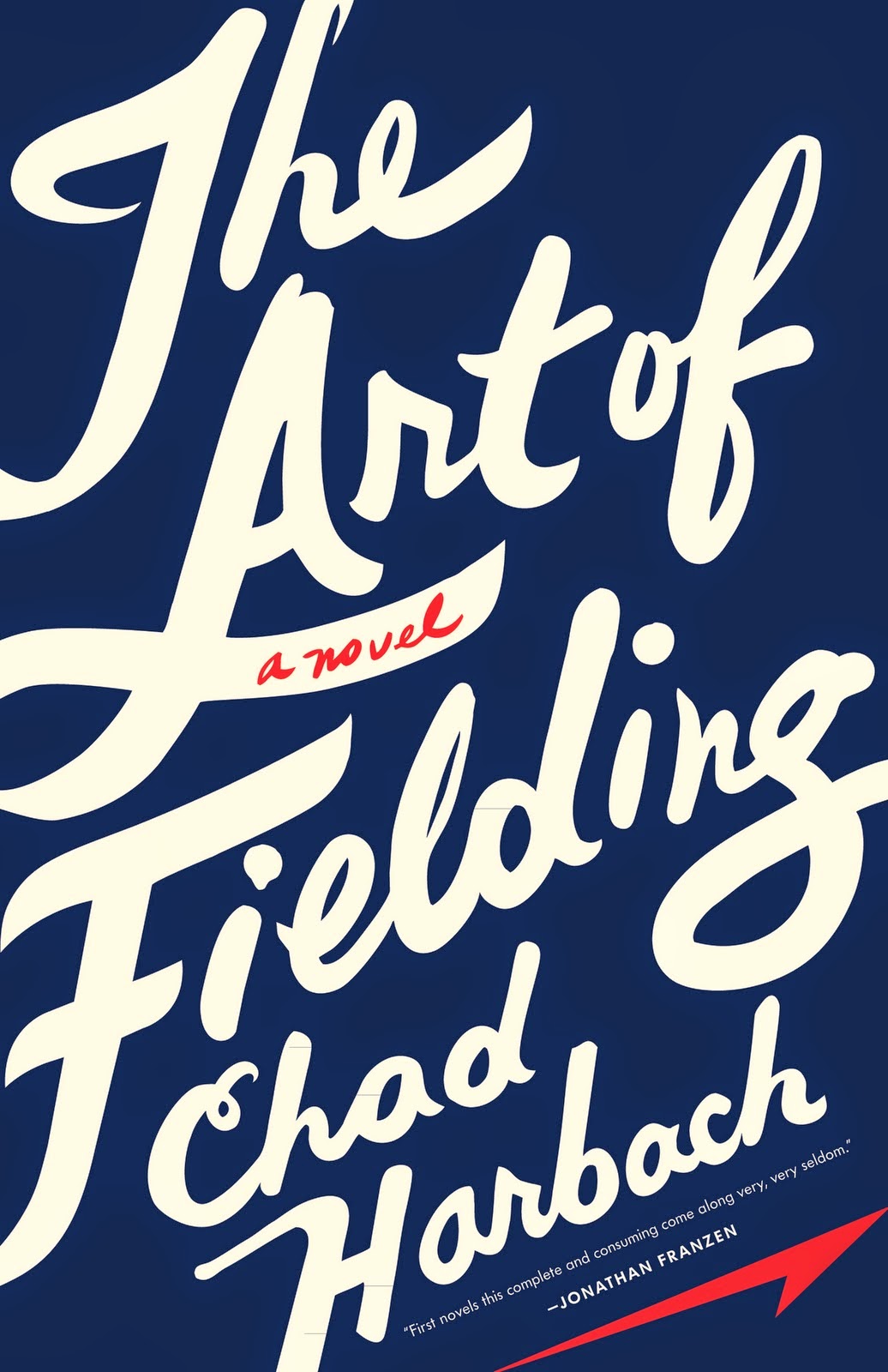
The Art of Fielding - Chad Harbach (2011)
I decided to read The Art of Fielding after it was recommended to me by the same anonymous poster that suggested The Love Affairs of Nathaniel P. The comments are worth reading, but I will not re-post them in the body of this review.
Did I find this book truly amazing? It may not surprise you, but, as is often the case: yes and no. During the first 150-200 pages, I was flirting with adding it to the "best books" list (which can be found here) at the time, but then I foolishly checked what Entertainment Weekly had to say with its nifty letter grade. They gave it a B+. They said it was great, totally great--but the characters were a bit undeveloped. I totally agree--but I would personally give it an A- because it is close to being a great book.
I am wary of spoiling this book by providing deeper detail to my criticisms, but I feel that I must. Do not read below the asterisks if you don't like spoilers (I do know at least one person that actively seeks out spoilers).
This book is about a lot of things, but it's mainly about baseball. It's the quintessential campus novel. There are probably tons of references to Moby Dick, but I can't really be sure since I haven't read it yet. The different themes in the novel work very well together, and nothing exactly feels out of place. But after a couple hundred pages it's almost as if Harbach is content to finish the book on auto-pilot. There are still wonderful, beautifully written passages, and some truly off the wall happenings, but the characters oddly seem less believable at the end than they do at the beginning. It's almost as if their decisions are random, that Harbach outlined the plot of the novel and forced the characters to do things that feel unnatural. Again this will be gotten into beneath the asterisks.
It's pretty easy to describe the plot. Henry Skrimshander is an antisocial baseball nut who has obsessively read The Art of Fielding by Aparicio Rodriguez, a former shortstop for the St. Louis Cardinals who took a very philosophical approach to his profession and nearly became the President of Venezuela. Henry is "discovered" by Mike Schwartz, who is one year older than him, and catches for the Westish Harpooners. Mike recruits Henry for the college, and a "beautiful friendship" develops.
Westish is a small liberal arts college in Wisconsin not far off the shores of Lake Michigan. At first I thought it was going to be a stand-in for Northwestern, but it's probably closer to Beloit College (though that is further from the lake). The novel contains a series of unlikely events, and it starts with the school: the recruiting for the baseball team is all over the place. They do find Henry, and a couple other players destined for big league franchises (*cough*cubsandcardinals*cough*), but then they have a bunch of random players that just seem to be on the team because they feel like it.
Obviously this is where I need to start in on Owen, who casually owns a copy of Henry's favorite niche-specific book and doesn't seem to care at all about the coincidence.
But quickly: the novel is not about Henry. This is one of the more pleasant surprises of The Art of Fielding: it's not content to just sit with one or two characters, and sports a more classic approach to the novel. There are five main characters, and their stories dovetail with one another up until the final scene. They are Henry, Mike Schwartz, Owen Dunne, Guert Affenlight (the 60-year-old college president) and Pella Affenlight (his 23-year-old soon-to-be-divorced daughter). Now I have said above that this is a great book, and that it should make the list of best books reviewed on Flying Houses, but really considering these characters I have to say that only the Affenlights are well-developed characters--and Pella should be qualified by a "barely."
Before we get to the spoilers (and my specific criticisms), I want to reiterate that I do recommend this book and cannot recall reading a better book about baseball. It appears popular for authors to blurb that, while they don't love baseball, Harbach got them into it. Baseball is an endlessly mythological game that has unfortunately been overshadowed by flashier athletic competitions in recent years, along with frequently being derided as "boring." Personally, I have been watching and following baseball since roughly 1991, and I love the recent history that has defined the last couple generations. Unfortunately again, today the words "baseball" and "steroids" will almost always be found together, and some of the more outlandish accomplishments (*cough*barrybondsrogerclemens*cough*) can't be celebrated like the 1998 home run race. This is significant for Harbach's focus. The star player of the Harpooners is not a power hitter, but an Ozzie Smith-esque shortstop whose landmark accomplishment is consecutive error-less games.
Another thing: why isn't Aparicio Rodriguez just called Ozzie Smith instead of being some pretend amalgam of Luis Aparicio and Ozzie Smith? I understand if Smith hasn't written a book like Aparicio's Art of Fielding, but he played shortstop for the St. Louis Cardinals for his entire career, bolstered by flawless fielding--and I even think there is a reference somewhere to Aparicio performing a full flip on the field, as Smith once famously did. Then again, there are bigger problems with the book than this.
***
The Art of Fielding has a terrific opening, and is relatively engrossing. However, it becomes a "novel" when Affenlight betrays his inappropriate gay crush on Owen--and this is not very deep into it, maybe fifty pages or sixty pages. It really comes out of nowhere and catches the reader off-guard (unless they like spoilers). And to me, a reader that has gushed about Death in Venice, the references to that work are either eerily coincidental, or intentional. I prefer to think they are intentional, the most obvious of which is Guert Affenlight's initials mirroring those of Gustav Aschenbach, not to mention their literary pedigrees, deceased wives, and middled-ages. Even more noteworthy is the way Harbach describes the "silent crush"--until the novel makes its first of several missteps.
I understand, okay. Unless Affenlight and Owen become an "item," the book lacks a certain profluence. I don't think that's a problem, though, because there are three other characters that are pushing the action forward. And I don't think I'm wrong, either, that this relationship is the most engrossing aspect of the novel. Anyone that wants can come pick on me and say, oh, of course you would think that, but I truly believe that is the case for everyone. The rest of the characters are pretty ordinary, but these two characters break out of the comfort zone of collective consciousness.
So when they kissed, I was like, okay, this is one-upping Thomas Mann, but it felt like a cop-out. I personally think this novel would have been way more interesting if no consummation had ever happened. And if at one moment it seems as if the book will also take a Lolita-like turn, then it is all the more impressive for awakening such references. This is of course, the scene with Genevieve, Owen's mother, who seems to be overtly flirting with Affenlight, who even suggests that Owen might get turned straight by Pella, who also joins them for an informal dinner party. This was one of the most memorable scenes in the novel for me, and made me think this could actually make a really entertaining, humorous film, but then again maybe not.
There are nice moments though that I think would be stronger if Affenlight kept constantly trying to think of ways to get Owen's attention, which maybe might not work until page 500 rather than page 200. I would have liked that ending better than the actual one. Some nice details emerge before both characters know exactly what is what:
"'Oh, I'm sure you do,' Owen said coyly. 'He was much better-looking than I am He might even have been better-looking than you.' Owen scratched his chin, his tone evaluative and probably slightly teasing. Affenlight blanched. If Owen though Jason was slightly better-looking than Affenlight but much better looking than Owen, then Owen thought that Affenlight was better-looking than Owen. Which was a compliment. But to be compared unfavorably to an ex-boyfriend: that was a slight. But the conditional had been used: might even have been. It was like an SAT for gay flirting. Not that gay flirting differed from straight flirting. But if it didn't differ, why was Affenlight so bad at it? Genevieve had returned and was perusing Affenlight's bookshelves, her back turned, sipping her wine." (185)
I'm trying to find "beautiful" passages, but I can't seem to find them from pure memory. They're all over the place, though I seem to remember at least a couple taking place during a game. The sports sequences are well-written, as is the entire novel. I've already expressed my displeasure to the "consummation" of the relationship above, but it's not that bad of a miscue compared to the relationship between Pella and Mike, then between Pella and Henry. It feels cliched that Henry would hook up with his teammate/mentor/best friend's girlfriend, as it does when there is much commotion about it in the locker room. Given the way the novel ends, I think it's unnecessary, except to show Pella as a "nurturer," which I don't really believe anyways.
Pella was married to David who was like ten years older than her and he comes back to visit at one part of the novel that was memorable but seemed sort of anticlimactic in relation to its build-up. I found Pella the least interesting of the characters--though probably more interesting than Mike. Mike's story is only notable in that he only applies to six law schools and gets rejected by them all. It arouses suspicion that he didn't apply to any more realistic options, but I think his thought process is right on the money. It feels unintentional, but this novel also offers helpful guidance on whether to attend law school.
Eventually, Henry develops an anxiety about throwing the ball:
"'Do you know who Steve Blass is?' Sarah asked.
'Never heard of him,' Henry lied. Steve Blass was an all-star pitcher on the Pirates in the early 70's. In the spring of 1973 he suddenly, inexplicably, became unable to throw the ball over the plate. He struggled for two years to regain his control and then, defeated, retired.
'What about Mackey Sasser?'
'Never heard of him.' Sasser was a catcher for the Mets who'd developed a paralyzing fear of tossing the ball back to the pitcher. He would double-, triple-, quadruple-, quintuple-pump, unable to believe it was okay to let go. Opposing fans would loudly, gleefully count the number of pumps. Opposing players would run around the bases. Total humiliation. When it happened to Sasser, they said he had Steve Blass disease.
'Steve Sax? Chuck Knoblauch? Mark Wohlers? Rick Ankiel?'
If Sarah X. Pessel hadn't been a girl, Henry might have socked her in the face. Her middle name probably didn't even start with X; she probably just liked the way it looked in her byline. 'None of those guys were shortstops,' he said." (215)
I remember Mark Wohlers being one of the great closers of his day, one of the guys who could throw really hard, like high 90's. Then I remember him pitching against the Cubs one day after being injured for a while and how he could not throw a strike to save his life, and everyone knew it, and the Cubs just stood in the batter's box and waited to get walked. Two or three runs were walked in before the manager pulled him. He retired not long after. I didn't know about the other guys, though.
I think the amount that Henry works out is unrealistic, as is his scene of jumping into Lake Michigan. It just seems kind of counter-productive--when you work out as hard as he does, I think you enter territory where toning it down yields the same gains. And then there is the matter of the ending. I think it's a pretty cliched ending, the way Henry gets to go to the game, and join the team. The manner in which he helps the team is not cliched in itself, however, so the last scene is good. It's everything that comes after that stinks. I mean, part of me is angry that, when asked to interpret a poem ("The Relic") by John Donne, for a British Literature I final exam, I wrote that Donne wanted the reader to go physically dig up his grave to see if he had really been buried in the same coffin as his wife. I received an F. So it seems incredible that at least this famous figure might have known where I was coming from:
"'I can't believe Affenlight's your dad,' he mused. 'That guy gives a hell of a speech.'
'I know.'
'He's the reason I came to school here. Not that I had a lot of options. But I drove up here for prefrosh weekend, and he gave a speech I'll never forget. About Emerson.'
Pella nodded. She knew the Emerson riff by heart, but Mike clearly wanted to tell it, and if that would cheer him up she was willing to listen.
'His first wife died young, of tuberculosis. Emerson was shattered. Months later, he went to the cemetery, alone, and dug up her grave. Opened the coffin and looked inside, at what was left of this woman he loved. Can you imagine? It must have been terrible. Just a terrible thing to do. But the thing is, Emerson had to do it. He needed to see for himself. To understand death. To make death real. Your dad said that the need to see for yourself, even in the most difficult circumstances, was what educa--'
'Ellen was nineteen,' Pella interruped to say. She hated the namelessness of women in stories, as if they lived and died so that men could have metaphysical insights. 'One of the cures the doctors prescribed for tuberculosis back then was 'jolting.' Which meant going for high-speed carriage rides on deeply rutted roads. Months, weeks before she died. Coughing up blood all the way.'" (118)
This probably isn't everything I wanted to say about this book, but I think I've written enough. You should know by now whether you want to check it out or not. Just don't blame me if I spoiled it for you. I warned you!
Monday, December 8, 2014
Gone Girl - Gillian Flynn (2012)
My roommate picked up Gone Girl at the local thrift shop for me. The night before, I had bought The Corrections from there for $3. It was a nice gesture, and I was mildly interested in reading Gone Girl before, if only because it would be educational to learn what it takes to build a blockbuster novel and film combo. Whatever Gillian Flynn did, she did it right, and she deserves her success. Because she wrote a book that wasn't aimed at children, nor a trilogy, and managed to create a nasty 1-2 punch of an enormously popular novel and a critically-acclaimed screen adaptation. (Stayed tuned for a review of the film.) I enjoyed this book very much, for the most part. Ultimately, I felt that Flynn was constrained by the confines of the plot, and while she makes a very powerful statement, eventually gets bogged down in melodrama more suited to soap operas than literary fiction. This is the problem with being a "genre writer," even though I feel like Flynn's next novel (presuming it does not take 20 years) will place her in a different category from most mystery or thriller writers. She is "literary thriller." It's when Gone Girl turns into more of a genre exercise than a sociopolitical statement that I started to get bored.
The opening of the novel reminded me of the recently-reviewed The Love Affairs of Nathaniel P., at least in the way the early 30's single Brooklyn writers scene is depicted. There are only a couple scenes of this at the beginning of Gone Girl, but I remember being struck by them in a way, because I didn't know what to expect.
My sister told me, over dinner at Ron of Japan, that she and her husband Stefan had gone to see it. Stefan remarked, "I wanted to throw my soda at the screen." My sister was similarly exasperated. I said I was surprised--I thought it was good to so far. She asked, "Did you get to Book Two yet?" I said no. She said, "Yeah, wait til you get there."
So I went in skeptical, and when I got to Book Two, I wasn't that disappointed. I can honestly say though that no one spoiled the book or movie for me, and I don't intend to do so here. I can genuinely say that I didn't know what was going to happen next at more than three crucial parts of the story. Maybe I am just an idiot who was reading it very casually, or didn't care that much because it was already gradually turning into something that felt like a genre exercise, but it didn't feel predictable.
Gillian Flynn is one of the most famous writers now living in Chicago, so I kind of have to give a positive review. This book takes place almost entirely in the town of North Carthage, with the remainder in New York City--primarily Brooklyn Heights. Flynn recently appeared on a WTTW show called "My Chicago," where she rode around in a car and told one of the hosts about all of the noteworthy locations she had frequented in Chicago. They picked up her husband, an attorney, and they ended the show at Logan Hardware, an arcade bar, (or maybe Emporium--whichever one has the combination record store). I do hope to run into her randomly in the Loop one day and be like, can we hang?
Gone Girl has been characterized as misogynistic in the press--but it is in these unfiltered moments of truth (or stereotype) that the novel flourishes. It is appropriate to include an example from an earlier section to illustrate:
"Nick and I, we sometimes laugh, laugh out loud, at the horrible things women make their husbands do to prove their love. The pointless tasks, the myriad sacrifices, the endless small surrenders. We call these men the dancing monkeys.
Nick will come home, sweaty and salty and beer-loose from a day at the ballpark, and I'll curl up in his lap, ask him about the game, ask him if his friend Jack had a good time, and he'll say, 'Oh, he came down with a case of the dancing monkeys--poor Jennifer was having a "real stressful week" and really needed him at home.'
Or his buddy at work, who can't go out for drinks because his girlfriend really needs him to stop by some bistro where she is having dinner with a friend from out of town. So they can finally meet. And so she can show how obedient her dancing monkey is: He comes when I call, and look how well groomed!
Wear this, don't wear that. Do this chore now and do this chore when you get a chance and by that I mean now. And definitely, definitely, give up the things you love for me, so I will have proof that you love me best. It's the female pissing contest--as we swan around our book clubs and our cocktail hours, there are few things women love more than being able to detail the sacrifices our men make for us. A call-and-response, the response being: 'Ohhh, that's so sweet.'" (55)
Built into this is the implicit feeling that, if the husband refuses, it will count as a major breach in the relationship and will always come back to haunt them. Flynn writes about mundane matters like this with the flair of a fine fiction writer, and I have to say that almost all of the novel that doesn't deal with the whole page-turning-thriller plot is very good, and the novel is only not "great" because the thriller plot dominates the mundane fiction part of the book.
I'm not sure if I should spoil what happens--I think it's generally an unfair thing to do because the first reason people read reviews of books or movies is to find out if it's worth their time or not. I could discuss a bit more if I spoiled it, but that's no fair. Perhaps the comments section will be used for "spoilers"--if anyone cares enough to point anything out.
There are 3 parts to this book. The first is definitely the best and the reason to read the book. Maybe stop there and then watch the movie. Because the movie does the ending better. The movie was playing at the Logan Theater one week ago, and since it's been out for a while, I feel its departure is imminent. But I just checked and there it still is, a week later. Anyways, I was at about page 400, and I kept saying I was going to finish the book before the movie, but then all of the sudden it was 2:40 and I needed to walk over. I ended up needing to skim the last 15 pages. I think it is probably the worst part of the book. The corresponding part of the movie is not as bad.
In short, ironically, I felt that the last 15 pages were scribbled down hurriedly and aren't as elegantly-plotted as the rest of the book. In truth, I could say that about the whole last 100 pages. But the 15 are noteworthy due to my problem of not finishing before seeing the movie. The story is resolved in an unsatisfactory way, and almost feels like it wants to open itself up to a sequel, But that would be terrible. After seeing the movie or reading the book, I don't think you will want to see the characters again in any new story.
I do want to comment on some nice parts the book has that the movie does not. One is the time that Nick goes to a bar to get away from his situation with all of the press parked at his house and ends up doing a video interview with a young female journalist that is posted to her blog:
"Good morning! I sat in bed with my laptop by my side, enjoying the online reviews of my impromptu interview. My left eyeball was throbbing a bit, a light hangover from the cheap Scotch, but the rest of me was feeling pretty satisfied. Last night I cast the first line to lure my wife back in. I'm sorry, I will make it up to you, I will do whatever you want from now on, I will let the world know how special you are.
Because I was fucked unless Amy decided to show herself. Tanner's detective (a wiry, clean-cut guy, not the boozy noir gumshoe I'd hope for) had come up with nothing so far--my wife had disappeared herself perfectly. I had to convince Amy to come back to me, flush her out with compliments and capitulation.
If the reviews were any indication, I made the right call, because the reviews were good. They were very good:
The Iceman Melteth!
I KNEW he was a good guy.
In vino veritas!
Maybe he didn't kill her after all.
And they'd stopped calling me Lance." (309)
Some characters are also excised from the book, the most memorable of which is Hilary Handy. Tanner Bolt's wife is also cut, along with Stucks Buckley, and maybe one or two more. And it occurs to me that Amy mentions Stucks Buckley in a diary entry and remarks that he has a stupid name. So, perhaps, Flynn is being self-aware that, a lot of her character have dumb names and sound like the obvious plot devices they are. Hilary Handy is certainly a handy person to have on your side. Tanner Bolt just sounds like a superhero that comes in to save the day (though he is depicted as far from that). Noelle Hawthorne and Nick Dunne and Amy Elliott all sound like realistic names, though. Rhonda Boney just sounds goofy.
But Hilary Handy. Maybe she was cut because her story struck me as a little more unrealistic than the rest of the book (and maybe people will think I am crazy for thinking this book is realistic--but I do think a good bit of the plot is very plausible and would be shocked if it didn't spawn a couple copycat crimes). This part in particular:
"'Instead, she starts getting me to do things. I don't realize it at the time, but she starts setting me up. She asks if she can color my hair the same blond as hers, because mine's mousy, and it'll look so nice a brighter shade. And she starts complaining about her parents. I mean she's always complained about her parents, but now she really gets going on them--how they only love her as an idea and not really for who she is--so she says she wants to mess with her parents. She has me start prank-calling her house, telling her parents I'm the new Amazing Amy. We'd take the train into New York some weekends, and she'd tell me to stand outside their house--one time she had me run up to her mom and tell her I was going to get rid of Amy and be her new Amy or some crap like that.'
And you did it?'
'It was just dumb stuff girls do. Back before cell phones and cyber-bullying. A way to kill time. We did prank stuff like that all the time, just dumb stuff. Try to one-up each other on how daring and freaky we could be.'" (291)
It's a bit implausible. It just wouldn't be cool to do that kind of stuff.
I've said about all I can about Gone Girl at this point. It's a very clever book, and I recommend it. Unfortunately, the movie is pretty good, so it sort of takes away an impetus to read the book. And by the time I watched the movie, I was sick of the story. It's best to experience one or the other--then maybe take a break for a long time, and experience the other one. I would not recommend doing it back-to-back, or concurrently.
There's more I could say, but I will save that for the film review I will post in a few days...
Monday, June 30, 2014
The Love Affairs of Nathaniel P. - Adelle Waldman (2013)
I was on a doc review project in the Willis Tower for about six weeks in May and June of 2014. Now we are always told by doc review agencies never to browse the web while we are working. I find it hard to believe that anyone actually follows this rule. On a previous project I was paid $16.50 an hour, and for that, I felt it was my duty to browse as often as possible. This recent one paid a fair rate of $25.00 (some still believe that fair is $30) so I was more wary of that rule. I indulged in reading a fair number of book reviews, among other things (but this post isn't a special comment about the vaguely disregarded notion of web browsing at work), and found the book reviews done by Entertainment Weekly to be fun, because they give everything a grade. The reviews themselves cannot hold a candle to what I do here (they are too short and limited in scope) but they seem to have a unified concept of what makes for good literature. (The only “A+” review I saw was for Building Stories by Chris Ware, and truly that looks like an A+ “book.”)
Naturally, I wanted to see if I had "gotten in right” with The Circle. They gave it a B+, which is about what I would give it, and they said it was “about fifty pages too long,” which I basically implied. Intriguingly, they gave The Goldfinch a B-, which heartened me some, though now I feel obligated to read it. I kept looking through 2013 reviews, vaguely hoping that I would find the book I was currently reading. And there it was! Apparently The Love of Affairs of Nathaniel P. was a big enough deal at the time of publication that EW ran a review of it. Almost a year ago, they gave it a B-. Strangely, they seem to indicate that it’s pretty well-written, but there’s nothing revelatory about it. While I agree to a certain extent, I would have to say it is better than a B-. I would give it a B+. I would say it is not quite as good as Taipei, but was a good “companion piece” to it, as my review of that book led to this recommendation.
Before I get into the plot (which is super easy to tell), I considered this book something of a challenge. I have had a problem in finding female writers that I enjoy. Edith Wharton is one of my all-time favorites, but there just haven’t been many others that have moved me. I can’t pin this down because I don’t want to sound like a misogynist, but I’m afraid it’s inevitable. The challenge for me was to read this book and see if I called “bullshit” on it with regard to the depiction of how men view relationships. I could not do that. This book is better than that. I am sure that there is plenty of “chick-lit” that could get me really pissed off, but this book did not make me throw it down in anger and shout, “You’re wrong about us!”
Nathaniel P., always referred to as Nate, is a writer in Brooklyn who has just gotten an advance for his first book, which is loosely based on his parents’ experience of living as immigrants in the U.S. We first see him run into an ex-girlfriend, Juliet, on the street. She had needed to get an abortion and Nate paid for it. He never really talked to her again after he paid for it, and she is clearly upset over this. He then goes to a party at the home of another ex-girlfriend, Elisa. There he meets Hannah, whom he will eventually date. Their relationship comprises the bulk of the novel’s 242 pages. Along the way, Nate circles back to reflect on growing up, and the girls he liked in high school and college. He eventually gets “serious” with Kristen in college, and lives with her for three years. However that ends because they began “drifting apart” while she went to med school. Eventually, he moves to New York and somehow makes a living as a writer. This is the first and only part that I call “bullshit” on. Ostensibly Nate works a temp job that becomes full-time, indefinitely termed, to pay the rent before any income from his writing emerges. Honestly I do not believe this is realistic. Or rather, while I do think that type of job could cover a person’s costs in NYC, the next paragraph is what I find unrealistic:
“Looking back, he was proud that he’d ‘persevered,’ by which he meant that he hadn't gone to law school. He’d moved to a cheaper apartment, which allowed him to quit the private equity job in favor of shorter bouts of temp work and freelance proofreading for a law firm. He worked on fiction and pitched articles and book reviews, getting assignments here and there. His critical voice improved. He began to get more assignments. Toward the end of his twenties, it became evident that he’d managed to cobble together an actual career as a freelance writer. The achievement was capped off when a major online magazine offered him a position as its regular book reviewer.” (34)
Now, I am sure some people can make it work as a freelancer, but can they afford an apartment they do not share? I doubt it. Hannah is also a freelancer and similarly lives alone in a pretty nice area in Brooklyn (Prospect Heights?). I never tried to be a freelancer and maybe I regret it after reading this book? I didn’t persevere. Aside from my nit-picky demand for “economic reality,” I can’t complain about much else. This book is very well-written, and it’s just subtle enough to appear true-to-life. I remember one particular observation about intellectual tastes at Harvard that seemed so obscure that it had to be true:
“Growing up, Nate discussed current events at the dinner table; as a family, they watched 60 Minutes and Jeopardy! Apparently, though, some parents read the New York Review of Books and drank martinis. In time, Nate would learn to make finer distinctions between the homes of his most sophisticated classmates—the old-school WASPs versus the academic intellectuals (Jew or gentile)—but in the first weeks of college it seemed to him that all of them, from the children of well-known leftist firebrands to the spawn of union-busting industrial titans, spoke the same language. It seemed that way because they did. (Many of them had gone to the same prep schools.) When it came right down to it, these groups were like the Capulets and the Montagues. Whatever their differences, they were both wealthy Veronese families. Nate’s family was from Romania.” (24)
Maybe that wasn’t the exact quote I was looking for, but it’s close enough and illustrates the point: Waldman is very articulate when it comes to the characteristics of the people she writes about, skirting a fine line between stereotype and fully-realized human being. That is to say, these characters are not stereotypes, and though sometimes they come very close to looking like one, Waldman is effectively writing about a stereotypical cadre of artists in Brooklyn. Nate himself is certainly given a thorough psychological profile. Most of the time it seems like he is the type of guy that most girls would call an “asshole,” but he doesn't come across as a bad guy in the typical sense of boyfriend-material. He is just passive aggressive and doesn't always say what’s on his mind, and Hannah notices this, and calls him out on it. Some of these scenes are great in their intensity—but on the other hand, the actual “incidents” that lead to a fight are petty. This is really where the novel hits hardest. Dating is all about trying to find “the one” that you can share the rest of your life with, and the process of figuring out what you want out of life. Hannah knows this, and she teaches Nate to understand that.
The other characters are a lot more interesting than Nate or Hannah. Nate and Hannah are both perfectly likable but almost stock characters. Aurit, to name the most obvious example, is probably the most interesting character in the book, with Jason taking second. Apparently Waldman wrote an “addendum short story” to this novel that is written from the perspective of Aurit. She is Nate’s closest female friend—pretty much a hardcore feminist, but again, not in the stereotypical sense—and he places much of his intellectual faith in her. Jason is like the character the reader may imagine Nate to be after looking at the cover of the book and reading the jacket description. Okay, maybe both Nate and Jason are assholes, but I think it’s clear that Jason is the more offensive of the two—and again, not stereotypically. Some of his philosophical pronouncements are insane, but I find value in at least some of them:
“Nate pressed his palms against the tabletop.
‘You aren’t arguing that the problem is that we don’t really have one—but that meritocracy itself is bad?’ Jason nodded enthusiastically. ‘Fairness in a meritocracy is just homage to exceptional talent. For the unexceptional—by definition, the bulk of people—meritocracy is a crueler system than what it replaced.’ ‘Than slavery? Feudalism?’
‘For every Jude the Obscure,’ Jason continued over him, ‘prevented by a hereditary class system from going to Oxford, there are a thousand other stonemasons who lack Jude’s intelligence. Meritocracy is great for guys like Jude, who had talent. For the others, it’s bad news.’
‘Wait,’ Nate said. ‘How are the other masons injured if Jude gets to go to Oxford? Is this like how straight marriage is injured by allowing gay marriage? Because I don’t get that either.’
‘They’re exposed as lacking. Duh.’ Jason shook his head. ‘If everyone remains in the station he’s born to, there’s no shame in it, but if it’s in one’s power to rise, the failure to do so becomes a personal failure.’” (213)
One other criticism I wanted to make, and this one will probably be insane, but I have to say it: the novel lacks any sort of struggle with sexuality. Clearly a person like Nate, who knows he is straight and who has slept with his fair number of women but has trouble building lasting relationships with them, would at least wonder if he might be gay or bi. This would have made the novel a lot more interesting, but unfortunately it is unpalatable for people to believe that people are not just born gay or straight. It wouldn't even need to be a whole chapter in the novel—a few paragraphs would do. To be a complete and true psychological profile, at least a cursory reference to this issue should be made.
***
While we are on the topic of other things this book should have done, it also appears unrealistic in that Nate does not really even consider online dating. At one point there is a brief narrative involving girls he met when he first moved to New York, that he would meet in public places (like subway trains). However he decides that the easiest way to meet them is through publishing parties. Maybe there are lots of attractive single women in the publishing industry, but I don’t think so. The “reality” of my experience has shown that once you hit your thirties, it is really hard to meet someone that isn't damaged goods or way younger. I think with guys it is different, but I know very few girls my age that are not yet engaged or married or living with their significant other, their careers in a good place and a plan for a bouncing baby a few years down the line already in place. Of course, such a cynical book might become tiresome, and while I do believe that great literature should reflect "reality," any book that is almost exclusively about “the dating scene” (as this one is) should probably be a little bit romantic, if only to give the inevitable lonely reader hope that they will not be doomed to a loveless existence. I've kind of gone on a tangent here, but what I mean is, Nate doesn't seem like the most outgoing guy in the world, and would ostensibly at least dabble, or go on one date with a girl he met online. But to return to the tangent, there are at least signs that Waldman acknowledges “reality” as I know it:
“When he was twenty-five, everywhere he turned he saw a woman who already had, or else didn’t want, a boyfriend. Some were taking breaks from men to give women or celibacy a try. Others were busy applying to grad school, or planning yearlong trips to Indian ashrams, or touring the country with their all-girl rock bands. The ones who had boyfriends were careless about the relationships and seemed to cheat frequently (which occasionally worked in his favor). But in his thirties everything was different. The world seemed populated, to an alarming degree, by women whose careers, whether soaring or sputtering along, no longer preoccupied them. No matter what they claimed, they seemed, in practice, to care about little except relationships.” (40-41)
One of the blurbs on the back of the book compares this book to High Fidelity, and I have to agree that they are quite similar. However, High Fidelity is also about music and I found it to be a much better book overall. Maybe my opinion of that book is colored by my feelings on the film, which I think is one of the most successful adaptations I’ve seen (I saw the movie first—didn’t like it that much when I was 17—liked it much better after reading the book). So I can’t give this book an “A.” Still, for a first novel, it is quite good. The writing is sharp, and a lot of readers will be able to identify with the depictions of the psychological warfare that longer-term relationships almost always engender. Minor quibbles to the side, I would recommend this book and thank the anonymous reader that suggested it to me. I do think a better book on the subject could be written, but it would also be difficult to craft something as satisfying.
Subscribe to:
Posts (Atom)


