Showing posts with label The Corrections. Show all posts

Friday, August 10, 2018

Less - Andrew Sean Greer (2017)


Less won the 2018 Pulitzer prize over The House of Broken Angels and others. There are many Pulitzers to be won. The journalism awards have been well publicized, but there are so many different kinds (posthumous recognition for Flying Houses in 2019 for Criticism?). Actually House of Broken Angels is not listed as a finalist but The Idiot is (I had heard a bit about that) as is In the Distance (I had not heard about that). Maybe they call nominations finalists until there is a winner, and the two runners up become the actual finalists. I didn't read the other "finalists" anyways so no point in comparison, but yes, I found Less more compelling than HOBA. This is probably not the most award-worthy opening to a review but as one should know, we need to talk about the ways we find out about books and the reasons we pick them up. And we like fun facts (such as seeing previous subjects The Goldfinch and The Pale King and The Brief Wondrous Life of Oscar Wao and The Corrections and American Pastoral and Underworld  in prize history).

Less is a character study of Arthur Less, a novelist about to turn 50, who has accepted a series of invitations for various international literary events in order to distract himself from the marriage of his ex-boyfriend of 9 years, to which he was also invited. He travels from his home in San Francisco to New York, Mexico, Italy, Germany, Morocco, India and Japan. He has to interview a more popular sci-fi writer, attend a prize ceremony, teach a 5 week class, touch up his work-in-progress at a retreat, and write an article on Japanese cuisine. Like HOBA, it's an easy plot to relay. Unlike HOBA, the identity of the narrator is an ongoing mystery, and eventually revealed. I will make no comment on the narrator except that I sort of guessed their identity and felt slightly disappointed. It is a conventional novel after all. It is not a Bad Ending, and I need not append spoilers beneath asterisks to discuss it. Ambivalence is sometimes difficult to justify, and here the ending is ultimately, quite bittersweet and comforting. So this goes into the "highly recommended but not Best Books" category.

You know what I never did with FH was come up with a set formula for a review. Like, pararaph 1 is how i came to read the subject, paragraph 2 is a plot overview, and here is paragraph 3, usually a set up for an excerpt. This is a highly-excerptable book. It's good most of the way through (the only reason it doesn't make Best Books is that it started to lose some of it's energy in the Morocco/India chapters--though the character that turns 50 right before Less is perhaps the greatest portrait) and it seems like the movie rights should have been scooped up swiftly. Movies about writers aren't always great, but I have to believe this could make for a very fun, highly-stylized film. Interesting topic: what are the best movies about writers? Wonder Boys, The Lost Weekend...I digress.

A word should be said about diversity. Maybe it doesn't. But it has been my experience that most people want to read books about people like them. Not anymore. One would believe that now, more than ever, people want to read about people different from themselves, to develop empathy and gain perspective on women, minorities, and other oppressed people (i.e. not cis straight white males). Because this is just a cis gay white male. Here, this is the perfect time for an excerpt:

"Less can think of nothing to say; this attack comes on an undefended flank.
'It is our duty to show something beautiful from our world.  The gay world.  But in your books, you make the characters suffers without reward.  If I didn't know better, I'd think you were Republican.  Kalipso was beautiful.  So full of sorrow.  But incredibly self-hating.  A man washes ashore on an island and has a gay affair for years.  But then he leaves to go find his wife!  You have to do better.  For us.  Inspire us, Arthur.  Aim higher.  I'm so sorry to talk this way, but it had to be said.'
At last Less manages to speak: 'A bad gay?'
Finley fingers a book on the bookcase.  'I'm not the only one who feels this way.  It's been a topic of discussion.'
'But...but...but it's Odysseus,' Less says.  'Returning to Penelope.  That's just how the story goes.'
'Don't forget where you come from, Arthur.'
'Camden, Delaware.'" (144)

This exchange occurs during a brief layover in Paris at a party. It comes from a concerned friend that wants to tell him what everyone says about him behind his back. It's ridiculous and it's meant to be humorous but it functions as a kind of r'aison d'etre for the novel. There is self-hate in Less, but it is not a first-person narrative. There is psychological realism, but it is transmitted through an outside lens. There are suggestions of the identity of the narrator, and if the reader has not figured it out for themselves, it is made obvious in the book's final pages. One could re-read the book to see if it holds up in the same way one could re-watch The Sixth Sense. Still it feels less like a twist that enhances one's appreciation for the story than a device that allows the protagonist to be deprecated without implications of self-loathing.  He's not just obsessed by his exes and his past--he's taking inventory of his life and trying to find a path forward. It still feels like his perspective.

It is not perfect, but it is rightfully lauded for the authenticity of its observations. It's entirely possible that Greer got on Google Earth/Maps and Wikipedia and made up a bunch of stuff, but the extent of the detail makes it seem unlikely. It is the "travelogue novel" par excellence. It is also "literary fiction" to an ironic extreme.  And there are many classic passages:

"A truth must be told.  Arthur Less is no champion in bed.
Anyone would guess, seeing Bastian staring up at Less's window each night, waiting to be buzzed in, that it is the sex that brings him.  But it is not precisely the sex.  The narrator must be trusted to report that Arthur Less is--technically--not a skilled lover.  He possesses, first of all, none of the physical attributes; he is average in every way.  A straightforwardly American man, smiling and blinking with pale lashes.  A handsome face, but otherwise ordinary.  He has also, since his early youth, suffered an anxiety that leaves him sometimes too eager in the sexual act, sometimes not eager enough.  Technically: bad in bed.  And yet--just as a flightless bird will evolve other tactics for survival, Arthur Less has developed other traits.  Like the bird, he is unaware of these.  
He kisses--how do I explain it?  Like someone in love.  Like he has nothing to lose.  Like someone who has just learned a foreign language and can use only the present tense and only the second person.  Only now, only you.  There are some men who have never been kissed like that.  There are some men who discover, after Arthur Less, that they never will be again.  
Even more mystical: his touch casts a curious spell.  There is no other word for it.  Perhaps it is the effect of his being 'someone without skin' that Less can sometimes touch another and send the spark of his own nervous system into theirs.  This was something Robert noticed right away; he said, 'You're a witch, Arthur Less.'  Others, less susceptible, have paid no attention, too intent on their own elaborate needs ('Higher; no, higher; no, HIGHER!').  But Freddy felt it as well.  A minor shock, a lack of air, a brief blackout, perhaps, and back again to see Less's innocent face above him, wreathed in sweat.  It is perhaps a radiation, an emanation of this innocence, this guilelessness, grown white-hot?  Bastian is not immune.  One night, after fumbling adolescently in the hall, they try to undress each other but, outwitted b foreign systems of buttons and closures, end up undressing themselves.  Arthur returns to the bed, where Bastian is waiting, naken and tan, and climbs aboard.  As less does this, he rests one hand on Bastian's chest.  Bastian gasps.  He writhes; his breathing quickens; and after a moment he whispers: 'Was tust du mir an?' (What are you doing to me?) Less has no idea what he is doing." (113-114)

The novel is well-paced and the prose flows elegantly, though at times it feel as if the word "Less" comprises an unusually high-percentage of its total number of words.  The scene near the end that takes place on a video call is a strikingly beautiful, as is the final scene.  There is more to admire in it than many others.  You could do far worse than this for a summer beach book.  I would recommend it especially for that occasion, or any international travel.

Tuesday, September 1, 2015

The Brief Wondrous Life of Oscar Wao - Junot Diaz (2007)


This is the first book I have read by Junot Diaz.  Recently, it held the #1 spot on the list referenced in the post on The Corrections.  I'm going to nip this one in the bud: that list is a bunch of BS.  The Brief Wondrous Life of Oscar Wao is a decent read, and I recommend it, but it is not the greatest novel of the still-young 21st century.  To hold that title, the novel must be perfect, or as close to perfect as practicable.  Assessing perfection isn't an easy task either.

What are the perfect novels I have read?  The Sorrows of Young Werther, The Great Gatsby and Lolita come to mind, but even such esteemed classics as these have their detractors--they're "overrated" or "the work of a sick man."  Truthfully, if Diaz had not been at the top of that list, I would give it a better review.  For me at least, something kicks in when a new book becomes critically-acclaimed: I want to find a defect to prove that it's not as good as everyone says it is.  I don't feel this way about films, TV shows, theater, music or any other type of art.  Just books.  I've been waiting to "hate-read" The Goldfinch for almost two years now.  Why?  Because books take concentration and sometimes people skim them.  I feel that I always put enough "effort" into a book to write an accurate review--not always the case for those other mediums (though I have toyed with writing reviews of Interstellar and Ant-Man over the past couple of weeks and months, it can be hard to say something original about them).

The first problem with this book (for me) is the Spanish.  There is a lot of Spanish in this book and it is almost never translated.  True, if one does not know the language, one can still easily read the book and get something out of it, but I have to believe that with the quantity of Spanish (or "Spanglish," if you call it that), knowledge will enhance your experience.  One comment on race: Spanish is already on its way to becoming a second national language, so perhaps the popularity of this book is merely a reflection of that cultural shift in progress.  Obviously, this book will be enjoyed most by children of immigrants from the Dominican Republic, and to a lesser extent, Hispanic-Americans generally.  "Nerds" are another target demographic, and though I think Comic Con attendees will also enjoy it, the ethnic connection is ultimately more powerful.  People that know what Hispanic families are like (and don't need to keep a Spanish-to-English dictionary at hand) will enjoy it the most.

The plot?  Fuku.  Fuku is a curse that has bedeviled Oscar's family for the past hundred years or more.  Oscar himself is not named Wao, but Cabral de Leon (he is called Oscar Wao by his friends in reference to a Doctor Who character, I think).  This account of "Oscar's life" is much more an account of his family's history.  Anybody going into this blind deserves to know that.  (As usual, I will avoid spoilers--though it is quite easy to go almost all the way to the end of this book without spoiling anything.)

Because of this aspect, the book bears an unsettling resemblance to One Hundred Years of Solitude (the rare review without an excerpt!).  Checking that review, I would say the historical parts are easier to follow in this one, but equally maddening.  Obviously, this story is about Oscar.  But really it amounts to about three or four decent-sized chapters or short stories about Oscar and the different periods in his life (teen-hood, college-dom, young adult-hood).  The book has 335 pages and it seems like less than half of them are about Oscar.

Oscar, the character, and the tales of his existence, are all very well done.  Though in the same way the book's structure and modus operandi seem plucked from Marquez, Oscar seems like Ignatius J. Reilly of A Confederacy of Dunces updated for the 1980's.  This is a book that wears its influences on its sleeve--in other ways more obvious than this.  I particularly enjoy the Watchmen references.

Along the way, the story is narrated by Oscar's former college roommate, and ex-boyfriend of his sister Lola.  Lola herself is one of the major characters, and a significant portion of the text is devoted to her, as well as their mother Beli.

Basically, the story starts with Oscar in the early 1980's.  On display right away is the Spanglish and the brash narrative tone--which is a bit unnerving.  A second comment on race, if I may--urban patois is used here not in the typical stereotypical way, but it seems a bit disingenuous.  I'm glad that it is not reserved for the token ghetto character that ambitious society-spanning comedie-humaines must include, but it seems like it's trying too hard to be cool or appeal to a younger generation of readers.  I prefer to excerpt passages that highlight certain great things about a book, but in this instance it's just going to sound really racist if I don't back it up.  On a related note the n-word is used way too breezily.  Okay, maybe this is realistic, but it feels...off....:

"...What's wrong with you? his mother asked.  She was getting ready to go to her second job, the eczema on her hands looking like a messy meal that had set.  When Oscar whimpered, Girls, Moms de Leon nearly exploded.  Tu ta llorando por una muchacha?  She hauled Oscar to his feet by his ear.
Mami, stop it, his sister cried, stop it!
She threw him to the floor.  Dale un galletazo, she panted, then see if the little puta respects you.
If he'd been a different nigger he might have considered the galletazo.  It wasn't just that he didn't have no kind of father to show him the masculine ropes, he simply lacked all aggressive and martial tendencies.  (Unlike his sister, who fought boys and packs or morena girls who hated her thin nose and straightish hair.) Oscar had like a zero combat rating; even Olga and her toothpick arms could have stomped him silly.  Aggression and intimidation was out of the question.  So he thought it over.  Didn't take him long to decide.  After all, Maritza was beautiful and Olga was not; Olga sometimes smelled like pee and Maritza did not.  Maritza was allowed over their house and Olga was not.  (A puertorican over here? his mother scoffed.  Jamas!) His logic as close to the yes/no math of insects as a nigger could get.  He broke up with Olga the following day on the playground, Maritza at his side, and how Olga had cried!  Shaking like a rag in her hand-me-downs and in the shoes that were four sizes too big!  Snots pouring out her nose and everything!" (14-15)

In a way, I can see how people find this tone to be charming, and sometimes it is very funny and more entertaining than not.  It keeps the action moving along.  It is "energetic."  But I need to look up what galletazo means to get it--sort of.  Like, I get it eventually, but this story is really made for a person that has a more innate understanding of the DR experience.  And I get that Dominicans are dark-skinned and the n-word is not confined to the African-American experience, but it feels unnecessary to me--this is probably a cultural thing though.

There are footnotes, and these usually provide background on the political history of the Dominican Republic.  In my humble opinion, these are some of the best parts of the book.  I'm not sure if they are made-up or actually true--most likely a "magical realism" blend--but they're great stories, told well (even with the sometimes unsettling narrative tone).  I had never heard of Trujillo previous to reading this, so in that sense, the book expanded my worldview.  Moreover, perhaps because I feel this way about the historical elements, my favorite chapter was the 5th, which concerns Oscar's heretofor-mysterious grandfather, Abelard.  For me, this was one of the finest moments of the novel.  On a personal note, I may have felt this way because I experienced a reversal in my employment situation around the time I read it, and certain details felt prescient:

"What followed is still, to this day, hotly disputed.  There are those who swear on their mothers that when Abelard finally opened the trunk he poked his head inside and said, Nope, no bodies here.  This is what Abelard himself claimed to have said.  A poor joke, certainly, but not 'slander' or 'gross calumny.'  In Abelard's version of the events, his friends laughed, the bureau was secured, and off he drove to his Santiago apartment, where Lydia was waiting for him (forty-two and still lovely and still worried shitless about his daughter).  The court officers and their hidden 'witnesses,' however, argued that something quite different happened, that when Dr. Abelard Luis Cabral opened the trunk of the Packard, he said, Nope, no bodies here, Trujillo must have cleaned them out for me.
End quote." (234-235)

There are also chapters featuring Lola and Beli, and one that is apparently written by Lola.  As one wades through the text, it can be jarring, and even though it comes together eventually, I'm not sure of the purpose (at least of the chapter that Lola narrates).

The ending of the book is both triumphant and maddening.  The reader will likely be stirred and uplifted by Oscar's redemption, but personally I don't understand why he needs to take his trip.  There is the nice motif of the sugar cane fields, but Oscar's actions also appear senseless to me.

Far be it from me to criticize a book that is not a series of sexual escapades, but rather a series of unrequited love-scapades, and featuring a main character named Oscar in 2007, but I do not buy the ending.  Oscar has transformed into a different person by the end of the novel, and one that appears readily capable of overcoming his "pathetic" nature.  So I do not buy that he needs to take the trip.  And I do not buy that he would act so recklessly in the face of such visceral threats.  Regardless, the setting is the occasion for my favorite line in the book, even though I've never been an RPG gamer or D&D wizard:

"What the fuck, Oscar, I said on the phone.  I leave you alone for a couple days and you almost get yourself slabbed?
His voice sounded muffled.  I kissed a girl, Yunior.  I finally kissed a girl.
But, O, you almost got yourself killed.
It wasn't completely egregious, he said.  I still had a few hit points left." (305)

In sum, this is an original book whose influences are worn on its sleeve.  It does feel "energetically" written and I can see why people like it.  It's not the best book of the 21st century though.  It's not aiming for that.  I liked it, even a lot at times, but I think it will be best appreciated by those with a better working knowledge of Spanish.  And big fat dorks that live in the ghetto.


Sunday, March 29, 2015

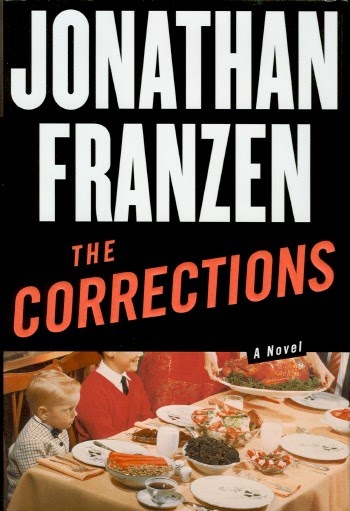
The Corrections - Jonathan Franzen (2001)


Oeuvre rule: I have only previously read How to be Alone, which came out a year after this.  I enjoyed it very much, while I thought Franzen sometimes went on too long and sounded a bit pretentious and cranky.  Some of the material intimates Franzen's raison d'etre in The Corrections--i.e. "this is what I was trying to do" or "this is what I was going for..."  I would like to revisit it in light of those comments, because I'm going to agree with the rest of the world and slap huge compliments on this novel.  Oprah, I'm not going to read everything in your book club, but you got it right with this one.  (No comment on Franzen's disavowal of that institution--except my belief that he regrets that in retrospect.) I don't have a book club, but I do name those I consider the best books reviewed on Flying Houses, and this one makes the list.

Recently, this novel was named the #5 novel of the 21st century so far, and overall it is a very fine piece of literature indeed.  I have minor complaints: the unfortunate media-driven obsession with sex in American society is transplanted into these pages, and Franzen occasionally goes off on a super-long tangent.  The second complaint is also a compliment, however, and I realize it is hard to produce an item designed for entertaining the masses without appealing to baser instincts.

The most notable thing about this book are the extremely long chapters.  There are only a few: "St. Jude" (9 pages), "The Failure" (120 pages), "The More He Thought About It, the Angrier He Got" (99 pages), "At Sea" (97 pages), "The Generator" (117 pages), "One Last Christmas" (99 pages), and "The Corrections" (5 pages).  7 chapters in 570 pages seems unwieldy, but this is not a criticism.  It serves to break the book up into recognizable sections.  "St. Jude" and "The Corrections" are short introductions and conclusions to the novel.  "The Failure" is about Chip.  "The More He Thought About It..." is about Gary.  "At Sea" is about the cruise that Enid and Alfred take.  "The Generator" is about Denise.  And "One Last Christmas" is about the family together for that event.  I found much to enjoy about each of them.  The book is a consistently pleasurable read.

The plot?  The major device is Alfred's failing health--he has dementia and Parkinson's disease, sprinkled together with Alzheimer's.  He is in his late 70's or early 80's.  He worked as a railroad engineer his whole life and raised his family as pitch-perfect members of the middle class.  He is married to Enid, who is constantly trying to put on a happy face and make everyone around her believe that her family is perfect.  Their oldest son, Gary, is a successful bank executive in his early 40's, married to an attorney who has gone into public interest work because they don't need the money, with three kids.  The middle child, Chip, is an anti-establishment English PhD pushing 40 who has recently fallen on hard times after a good teaching job, and is trying to finish a screenplay.  Denise is a chef, but really "culinary master" seems more accurate, 32 and divorced, going through a transitional period.  Enid and Alfred come to visit Chip in New York City before embarking on a cruise along the Canadian coast.  Denise comes to visit from Philadelphia the same day, and Enid pushes the idea of bringing everyone back to the family house for "one last Christmas," because Alfred is losing his lucidity.

The first aforementioned "long tangent" occurs during these preliminary introductions.  Out of nowhere, seemingly, Franzen stops the narrative and tells the entire story of Chip's rise and fall as a college professor.  It was just as engaging, so I didn't mind, but it challenged my expectations.  One other thing I wanted to mention about Chip is that he is the most overused character in all of modern literature: the struggling male writer in his 30's.  I felt like I was reading about Nate or Guert (in his younger days) or even Nick (obviously to a lesser extent)--but while I am sure there are many more examples to be had of this "type," Franzen paints him as more of an unpredictable "bad boy" such that he feels more real, behaving impulsively and making bad decisions.

While Franzen's prose is remarkably pristine, I did come across one passage that made me believe he was not godlike, and could have put in a couple more minutes of research:

"The clerk laughed in a way that was the more insulting for being good-humored.  But then, Chip had reason to be sensitive.  Since D---- College had fired him, the market capitalization of publicly traded U.S. companies had increased by thirty-five percent.  In these same twenty-two months, Chip had liquidated a retirement fund, sold a good car, worked half-time at an eightieth-percentile wage, and still ended up on the brink of Chapter 11.  These were years in America when it was nearly impossible not to make money, years when receptionists wrote MasterCard checks to their brokers at 13.9% APR and still cleared a profit, years of Buy, years of Call, and Chip had missed the boat.  In his bones he knew that if he ever did sell 'The Academy Purple,' the markets would all have peaked the week before and any money he invested he would lose." (103)

Now it is technically allowed for an individual to file Chapter 11 (see Sheldon Toibb, proper citation way too fucking lazy to track down), but that is rare.  It would be most proper to write Chapter 7 here, as Chip would not be a good candidate for Chapter 13 at this moment.  Perhaps Franzen meant to characterize Chip as a business, but I highly doubt it and digress.

From there, the book shifts its focus to Gary.  Gary is somewhat mysterious throughout the beginning of the book, referenced by all the characters but silent, so his prominence in the chapter is noteworthy.  The idea of what the novel will be about is completed here, basically.  Gary is shown working in a darkroom, developing photographs of his family for an epic album that he will give everyone for Christmas, while his youngest son Jonah enthuses about The Chronicles of Narnia.  His two older boys play outside with his wife, Caroline, and seem to like her more.  Gary resents this, and calls her out for lying about a minor injury that she suffers while playing with them.  This happens when Enid calls him and asks if they will all come for Christmas.  Caroline refuses to visit his parents, and Alfred does not feel comfortable staying at their house for more than 48 hours.  She pretty much comes off as a huge bitch when she explains why:

"'The truth, Caroline said, 'is that forty-eight hours sounds just about right to me.  I don't want my children looking back on Christmas as the time when everybody screamed at each other.  Which basically seems to be unavoidable now.  Your mother walks in the door with three hundred sixty days' worth of Christmas mania, she's been obsessing since the previous January, and then, of course, Where's that Austrian reindeer figurine--don't you like it?  Don't you use it?  Where is it?  Where is it?  Where is the Austrian reindeer figurine?  She's got her food obsessions, her money obsessions, her clothes obsessions, she's got the whole ten-piece set of baggage which my husband used to agree is kind of a problem, but now suddenly, out of the blue, he's taking her side.  We're going to turn the house inside out looking for a piece of thirteen-dollar gift-store kitsch because it has sentimental value to your mother---'" (185)

I have to say that Caroline is probably the least sympathetic character in the book.  In one sense she may be rational.  Her husband's family is crazy, and she wants her family to be healthy and emotionally stable.  But the reader feels very bad for Gary, when she seems to think that this fight over Christmas is going to lead to their divorce.  Unfortunately, this is not a very charitable depiction of an attorney.

Much of this chapter is about Gary's fear of anhedonia--basically, depression.  Lack of interest in things.  But then, the end is this long shareholder's meeting of the Axon Corporation, which has offered Alfred $5,000 for his patent on a process for developing pharmaceutical anti-depressants, and which is coming out with a drug called Corecktall.  Later on, Denise and Enid try to get Alfred on a regimen, because it may be able to cure his condition.  While I would never suggest this chapter is "bad," I must admit that while I found certain parts of it highly enjoyable and stimulating, on the whole it was the least memorable section of the book.

"At Sea" details the cruise that Enid and Alfred take, and is fantastic from start to finish.  It reaches its pinnacle in the conversation between Enid and Sylvia, a woman she meets while sharing a dinner table on the cruise, whom she intuits will either be an arch-nemesis or a friend.  The two women spill out all their feelings as they continue to have "just one more."  I do not want to spoil it.

Later, Enid is offered a drug called Aslan by a rogue doctor (who shares his name with a Simpsons character, albeit with different spelling) on board, and I feared that the book was turning into a rip-off of White Noise, which is now turning thirty years old and remains an absolute classic of the late 20th century.  Thankfully, Franzen seems to recognize this (indeed Don DeLillo even offers a blurb in praise on the back cover), so this scene ends up being a mere homage to White Noise.  Maybe it's not and I'm crazy but if you've read that book, you must admit that Aslan and Dylar are essentially identical plot devices:

"'We think of a classic CNS depressant such as alcohol as suppressing "shame" or "inhibitions."  But the "shameful" admission that a person spills under the influence of three martinis doesn't lose its shamefulness in the spilling; witness the deep remorse that follows when the martinis have worn off.  What's happening on the molecular level, Edna, when you drink those martinis, is that the ethanol interferes with the reception of excess Factor 28A, i.e., the "deep" or "morbid" shame factor.  But the 28A is not metabolized or properly reabsorbed at the receptor site.  It's kept in temporary unstable storage at the transmitter site.  So when the ethanol wears off, the receptor is flooded with 28A.  Fear of humiliation and the craving for humiliation are closely linked: psychologists know it, Russian novelists know it.  And this turns out to be not only "true" but really true.  True at the molecular level.  Anyway, Aslan's effect on the chemistry of shame is entirely different from a martini's.  We're talking complete annihilation of the 28A molecules.  Aslan's a fierce predator."  (318)

"The Generator" comes next, and for me it was the strongest section of the book overall, from start to finish (thus, "At Sea" combined with "The Generator" is certainly the strongest stretch of the book).  It is Denise's chapter, and she is probably better developed than any other character.  She spends her last summer before college working at Alfred's railroad company, goes to Swarthmore, and drops out not long after, discovering a love for culinary art.  She marries a man much older than her while serving as his sous-chef.  They get divorced not long after, and the major plot of the section is set into motion.  Paid a generous salary by a benefactor, she travels through Europe to sample the cuisine, and returns to open her own restaurant in a massive building previously owned and utilized by the Philadelphia Electric Company.

Later this same benefactor (Brian) gets involved with a film project, and Stephen Malkmus is name-dropped as a person who would eat dinner with him at fancy New York restaurants, seemingly as a technical adviser.  This really came out of nowhere, and it's particularly ironic because the previous book I reviewed here thanked "Steven Malkamus" in the acknowledgements section.  I really wanted to point that out previously (was it just sloppy editing or some kind of weird SM Jenkins joke?).  There is also this reference, which was prescient in 2001:

"Their few real differences came down to style, and these differences were mostly invisible to Robin, because Brian was a good husband and a nice guy and because, in her cow innocence, Robin couldn't imagine that style had anything to do with happiness.  Her musical tastes ran to John Prine and Etta James, and so Brian played Prine and James at home and saved his Bartok and Defunkt and Flaming Lips and Mission of Burma for blasting on his boom box at High Temp." (349)

Prescient because, Mission of Burma was primed to come back about a year after this novel was published, and because the Flaming Lips were about to "peak."

The last large section of the book, "One Last Christmas," wraps up the story in relatively satisfying fashion.  There is one particular sentence that almost made me want to cry--when Enid says, "This is the best Christmas present I've ever had!" There are a few strange moments at the end, though, and Franzen definitely does not arrange a conventional denouement.  There is one seriously WTF moment (I will just say the word "enema" and anyone who has read it will know what I mean) that I don't understand, unless it's just supposed to be sort of icky and disturbing and nothing more.

The closing eponymous chapter reminded me of the ending to Buddenbrooks, which is also referenced on back cover in a blurb by Michael Cunningham (in the same breath as White Noise)--that is, it feels oddly unceremonious, but appropriate.  There is a short dialogue about whether being gay is a choice and a reference to Six Days, Seven Nights.  And then there is a type of "where are they now?" conclusion.

I've failed when it comes to highlighting the craft of Franzen's prose.  I've picked out really random passages that I found notable for idiosyncratic and insignificant reasons, and I've avoided certain passages to preserve the pleasure of their discovery.  Rest assured this entire novel is well-written.  There are probably 10-15 pages of sentences included throughout the book that annoyed me for some reason, but they do not detract enough to remove it from its rightful place as one of the best books reviewed on Flying Houses.  I just hope this review has done it justice.

Sunday, March 15, 2015

Girl in a Band - Kim Gordon (2015)


At my 30th birthday party, now nearly two years ago, a friend gave me a gift card to Barnes & Noble for $20.  I visited the store a few different times recently, but there was nothing I really wanted.  Of course there were books I wanted to read, but I could usually stand to wait for them to be held on reserve for me at the library.  I don't like buying books at sticker price, especially hardcovers.  But when I tried to reserve Kim Gordon's new memoir, and realized I would need to wait a couple months, I found my occasion to redeem the gift.

It didn't work at first.  I went to the location on Jackson Blvd. in the Loop on the day it was released - February 24, 2015 - and looked in the music section.  Nothing.  I went to the information desk and asked if they could look up a book on their system.  The girl at the desk asked which book, prepared to type, and I said it was Kim Gor----"We've been getting a lot of calls for that - it's all sold out, but we can order you a copy."  I gave them my number, and one week later, on March 1st, I got my copy.  It was just over $30, so I had to pay $10 extra.  I put down The Corrections (which I fully expect to review in the next two weeks), and started.  I finished it on Saturday, March 7th.  Now, I must delve into reviewing it, which I feel more equipped to handle than nearly any other post in the history of Flying Houses.

For those that don't know me personally, it is worth explaining that Sonic Youth is one of my favorite bands of all time.  I was first exposed to them in the Fall of 2001, by the same friend that I have probably written about more than once here, but most prominently regarding Cap'n Jazz.  He lent me Sister and Daydream Nation.  I didn't really get them at the time, but I remember liking Sister slightly more, probably because it was shorter and more digestible.  At the time though, I experienced what most people probably do upon first listening to them: confusion.  Yes, it was rock music, but it seemed like they were purposefully trying to be a difficult listen.  A year later I went to NYU and a friend showed me The Year Punk Broke, and my interest was renewed.  By the time Murray Street came out in 2002, I had burnt CDs of several of their albums and picked it up on or around its release date.  At the time, I thought they were old, and were losing their edge.  I hadn't even really listened to A Thousand Leaves yet, so I guess Washing Machine was my most recent point of reference.  Except for "Plastic Sun," it seemed kind of mellow and boring to me.  I got into basically all of their other albums after that, and when Sonic Nurse came out in 2004, I proclaimed to everyone that it was their best since Washing Machine.  I would say the same thing after Rather Ripped in 2006 and The Eternal in 2009.  I also saw them play live about five different times, the last of which was performing Daydream Nation at the Pitchfork Festival in 2007, a really fond memory of mine.  

Then there was also the time I met Kim and Thurston.  It was at the Tonic lounge in the Fall of 2002. Thurston was playing a weird, free jazz noise concert with the drummer Chris Corsano and another guy I forget, and I approached Kim.  I totally forgot what I said to her, but I think I asked her if she could give a zine I had just printed to Thurston.  I said, "Kim," and she turned around and said something to me in German, I think.  Later I would talk to Thurston after the show and get his autograph in my journal and find out from him that the band would next be playing at Irving Plaza, a show that wasn't announced yet.  I think I saw them both at one other show, about a year later--Godspeed You! Black Emperor at Warsaw in Brooklyn.  

Girl in a Band got a lot of advance press, primarily from the salacious excerpts that were unveiled in a couple different reviews about the breakdown of their marriage.  There were also extremely pointed comments on Courtney Love, Billy Corgan and Lana Del Rey.  I read them in awe, and could not wait to read the book.  It seemed like Kim was about to absolutely destroy all the posers and bust out with pure, unadulterated truth.  While this book is extremely powerful, and made me super nostalgic and happy, reigniting my desire to make art and challenge expectations, I must report that those looking for similar cutting remarks will not find many more.  They will probably be most enthralled by the last thirty pages or so--but nobody should be disappointed by this book.  I only don't name it one of the best books reviewed on Flying Houses because it sometimes feel clipped--many of the first chapters are only a few pages long, giving the appearance that they were each written as one day's work--and some details or impressions are repeated, as if the reader will not remember the first mention.  Regardless, I loved it.

It begins with an account of Sonic Youth's final show in Brazil, and after finishing the book last Saturday, I watched it on YouTube.  The sound leaves something to be desired, and it takes them a while to gain momentum, but it is a fitting end to their epic career.  It's a good place to start the book, because it sucks the reader into what unfortunately must be the main gossipy reason for its allure: telling the story of how the marriage failed.  After watching the show I had to conclude that Kim was either really good at faking the appearance of having a good time, or genuinely savoring the catharsis.

From there, the book goes into a narrative of her family history and early life.  It is tempered with just the right amount of detail--not an exhaustive genealogical report, but a collection of highlights one might tell a close friend.  This one reads like an extrapolation of the meaning behind the song "Brave Men Run," which is later referenced around the middle of the book:

"In my family, history showed up in casual remarks.  I was in my senior year of high school when my aunt told me that my mother's family, the Swalls, was one of California's original families.  Pioneers.  Settlers.  The story went that along with some Japanese business partners, my great-great-grandparents ran a chili pepper farm in Garden Grove, in Orange County.  The Swalls even had a ranch in West Hollywood, at Doheny Drive and Santa Monica Boulevard, on land that's today all car washes and strip malls and bad stucco.  At some point the railroad laid down tracks, slicing the street into Big and Little Santa Monica Boulevards.  The ranches are all gone today, of course, but Swall Drive is still there, swishing north and south, a fossil of ancestral DNA.
I've always felt there's something genetically instilled and inbred in Californians--that California is a place of death, a place people are drawn to because they don't realize deep down they're actually afraid of what they want.  It's new, and they're escaping their histories while at the same time moving headlong toward their own extinctions.  Desire and death are all mixed up with the thrill of and the risk of of the unknown.  It's a variation of what Freud called the 'death instinct.'  In that respect the Swalls were probably no different from any other early California family, staking out a new place, lured there by the gold rush and hitting an ocean wall." (15-16)

She writes about her father, and how he conducted the first sociological study on categorical high school cliques, for UCLA while in Hong Kong.  She compares him to William S. Burroughs, whom she visited with Thurston, their daughter Coco, and Michael Stipe in 1994.  She writes about idyllic fishing trips with her parents and their friends in Northern California.  She writes about her mother, who was somewhat mysterious to her.  And she writes about her brother, who may have affected her personality more than anyone else:

"His ridiculing and button-pushing went beyond the typical sibling ragging.  At dinner, I'd let drop some trendy word or expression and Keller would jump on it, and on me, for my faddishness, my ordinariness, my lack of originality.  When a scene in a movie or a Disney special made me laugh or cry, he'd make fun of me for laughing and make fun of me for crying and make fun of me when I didn't say anything at all.  He always knew he could get a response from me, which provoked him to do it even more.
At some point I turned off entirely.  Knowing I'd get mocked or teased, I would do anything not to cry, or laugh, or show any emotion at all.  The biggest challenge as I saw it was to pretend I had some superhuman ability to withstand pain.  Add that to the pressure girls feel anyway to please other people, to be good, and well mannered, and orderly--and I backslid even more into a world where nothing could upset or hurt me." (40)

From there she goes on to talk about her high school days, and college at three different schools.  There are fascinating stories about her early brushes with art-punk and encounters with semi-obscure celebrities.  The book seems to hit its sweet spot when she writes of first moving to New York and ruminates on the artistic motivations of her colleagues and the burgeoning No-Wave scene.  Such nostalgia trips become all the more poignant when situated against the present:

"These days, when I'm in New York, I wonder, What's this place all about, really? The answer is consumption and moneymaking.  Wall Street drives the whole country, with the fashion industry as the icing.  Everything people call fabulous or amazing lasts for about ten minutes before the culture moves onto the next thing.  Creative ideas and personal ambition are no longer mutually exclusive.  A friend recently described the work of an artist we both know as 'corporate,' and it wasn't a compliment.  The Museum of Modern Art is like a giant midtown gift store." (85)

Passages like these make me glad that I am no longer there (though obviously my present abode has its own depressing defining qualities).  But they also make me miss, terribly, the years between 2001 and 2004.  Kim probably would say that things have not really changed that much since then, though.

The section of the book about Sonic Youth feels somewhat touch-and-go.  There are 53 chapters, and several "movements," but the majority of the material on the band comes in the context of specific songs she highlights (though again, these chapters also feel loose--the chapter on "Death Valley '69" is pretty much about Bad Moon Rising, etc.).  I particularly appreciate her discussions on women in the music and art worlds.  Of course there is the regrettable (and revised) comment on Lana Del Rey's version of feminism--which felt very badass at first and now feels watered-down, but was the right thing to do (I won't reprint it here, you can find it on plenty of other sites).  Feminism is a super-hot topic right now and younger voices should take heed: Kim is a perfect example of a pioneer that can equivocate calmly and speak with maturity and wisdom:

"I also felt limited as a singer.  When the band first started, I went for a vocal approach that was rhythmic and spoken, but sometimes unleashed, because of all the different guitar tunings we used.  When you listen to old R&B records, the women on them sang in a really fierce, kick-ass way.  In general, though, women aren't really allowed to be kick-ass.  It's like the famous distinction between art and craft: Art, and wildness, and pushing against the edges, is a male thing.  Craft, and control, and polish, is for women.  Culturally, we don't allow women to be as free as they would like, because that is frightening.  We either shun those women or deem them crazy.  Female singers who push too much, and too hard, don't tend to last very long.  They're jags, bolts, comets: Janis Joplin, Billie Holiday.  But being that woman who pushes the boundaries means you also bring in less desirable aspects of yourself.  At the end of the day, women are expected to hold up the world, not annihilate it.  That's why Kathleen Hanna of Bikini Kill is so great.  The term girl power was coined by the Riot Grrl movement that Kathleen Hanna spearheaded in the 1990s.  Girl power: a phrase that would later be co-opted by the Spice Girls, a group put together by men, each Spice Girl branded with a different personality, polished and stylized to be made marketable as a faux female type.  Coco was one of the few girls on the playground who had never heard of them, and that's its own form of girl power, saying no to female marketing!" (127)

As she approaches the end of the "songbook" section of the book, Kim describes the events of 9/11, which rendered the band's recording studio on Murray Street inoperable.  As a person that witnessed the events, from about ten blocks further north, I found the description spot-on:

"The next morning Daisy called me and told me to turn on the TV because a plane had just flown into the World Trade Center.  Daisy's husband, Rob, worked in a building across from the Towers but hadn't left for the office yet.  I called Jim [O'Rourke] and told him to leave the studio, and then I called Thurston.  Jim knew nothing but told me that dust was starting to gather through the open windows.  It was difficult for me--for everybody--to make any sense of what was happening.  I had no TV or radio, but the phone worked, at least first.  By the time the second plane hit, phone service was crackling away to nothing, and when I called Thurston a second time, I couldn't reach him, but I finally convinced Jim to come to our apartment.  As Jim was leaving Murray Street, the second tower was collapsing and people were jumping out of windows.  Lee, his wife Leah, and their kids, who lived downtown, showed up at our apartment, too.  Below us, literally right outside our door, Houston Street and Lafayette were barricaded, and police weren't letting anyone go south of Houston without ID and proof of residence.
It was a surreal, terrifying day.  People--stranded models, people who'd come to town for Fashion Week--were wandering around Nolita and Soho in a daze.  Jim arrived finally, completely traumatized.  We all slept there that night." (216)

The ending may be the strongest part of the book, just because throughout the entire story Kim has portrayed herself as an emotionally-distanced person, in line with the impressions of her personality in the popular culture (though this phrase sounds super-awkward because if you randomly asked 100 people on the street--outside of Greenwich Village, etc--if they know who Kim Gordon is, maybe 10 might say yes).  She finally drops her cool exterior and divulges nearly as heartbreaking an account of a relationship's end as I've ever read.  It is raw, and feels more like the work of a seasoned fiction writer than a primarily musical and secondarily visual artist.  Thurston does not come off very well, but it is especially touching when they attempt to work through their difficulties.  Kim does not write bitter, hateful prose--it is more along the lines of intense disappointment.

This is probably a really inappropriate place to mention the song "Kim Gordon's Panties" by Steve Albini's post Big-Black project Rapeman, but it's too bad Kim never mentions anything about that song.  The song feels like a pseudo-parody of "Teenage Riot" and "Schizophrenia," the opening guitar part and lyrics directly referential.  It feels particularly ironic in that it seems predictive of events that would take place 23 years later.  "I went up to Milwaukee to see an old friend of mine/then Thurston came over/he was out of his mind."  And later: "If I had that to come home to/I'd never leave again."  Gordon did write an essay that is excerpted here, and also in Our Band Could Be Your Life, where she drops the line, "How many boys want to get whipped by Steve Albini's guitar?" but there are no other references.  I've always been a bit confused by the weird rivalry between Albini and the band, and I am curious whether she found it offensive or amusing.  Some mysteries must remain....

I am not going to spoil the sequence of events at the end, but there is one detail that I found scathing, humorous, and incredibly sad:

"Thurston's solo record, Demolished Thoughts, was like a collection of sophomoric, self-obsessed, mostly acoustic mini suicide notes.  When I first encouraged him to record it, I hadn't given any thought to what the lyrics might be about, but hearing pieces of one or two songs, I realized I could never listen to it again.  'I think the lyrics are probably about both of you,' Julie said helpfully, but to me, the lyrics, and the songs, were, and always will be, about her." (256)
 
She also mentions performing "Aneurysm" with the surviving members of Nirvana at their induction into the Rock and Roll Hall of Fame.  A friend tells her that it was the most punk thing that will ever be done at the show, and it is definitely worth a view.  In a similar way, this book is worth a read.  I've read a few memoirs by musicians, but none have been as punk (they've lacked the raw honesty exhibited here).  There is an artistic rendering of the word "DARKNESS" on the inside covers, and the implication is both ominous and profound.  It is up to us to make something beautiful or true in this window between two periods of nothingness.  Kim has done that in her life, as well as these pages, and we are all the more fortunate for it.   

Sunday, August 3, 2014

How to be Alone - Jonathan Franzen (2002)


I picked up How to be Alone at the Printer's Row Lit Fest, so it shares the dubious honor of being the second book after Rick Moody's Purple America to be purchased there and reviewed here.  I liked Purple America and I liked How to be Alone but for different reasons.  How to be Alone is a book of essays, and I don't know, I just kind of like reading essays.  Let me put it this way: I prefer to read "essays" over "articles," and I hope that my posts on Flying Houses are considered "essay-like reviews" rather than "article-like reviews."  But I digress - we must discuss the author.

The only time I read anything by Jonathan Franzen before was when I read a chapter from The Corrections that was re-printed in an anthology released for the 50th anniversary of The Paris Review (ironically, also purchased at the Printer's Row Lit Fest(!) - a decade ago when it was called the Printer's Row Book Fair).  I didn't really get into it.  So I never checked out that novel, or anything else by him.  But he seemed like the real deal after Freedom got so much attention so I figured I should give him a chance when I saw this book for $5.00.  And after reading it I will definitely check out more of his work.

But I can't go on without mentioning that I was put off by him before because he seemed like a kind of vanilla great writer--doing everything right, but lacking the ability to really engage the reader--from that little excerpt I read in that Paris Review anthology.  Mainly I compared that with "Little Expressionless Animals," a short story by David Foster Wallace that was also in there and is probably the best (and only) thing I have finished by him, and decided that Franzen just wrote pretentiously.
***
The book starts off on an almost impossibly high note with "My Father's Brain."  This is a remarkable essay that should be anthologized for any collection of 20th or 21st century writers studied by high school students (it could almost be an essay by Richard Selzer).  Franzen ties together autobiography and science to produce an extraordinary tribute to his father that is highly emotional as well as educational.  Having lost a grandmother to Alzheimer's disease, it was especially poignant for me when he mentioned how his father could still recognize the people around him as familiar, but could not identify their relationship to him.  To be clear, the last time I saw her before she went to a nursing home, she referred to her son and his wife (who had moved in with her to care for her) as two nice people who were letting her stay with them for some unknown reason.  Franzen's father similarly retained familiarity with his family members, but probably only thanked them for coming to visit in the nursing home because (apparently) Alzheimer's patients retain their manners and politeness, and other learned, ingrained social pleasantries.  This, along with several other observations and scientific hypotheses, tells the reader everything they need to know about Alzheimer's.  But what makes this essay even more amazing is the way Franzen branches off to discuss the nature of memory, and how writers employ it:
***
Before I go on, a confession: it has taken me a very long time to write this review.  Not because I have complicated feelings about it, but because I've been lazy.  Also I couldn't find a good quote from the first essay, so we move on.

"Imperial Bedroom" comes next and at this point I need to say several things: (1) that is the title of an Elvis Costello album; (2) that is almost the title of a Bret Easton Ellis novel; (3) a few days after starting this book on June 30, 2014, Bret Easton Ellis linked to an old interview he did on Facebook which referenced the most infamous essay in this book and also commented on Donna Tartt in June 1999; (4) this essay is about the Starr Report and was published in 1998; (5) this essay references the "zone of privacy" codified by the Supreme Court in the late 1800's, (6) this essay feels dated in a very charming way, like many of the other pieces in this book.  I will get more into this later.  But basically, this essay was o.k.:

"Walking up Third Avenue on a Saturday night, I feel bereft.  All around me, attractive young people are hunched over their StarTacs [!] and Nokias with preoccupied expressions, as if probing a sore tooth, or adjusting a hearing aid, or squeezing a pulled muscle; personal technology has begun to look like a personal handicap.  All I really want from a sidewalk is that people see me and let themselves be seen, but even this modest ideal is thwarted by cell-phone users and their unwelcome privacy.  They say things like 'Should we have couscous with that?' and 'I'm on my way to Blockbuster.'  They aren't breaking any law by broadcasting these breakfast-nook conversations.  There's no PublicityGuard that I can buy, no expensive preserve of public life to which I can flee.  Seclusion, whether in a suite at the Plaza or in a cabin in the Catskills, is comparatively effortless to achieve.  Privacy is protected as both commodity and right; public forums are protected as neither.  Like old-growth forests, they're few and irreplaceable and should be held in trust by everyone.  The work of maintaining them gets only harder as the private sector grows ever more demanding, distracting, and disheartening.  Who has the time and energy to stand up for the public sphere?  What rhetoric can possibly compete with the American love of 'privacy?'" (53)

Okay, I'll admit sometimes I don't get exactly what point Franzen is trying to make, but let's just say he sounds like a curmudgeon in 1998 and he must totally want to kill himself with the state of things in 2014, as do I.  So I make this offer to him: the next time he is in Chicago, he should contact me and we should take the El together and yell at everyone staring down at their phones.  [Note: I have absolutely no problem with people reading Flying Houses on personal electronic devices].

The aforementioned infamous essay comes next.  "Why Bother? (The Harper's Essay)" is one of the main attractions of this book, but not for the right reasons.  I am sure there are plenty of people that would defend this essay as a "tour de force" and one of the finest essays about literature in the 1990's, but most people (and Franzen himself) probably consider it embarrassing and pretentious.  Originally titled "Perchance to Dream" and published in April 1996, Franzen writes that when he actually opened up the magazine to read it, "I found an essay, evidently written by me, that began with a five-thousand-word complaint of such painful stridency and tenuous logic that even I couldn't quite follow it." (4) He "cut the essay by a quarter" and retitled it, and hoped "it's less taxing to read now, more straightforward in its movement." (5) It is 43 pages long and only wasn't taxing for me to read because I was stuck on an airline commute from hell that majorly comprised a 15 hour travel day. Also, it was not taxing because I kept waiting to see what ridiculous thing Franzen was going to write next.  It is a gold mine for ridiculousness, but some valid points are made along the way.

As is the case for most of the essays here, it is spurred by something Franzen recently read.  In this case it is the short novel Desperate Characters by Paula Fox published in 1970. (As a side note, Franzen name-checks many, many writers throughout this book, most of them a bit more obscure than the usual names mentioned.  So it can be helpful also in terms of discovering new writers.) He writes a lot about how simple and beautiful this novel is and how symbolic it all is.  He also writes about his first novel The Twenty-Seventh City and how his ideas of what literature should be shifted throughout the years.  Now, I kind of want to read his first novel now, and I kind of get where he's coming from, even though I don't agree entirely with his stance.  But maybe I'm confusing this with the later essay "Mr. Difficult," which I think is probably the strongest essay in this book ("Why Bother?" done right).

He writes a lot about Shirley Brice Heath and the observations she made about the reading public.  He basically complains that nobody reads anymore.  There's a lot of confessional stuff about his own writing, and he is usually pretty funny and occasionally lands solid moments of truth:

"Unfortunately, there's also evidence that young writers today feel imprisoned by their ethnic or gender identities--discouraged from speaking across boundaries by a culture in which television has conditioned us to accept only the literal testimony of the Self.  And the problem is aggravated when fiction writers take refuge in university creative-writing programs.  Any given issue of the typical small literary magazine, edited by MFA candidates aware that the MFA candidates submitting manuscripts need to publish in order to obtain or hold on to teaching jobs, reliably contains variations on three generic short stories: 'My Interesting Childhood,' 'My Interesting Life in a College Town,' and 'My Interesting Year Abroad.'  Fiction writers in the Academy do serve the important function of teaching literature for its own sake, and some of them also produce strong work teaching, but as a reader I miss the days when more novelists lived and worked in big cities.  I mourn the retreat into the Self and the decline of the broad-canvas novel for the same reason I mourn the rise of suburbs: I like maximum diversity and contrast packed into a single exciting experience.  Even though social reportage is no longer so much a defining function of the novel as an accidental by-product--Shirley Heath's observations confirm that serious readers aren't reading for instruction--I still like a novel that's alive and multivalent like a city." (80)

I can see what he's saying about the MFA contingent (and I've complained about them several times over the years here), but I have to admit that, even though I can't consider myself part of that group (because I didn't get in to one of those programs, I'm more of the novelist that lives and works in a big city), I feel like I have to retreat into the Self, at least for the first couple major works.  I feel like you can't truly understand the world until you've thoroughly examined yourself, and to give an idea of your perspective, you should publish at least a couple books that present it.    

I seriously could write an entire blog post about each essay--and this one is a doozy for sure.  But I have to move on as I'm doing the entire book and I think I've given an idea about the notoriety of this essay.  Bret Easton Ellis said it wasn't a good essay in its original form, and I'm not sure if he thinks it's any better in its revised form, but it's certainly worth reading because you can't help but have strong feelings about it.

"Lost in the Mail" is an essay about the decline of the U.S. Post Office in Chicago in 1994.  I loved it because so much of it is about Chicago, but as I was reading it I was paranoid that my city sticker wouldn't arrive that day in the mail, and that I'd get penalized for not having a new one on my windshield on July 1, but in reality they didn't start enforcing that until July 17th this year (and ironically, my city sticker arrived right after I finished the essay).  As is the case for most of the essays here, it feels dated, but then again I don't live on the South Side.  I feel like the Post Office has cleaned up its act over the past 20 years, but this is still an entertaining read because it is the first "live reportage" type essay here and feels like it's "from the front lines" and "an insider's look."

"Erika Imports" is probably the strangest thing in the book, but it's nice.  It's like four pages long and is a brief nostalgia trip about the first summer job Franzen ever had, working for his neighbors.  Maybe I only thought it was nice because it was so short though, and was such a counterpoint to the 30 page essay I was expecting.

"Sifting the Ashes" is a great essay about cigarettes.  However, I was confused at the beginning as to whether Franzen had actually quit at the time he was writing it.  Again, he references a recent book he read, Smoke Screen by Philip J. Hilts.  Though this essay was published in 1996, it doesn't feel that dated.  The only thing that's changed is that cigarettes have become subject to much higher taxation and have been banned from most indoor establishments across the country.  I feel like somebody needs to write an essay about marijuana right now so that in 18 years we can consider whether it feels dated.

"The Reader in Exile" is the 2nd example of the "quintessential Franzen essay" in this book, after "Why Bother?"  You can guess what it is about.  He references A is for Ox by Barry Sanders, but mostly talks about Being Digital by Nicholas Negroponte.  I mainly remember this essay for Negroponte's relentless positivity about the rise of technology, and Franzen's skepticism.  It makes me feel like Negroponte was an early proponent of the robo basilisk paranoia, but I digress.

"First City" is an essay about New York City.  It is also about the nature of cities, and how they differ in Europe from the U.S.  Some interesting comments are made about urban planning.  He references Witold Rybczysnki's book City Life.  Further comments are made about The Encyclopedia of New York City, which are entertaining.  In general, this is a paean to New York as the most European city in the U.S. and it makes me want to write an essay titled "Second City."

"Scavenging" is probably the 2nd strangest thing in the book.  He also gripes about new technology here, waxing nostalgic about his rotary phone.  He kind of jumps all over the place in this essay, but he mostly writes about using outdated technology.  And it is here that we reach a milestone.  For I read this essay right before I accidentally destroyed my old laptop's screen, and felt very sad, but then felt very proud like I would blog on a semi-broken machine.  And I did that for a while, but at this moment, this post is the first post being written on my new laptop.

"Control Units" is about super maximum security prisons, and is a really great essay, actually.  It's not quite on the level of "My Father's Brain," but it's like a more compelling "Lost in the Mail."  Basically, Franzen is in full-on journalist mode here again, and he makes some great comments about the prison system in a particular Colorado town, and though it was published in 1995, this is another essay that has only grown more true as time has gone on.

"Mr. Difficult" is my favorite essay in this book.  It is mainly about William Gaddis.  I have never read anything by Gaddis but it made me want to--sort of.  Franzen gives Gaddis the highest compliments imaginable, but also openly admits that some of his later work is a mess.  This is one of the most fascinating essays in the book because Franzen seems openly enthusiastic about the material, and his opportunity to make a statement about it.  There is also the interesting revelation that the title of The Corrections is meant as a nod to The Recognitions.  Franzen also writes about his failed attempt to write a screenplay, because somebody told him that his movie seemed to plagiarize Fun with Dick and Jane (which seems weird for some reason).  He also talks about books that he couldn't finish.  He references The Sot-Weed Factor, and that is another notable example of a book that I tried to read while starting this blog, but failed to review as "incomplete." I guess this is about a certain period of American authors.  Franzen says he didn't particularly like any of them that much except for Don DeLillo and Gaddis.  Generally, I liked what he did with this essay.  Franzen seems to have a deep understanding of Gaddis's oeuvre, and I can appreciate an essay on this sort of subject matter.

"Books in Bed" is another essay that is kind of like "Imperial Bedroom" but is mostly about sex rather privacy.  It is also about watching CNN in airports.  He again references recent books he has read  This time it is The Joy of Writing Sex by Elizabeth Benedict, which is a compilation of sex scenes in literature.  Franzen seems to view the culture's obsession with sex, and literary sex scenes, as another indication of the sad state of the modern world.  But along the way, as usual, he is entertaining:

"Until the Rules become universal, though, such comfort as can be found in the market economy comes principally from norms.  Are you worried about the size of your penis?  According to Sex: A Man's Guide, most men's erections are between five and seven inches long.  Worried about the architecture of your clitoris?  According to Betty Dodson, in the revised edition of her Sex for One: The Joy of Selfloving, the variations are 'astounding.'  Worried about frequency?  'Americans do not have a secret life of abundant sex,' the researchers in Sex in America concluded.  Worried about how long it takes you to come?  On average, says Sydney Barrows, it takes a woman eighteen minutes, a man just three."  (273)

"Meet Me in St. Louis" is the last longer essay in the book, and is about Franzen's experience becoming a member of "Oprah's Book Club" and how a promotional movie was shot in St. Louis about his life.  It's awkward and is one of the other major highlights of this book.  In a way, it is similar to "My Father's Brain" because it delves into personal details about his life and his parents.  It's entertaining and emotionally engaging to see how a bigger promotional machine can twist the meaning of a work of art into something different than its meant to be in search of a bigger return.

The collection ends with a trip that Franzen took to see the inauguration of George W. Bush in 2001.  It's breezy and short--only "Erika Imports" is shorter.  But it makes a stronger impression than that essay.  It reads like a combination of "Journalist Franzen" and "Skeptical Franzen."  It seems like a reactionary piece to the Bush v. Gore decision, and it feels very raw and angry.  Obviously your political views may tint how you view this essay, but it seems like the vast majority of Frazen's fans will not take issue.

On the whole, How to be Alone is a nice collection, and was worth buying for $5.  I'm not sure I'll revisit it anytime soon (maybe in a decade, who knows), but it was a thoroughly entertaining collection that made me feel very literary for reading.  Anybody that wants to be a well-respected author that sells a lot of copies should read this to see inside the mind of one of them.  Franzen is generous in that regard.  Still, I can't help but feel that 50% or more of modern-day writers may claim he is full of it and you don't need to live the way he does to write great books.  I'm not sure how I'll review his fiction, but I hope to have the chance soon.