Showing posts with label The Art of Fielding. Show all posts

Thursday, April 7, 2016

Colorless Tsukuru Tazaki and His Years of Pilgrimage - Haruki Murakami (2014) (Trans. Philip Gabriel) (JK)


Oeuvre rule: as previously mentioned in my review of What I Talk About When I Talk About Running (WITAWITAR), Murakami is the author of the only book I have read in the past 8 years that did not result in a review on Flying Houses.  Hard-Boiled Wonderland and the End of the World is an interesting book and I would recommend it, but among the three Murakami books I have read, it would be on the bottom.  WITAWITAR would be at the top and this would be in the middle.

The incomparable Dr. Emily Dufton has graciously reviewed both IQ84 and this book for Flying Houses and now I will offer my first fiction review of this redoubtable literary giant.  Most of my comments will be repetitive of Emily's, and she has certainly read much more of his oeuvre than I have, so her review is more authoritative as a seasoned reader of his.  I hope that my review will be useful for relative Murakami newbies.

The first thing that struck me about Tsukuru is its relative lack of fantasy sequences.  Maybe Hard-Boiled Wonderland was a bad example, but I feel like most of his other works are similarly fantasy-driven.  This is actually a very realistic novel.  The main character is 36, and it takes place in present day, and I feel that its reflective of our times and remarkably perceptive about all the different forms of passive aggression.

The main thrust of the story is that Tsukuru has been abandoned by his four closest friends at age 20, and 16 years later, he goes back to investigate why they suddenly decided to cease contact.  It ends up being a relatively simple explanation--and while I am not going to spoil it here (unlike The Art of Fielding - let spoilers be reserved for disappointing endings)--the explanation does sort of reference the only quasi-fantasy sequences in this book, which are erotic dreams.  I do want to say that I think that element is beautifully evoked in Tsukuru.

I was with a friend at the library and he wanted to pick something out to read on his spring break, and they didn't have the Tolstoy he wanted.  I perused the aisles with him and thought to see if they had any Murakami.  I found this available and told him to take it out.  He read it in like a day or two.  It's 380 pages or so but the pages are small.  He said I should read it, so after finishing M Train I picked this up.  It was good for us to read the same thing and to be able to talk about it.  For example, I asked him, "Does Haida come back?"  He said, "Do you want me to spoil it for you?" I said, "No."  And now I know what happens and I have to say that matters being left sort of unresolved at the ending (I don't think it's spoiling anything to reveal that) made the book feel less satisfying to me.  Murakami did not want to write a standard happy ending.  This is a really quirky little book, and kind of delightful at times for its simplicity and directness.  It is a pleasure to read the language, which is to the credit of Philip Gabriel.

I could quote any number of passages, but inevitably I must include something from the sequence with Haida...But first I came across one hilarious aspect of the sequence with Ao:

"As Tsukuru was wondering how to respond, 'Viva Las Vegas!' blared out on Ao's cell phone again.  He checked the caller's name and stuffed the phone back in his pocket.
'I'm sorry, but I really need to get back to the office, back to hustling cars.  Would you mind walking with me to the dealership?
They walked down the street, side by side, not speaking for a while.  Tsukuru was the first to break the silence, 'Tell me, why "Viva Las Vegas!" as your ringtone?'
Ao chuckled.  'Have you seen that movie?'
'A long time ago, on late-night TV.  I didn't watch the whole thing.'
'Kind of a silly movie, wasn't it?'
Tsukuru gave a neutral smile.
'Three years ago I was invited, as the top salesmen in Japan, to attend a conference in Las Vegas for U.S. Lexus dealers.  More of a reward for my performance than a real conference.  After meetings in the morning, it was gambling and drinking the rest of the day.  '"Viva Las Vegas!" was like the city's theme song--you heard it everywhere you went.  When I hit it big at roulette, too, it was playing in the background.  Since then that song's been my lucky charm." (182)

Murakami translated Raymond Carver into Japanese, and spent time with him in the late 80's.  At times I feel as if he is mimicking Carver in the starkness of the language and the generally sad story.  This is not an unwelcome development.  Anyways, in the Haida sequence, I thought things were just going to be so innocent, so when it became the raunchiest part of the book, I was sort of relieved:

"Now, though, he wasn't coming inside Shiro, but in Haida.  The girls had suddenly disappeared, and Haida had taken their place.  Just as Tsukuru came, Haida had quickly bent over, taken Tsukuru's penis in his mouth, and--careful not to get the sheets dirty--taken all the gushing semen inside his mouth.  Tsukuru came violently, the semen copious.  Haida patiently accepted all of it, and when Tsukuru had finished, Haida licked his penis clean with his tongue.  He seemed used to it.  At least it felt that way.  Haida quietly rose from the bed and went to the bathroom.  Tsukuru heard water running from the faucet.  Haida was probably rinsing his mouth." (127)

Okay, I'm sorry, that was probably the dirtiest thing I have ever posted on this blog, so I'm sorry if it offended you.  It's just that something about this book just seems a little prudish, and then it kind of breaks into this hugely graphic scene.  It's a nice contrast.

I really don't know what else to say about this book.  Dr. Dufton noted that Murakami seems to be getting repetitive with age, but this was still a very good book.  And I agree, while professing ignorance on the former topic.  I do want to say that I think there are a few loose ends that remain untied.  Of course, there is the obvious big uncertainty at the end with Sara, but on the whole I think the whole ending sequence is very beautiful, if a bit strange with all the phones ringing and not getting picked up.  There's a definite atmosphere to the ending, as well as with Tsukuru's lonely pastime of watching from a bench as the trains arrive and depart at stations in Helsinki and Tokyo.  I don't understand what Haida's story about his father (or is it made up?) means, or the significance of Haida as a character in relation to Shiro.  There is this great passage though, involving Tsukuru's first girlfriend at age 21, shortly after Haida leaves their college:

"She wasn't good at cooking, but enjoyed cleaning, and before long she had his apartment sparkling clean.  She replaced his curtains, sheets, pillowcases, towels, and bath mats with brand-new ones.  She brought color and vitality into Tsukuru's post-Haida life.  But he didn't choose to sleep with her out of passion, or because he was fond of her, or even to lessen his loneliness.  Though he probably would never have admitted it, he was hoping to prove to himself that he wasn't gay, that he was capable of having sex with a real woman, not just in his dreams.  This was his main objective." (142-143)

It's a good story, and though it seems a few things remain unsettled, it seems like this narrative gets wrapped up a bit more tidily than most of Murakami's other novels.  Dr. Dufton could correct me if I am wrong.  Like her, I am glad I read it.  Unlike her, I look forward to experiencing the rest of Murakami's oeuvre for the first time.

Sunday, January 18, 2015

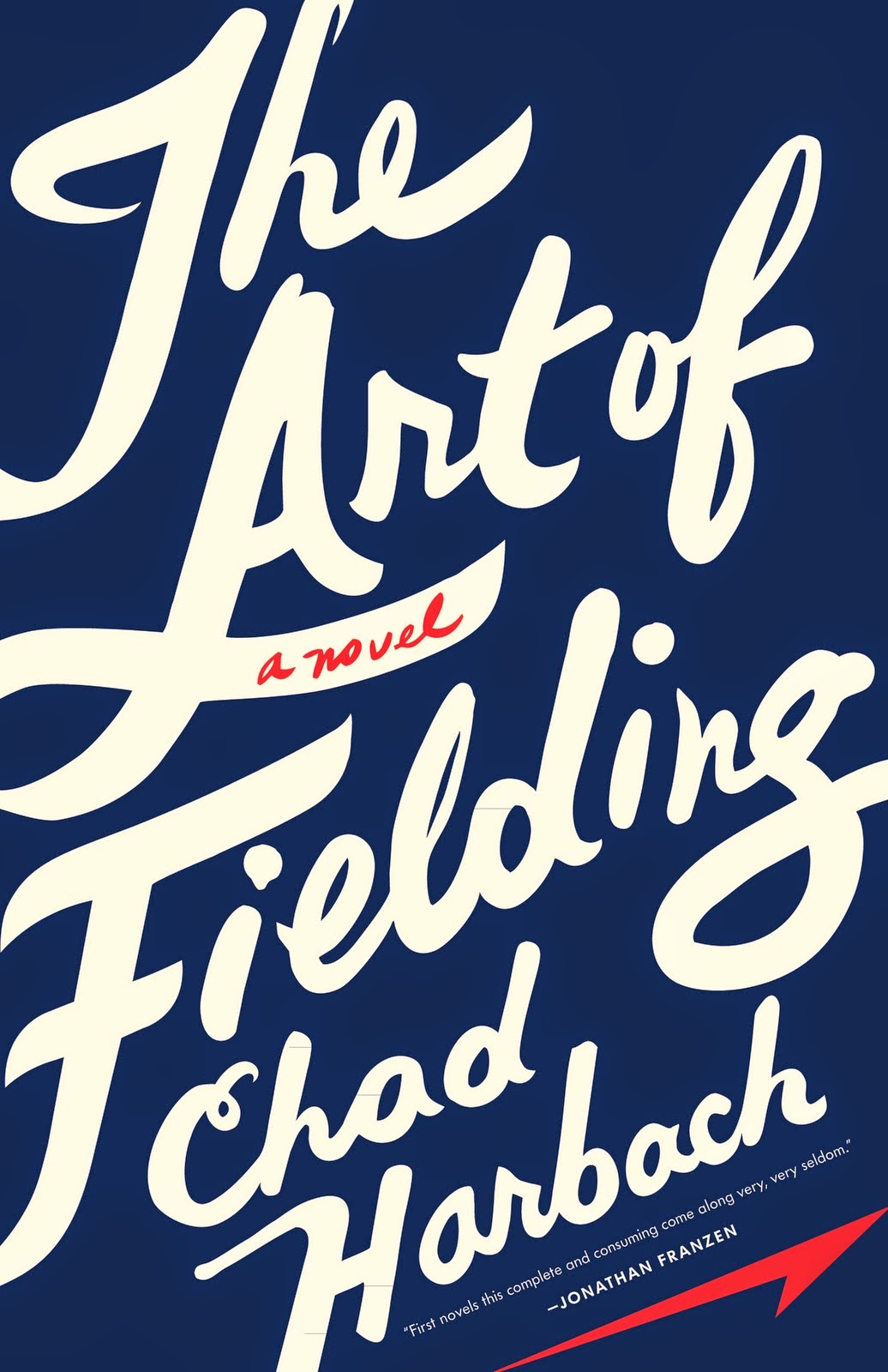
The Art of Fielding - Chad Harbach (2011)


I decided to read The Art of Fielding after it was recommended to me by the same anonymous poster that suggested The Love Affairs of Nathaniel P.  The comments are worth reading, but I will not re-post them in the body of this review.

Did I find this book truly amazing?  It may not surprise you, but, as is often the case: yes and no.  During the first 150-200 pages, I was flirting with adding it to the "best books" list (which can be found here) at the time, but then I foolishly checked what Entertainment Weekly had to say with its nifty letter grade.  They gave it a B+.  They said it was great, totally great--but the characters were a bit undeveloped.  I totally agree--but I would personally give it an A- because it is close to being a great book.

I am wary of spoiling this book by providing deeper detail to my criticisms, but I feel that I must.  Do not read below the asterisks if you don't like spoilers (I do know at least one person that actively seeks out spoilers).

This book is about a lot of things, but it's mainly about baseball.  It's the quintessential campus novel.  There are probably tons of references to Moby Dick, but I can't really be sure since I haven't read it yet.  The different themes in the novel work very well together, and nothing exactly feels out of place.  But after a couple hundred pages it's almost as if Harbach is content to finish the book on auto-pilot.  There are still wonderful, beautifully written passages, and some truly off the wall happenings, but the characters oddly seem less believable at the end than they do at the beginning.  It's almost as if their decisions are random, that Harbach outlined the plot of the novel and forced the characters to do things that feel unnatural.  Again this will be gotten into beneath the asterisks.

It's pretty easy to describe the plot.  Henry Skrimshander is an antisocial baseball nut who has obsessively read The Art of Fielding by Aparicio Rodriguez, a former shortstop for the St. Louis Cardinals who took a very philosophical approach to his profession and nearly became the President of Venezuela.  Henry is "discovered" by Mike Schwartz, who is one year older than him, and catches for the Westish Harpooners.  Mike recruits Henry for the college, and a "beautiful friendship" develops.

Westish is a small liberal arts college in Wisconsin not far off the shores of Lake Michigan.  At first I thought it was going to be a stand-in for Northwestern, but it's probably closer to Beloit College (though that is further from the lake).  The novel contains a series of unlikely events, and it starts with the school: the recruiting for the baseball team is all over the place.  They do find Henry, and a couple other players destined for big league franchises (*cough*cubsandcardinals*cough*), but then they have a bunch of random players that just seem to be on the team because they feel like it.

Obviously this is where I need to start in on Owen, who casually owns a copy of Henry's favorite niche-specific book and doesn't seem to care at all about the coincidence.

But quickly: the novel is not about Henry.  This is one of the more pleasant surprises of The Art of Fielding: it's not content to just sit with one or two characters, and sports a more classic approach to the novel.  There are five main characters, and their stories dovetail with one another up until the final scene.  They are Henry, Mike Schwartz, Owen Dunne, Guert Affenlight (the 60-year-old college president) and Pella Affenlight (his 23-year-old soon-to-be-divorced daughter).  Now I have said above that this is a great book, and that it should make the list of best books reviewed on Flying Houses, but really considering these characters I have to say that only the Affenlights are well-developed characters--and Pella should be qualified by a "barely."

Before we get to the spoilers (and my specific criticisms), I want to reiterate that I do recommend this book and cannot recall reading a better book about baseball.  It appears popular for authors to blurb that, while they don't love baseball, Harbach got them into it.  Baseball is an endlessly mythological game that has unfortunately been overshadowed by flashier athletic competitions in recent years, along with frequently being derided as "boring."  Personally, I have been watching and following baseball since roughly 1991, and I love the recent history that has defined the last couple generations.  Unfortunately again, today the words "baseball" and "steroids" will almost always be found together, and some of the more outlandish accomplishments (*cough*barrybondsrogerclemens*cough*) can't be celebrated like the 1998 home run race.  This is significant for Harbach's focus.  The star player of the Harpooners is not a power hitter, but an Ozzie Smith-esque shortstop whose landmark accomplishment is consecutive error-less games.

Another thing: why isn't Aparicio Rodriguez just called Ozzie Smith instead of being some pretend amalgam of Luis Aparicio and Ozzie Smith?  I understand if Smith hasn't written a book like Aparicio's Art of Fielding, but he played shortstop for the St. Louis Cardinals for his entire career, bolstered by flawless fielding--and I even think there is a reference somewhere to Aparicio performing a full flip on the field, as Smith once famously did.  Then again, there are bigger problems with the book than this.

***

The Art of Fielding has a terrific opening, and is relatively engrossing.  However, it becomes a "novel" when Affenlight betrays his inappropriate gay crush on Owen--and this is not very deep into it, maybe fifty pages or sixty pages.  It really comes out of nowhere and catches the reader off-guard (unless they like spoilers).  And to me, a reader that has gushed about Death in Venice, the references to that work are either eerily coincidental, or intentional.  I prefer to think they are intentional, the most obvious of which is Guert Affenlight's initials mirroring those of Gustav Aschenbach, not to mention their literary pedigrees, deceased wives, and middled-ages.  Even more noteworthy is the way Harbach describes the "silent crush"--until the novel makes its first of several missteps.

I understand, okay.  Unless Affenlight and Owen become an "item," the book lacks a certain profluence.  I don't think that's a problem, though, because there are three other characters that are pushing the action forward.  And I don't think I'm wrong, either, that this relationship is the most engrossing aspect of the novel.  Anyone that wants can come pick on me and say, oh, of course you would think that, but I truly believe that is the case for everyone.  The rest of the characters are pretty ordinary, but these two characters break out of the comfort zone of collective consciousness.

So when they kissed, I was like, okay, this is one-upping Thomas Mann, but it felt like a cop-out.  I personally think this novel would have been way more interesting if no consummation had ever happened.  And if at one moment it seems as if the book will also take a Lolita-like turn, then it is all the more impressive for awakening such references.  This is of course, the scene with Genevieve, Owen's mother, who seems to be overtly flirting with Affenlight, who even suggests that Owen might get turned straight by Pella, who also joins them for an informal dinner party.  This was one of the most memorable scenes in the novel for me, and made me think this could actually make a really entertaining, humorous film, but then again maybe not.

There are nice moments though that I think would be stronger if Affenlight kept constantly trying to think of ways to get Owen's attention, which maybe might not work until page 500 rather than page 200.  I would have liked that ending better than the actual one.  Some nice details emerge before both characters know exactly what is what:

"'Oh, I'm sure you do,' Owen said coyly.  'He was much better-looking than I am  He might even have been better-looking than you.' Owen scratched his chin, his tone evaluative and probably slightly teasing.  Affenlight blanched.  If Owen though Jason was slightly better-looking than Affenlight but much better looking than Owen, then Owen thought that Affenlight was better-looking than Owen.  Which was a compliment.  But to be compared unfavorably to an ex-boyfriend: that was a slight.  But the conditional had been used: might even have been.  It was like an SAT for gay flirting.  Not that gay flirting differed from straight flirting.  But if it didn't differ, why was Affenlight so bad at it? Genevieve had returned and was perusing Affenlight's bookshelves, her back turned, sipping her wine." (185)

I'm trying to find "beautiful" passages, but I can't seem to find them from pure memory.  They're all over the place, though I seem to remember at least a couple taking place during a game.  The sports sequences are well-written, as is the entire novel.  I've already expressed my displeasure to the "consummation" of the relationship above, but it's not that bad of a miscue compared to the relationship between Pella and Mike, then between Pella and Henry.  It feels cliched that Henry would hook up with his teammate/mentor/best friend's girlfriend, as it does when there is much commotion about it in the locker room.  Given the way the novel ends, I think it's unnecessary, except to show Pella as a "nurturer," which I don't really believe anyways.

Pella was married to David who was like ten years older than her and he comes back to visit at one part of the novel that was memorable but seemed sort of anticlimactic in relation to its build-up.  I found Pella the least interesting of the characters--though probably more interesting than Mike.  Mike's story is only notable in that he only applies to six law schools and gets rejected by them all.  It arouses suspicion that he didn't apply to any more realistic options, but I think his thought process is right on the money.  It feels unintentional, but this novel also offers helpful guidance on whether to attend law school.

Eventually, Henry develops an anxiety about throwing the ball:

"'Do you know who Steve Blass is?' Sarah asked.
'Never heard of him,' Henry lied.  Steve Blass was an all-star pitcher on the Pirates in the early 70's.  In the spring of 1973 he suddenly, inexplicably, became unable to throw the ball over the plate.  He struggled for two years to regain his control and then, defeated, retired.
'What about Mackey Sasser?'
'Never heard of him.' Sasser was a catcher for the Mets who'd developed a paralyzing fear of tossing the ball back to the pitcher.  He would double-, triple-, quadruple-, quintuple-pump, unable to believe it was okay to let go.  Opposing fans would loudly, gleefully count the number of pumps.  Opposing players would run around the bases.  Total humiliation.  When it happened to Sasser, they said he had Steve Blass disease.
'Steve Sax?  Chuck Knoblauch?  Mark Wohlers?  Rick Ankiel?'
If Sarah X. Pessel hadn't been a girl, Henry might have socked her in the face.  Her middle name probably didn't even start with X; she probably just liked the way it looked in her byline.  'None of those guys were shortstops,' he said." (215)

I remember Mark Wohlers being one of the great closers of his day, one of the guys who could throw really hard, like high 90's.  Then I remember him pitching against the Cubs one day after being injured for a while and how he could not throw a strike to save his life, and everyone knew it, and the Cubs just stood in the batter's box and waited to get walked.  Two or three runs were walked in before the manager pulled him.  He retired not long after.  I didn't know about the other guys, though.

I think the amount that Henry works out is unrealistic, as is his scene of jumping into Lake Michigan.  It just seems kind of counter-productive--when you work out as hard as he does, I think you enter territory where toning it down yields the same gains.  And then there is the matter of the ending.  I think it's a pretty cliched ending, the way Henry gets to go to the game, and join the team.  The manner in which he helps the team is not cliched in itself, however, so the last scene is good.  It's everything that comes after that stinks.  I mean, part of me is angry that, when asked to interpret a poem ("The Relic") by John Donne, for a British Literature I final exam, I wrote that Donne wanted the reader to go physically dig up his grave to see if he had really been buried in the same coffin as his wife.  I received an F.  So it seems incredible that at least this famous figure might have known where I was coming from:

"'I can't believe Affenlight's your dad,' he mused.  'That guy gives a hell of a speech.'
'I know.'
'He's the reason I came to school here.  Not that I had a lot of options.  But I drove up here for prefrosh weekend, and he gave a speech I'll never forget.  About Emerson.'
Pella nodded.  She knew the Emerson riff by heart, but Mike clearly wanted to tell it, and if that would cheer him up she was willing to listen.
'His first wife died young, of tuberculosis.  Emerson was shattered.  Months later, he went to the cemetery, alone, and dug up her grave.  Opened the coffin and looked inside, at what was left of this woman he loved.  Can you imagine?  It must have been terrible.  Just a terrible thing to do.  But the thing is, Emerson had to do it.  He needed to see for himself.  To understand death.  To make death real.  Your dad said that the need to see for yourself, even  in the most difficult circumstances, was what educa--'
'Ellen was nineteen,' Pella interruped to say.  She hated the namelessness of women in stories, as if they lived and died so that men could have metaphysical insights.  'One of the cures the doctors prescribed for tuberculosis back then was 'jolting.' Which meant going for high-speed carriage rides on deeply rutted roads.  Months, weeks before she died.  Coughing up blood all the way.'" (118)

This probably isn't everything I wanted to say about this book, but I think I've written enough.  You should know by now whether you want to check it out or not.  Just don't blame me if I spoiled it for you.  I warned you!