Showing posts with label Law School. Show all posts

Tuesday, April 7, 2015

Negligent Infliction of Emotional Distress #26: Didn't We Deserve a Look at You the Way You Really Are?


For decades, you paraded around like a crazy bitch
Wretchedness, your lucky charm
Hung on a bracelet displayed on your arm

All we saw is not how you are

Caught a glimpse of you
In an unselfconscious smile
Revealing yourself
Didn't we deserve a look at you the way you really are?
-Shellac


Don't judge me for posting Shellac lyrics again.  They were appropriate for #24 and they are appropriate for #26.  There are three interpretations to make of this reference: (1) we deserve a look at the way law schools (and legal jobs) really are; (2) you deserve a look at the way I really am; (3) we deserve a look at the way all the anonymous scam-bloggers really are.
Not for decades, but for nearly a decade, we have all paraded around like crazy bitches, trumpeting inflated employment statistics, selling our desperate souls for a pittance, blacklisting alternative voices.  The time has come to take off the mask.

I have never worn a mask.  But I have taken off my make-up.  Let's see if you can take off yours.

***


BLS was #67 on The List when I accepted.  Now they are #78 (and list their tuition as $1,795 per credit).  This isn't that egregious of a decline, but I've seen a graphic that the median LSAT of incoming students has, in fact, egregiously declined.  I read once that top 50 schools were first tier, schools 50-100 were second tier, and everything after 100 was third tier.  I disagree and think most people know the top 14 schools are first tier, 15-50 are second tier, and everything after 50 is third tier.  But then I have heard the whole tier system has been purged.  Regardless, I like referring to BLS as TT.  So that is the working title for my fourth book.

The book will mostly be about social life, but it is certainly aimed squarely at my debt and the need to relieve myself of it.  So I will not comment on that here, except to say that Pepperdine struck me as being like a high school, when I overheard or observed the students interacting.  I did not want that.  BLS ended up being its own version of high school.  Regardless, while I regret basically everything that happened in my life between the years of 2010 and 2013, I do not regret, for one second, any of my interpersonal relationships from that period.  Ironically I have about two friends in Chicago, so a whole lot of good my BLS friends have done me, updating their status, allowing me to compare myself unfavorably.  I am happy that I will not run into certain classmates in court, but I miss most of them very, very much.  They were all intelligent, open-minded, curious, and inspiring.  I could tell them everything and never feel ashamed.  I feel the need to write TT to honor my love for them and the memories we shared, before any more of us are lost in unfortunate accidents.

Nothing more about BLS, except that their employment statistics are grossly inflated.  I believe they have changed their disclosure: their website now links to an ABA-stamped employment summary.  However, only 44 out of 478 defined themselves as unemployed.  So when they said 91% employment before, it wasn't untrue.  But it was probably highly misleading.  Supposedly, there were only 33 law school funded positions.  All I know is, I filled out that employment survey, and my CTA post-graduate fellowship counted as "employed."  But if you knew what my life was like from November 2013 through May of 2014, you would not feel "employed." (I do have to say though, that these numbers do not look that bad, and that maybe I am unnaturally disappointed because BLS has zero pull in Chicago.)

***

I never had BLS on my radar until they solicited an application from me with the fee-waived.  This was warning sign #1.  Plenty of schools do this, but it is nefarious.  
Oh, you haven't heard of our school?  It's free to apply!  What is it going to hurt?
Inevitably, these schools end up offering tempting scholarship packages.  

I picked BLS over Loyola Law School.  I've written about this before, and I'll be writing about it again.  Neither BLS or LLS would have been a smart decision.  LLS gave me slightly more money, subject to finishing in the top 33% of the 1L class.  BLS gave maybe $6,000 less, but only subject to a top 40% finish.  BLS also coordinated student housing, and this ultimately won the day for them.  LLS has a beautiful campus with beautiful architecture, though it is not in the best neighborhood.  BLS must have one of the ugliest law school buildings in the country, but it is in the fanciest neighborhood in the hippest borough.  I couldn't pay too much attention to the quality of the faculty, but for what it's worth BLS did have a more impressive "sample class" than Pepperdine, DePaul or LLS (though LLS was definitely #2).  If it's not already clear to you, I regret going to BLS.  Given that I live in Chicago, I wish I had gone to DePaul or Loyola University.  I also wish I had gone to LLS, but there it was more apparent to me that I was making a huge financial gamble - I'd have enough to afford first and last month's rent, and a security deposit, but not 12 months of rent, and I was not going to have a job.  A loan, untied to the school's bursar, frightened me.  Of course in retrospect, I would much rather have given government-borrowed money to a landlord than an institution [at least partly] responsible for my demise.

I think that's all we need to say about that.

***

You deserve to know that I work for a wage--not a salary--but if you attend work perfectly, logging the maximum 37.5 hours per week, staying late Tuesday through Friday to make up for the 7.5 hours you can't work on the dozen or so holidays throughout the year, perhaps using your accrued vacation days (1 per month), billing 52 weeks, it would work out to $26,949.  

I'm wary about spilling too many details about my job, except to say I am a crime-fighter and building-doctor.  I do not practice criminal law, but I am put into a position where I have to request that criminal offenders be banned from their place of abode.  It can be pretty unsavory at times, and I'm not really sure it's providing any transferable experience.  What I do is very niche, and the only option might be to "go to the dark side"--i.e. the solo practitioners or bank-funded midsize firms we meet in court and AH.  I could say a lot more about this, but again, do not want to call undue attention to what I do.  Even with all of my frustrations about my job, I mentioned in the previous post that this year felt better than last probably because of my professional situation.  You probably deserve to know how that has changed, too.  But before I get there, let me just say, while I may hate a lot of things about my job, I do not hate my job.  It's a tremendously depressing experience, but it has lent me a certain stability.

I nearly had a job, and I'm not sure I've ever written about this here.  But, to cut to the chase, I pretty much decided to move back to Chicago after spending my 2L summer here in 2012.  Still, I interned at Legal Aid when I got back to Brooklyn that fall, and apparently got my "guaranteed" interview.  Just about two years ago, I went up to the Bronx and delivered a summation in defense of a woman who had been caught shoplifting from a Target, to two attorneys.  It went well, I suppose, because I received an invitation to interview a second time, in lower Manhattan on Water St., across the street from a building I lived in for the first half of the summer, 11 years earlier.  Interviews never go well for me, so this was something.  

The second interview didn't allow me to show off the more dramatic side of myself, and I guess I came across as a dullard.  No offer came.  At that point, I decided to withdraw from the NY Bar Exam.  I was fully refunded, which I will never forget.  Illinois, however, charged me $1,550 to register ($1,450 for "really late" registration, and $100 for the computer fee) at that late date, and I guess that's when I really started feeling the sting for how outrageously Illinois will gouge you on everything, particularly if it has to do with practicing law.  Just curious, but how much is it to renew your bar license in NY?  $395?  Higher?  And now there is all sorts of talk about slapping a sales tax onto legal services, as if the poor people and generally poor attorneys (unless of course there is no exemption for large firms, which would be surprising) that will bear the brunt of this revenue boosting measure can afford that little extra ding.

I put out all the feelers I could when I moved back into my parents' house in August of 2013.  I would only live there a couple months before it would be foreclosed upon and short-sold. Miraculously, the moment I found an apartment, I got offered a short term document review job.  It only lasted six days, but I made over $1000 on it after taxes, and that would cover the rent for the next month and most living expenses.  I would also be starting my post-graduate fellowship at CTA, which would pay $1000 per month for 20 hours per week.  

I do not want to say too much about CTA except that it was a mistake to do the fellowship there.  About a year ago, I interviewed with the Cook County Public Defender.  If I had tried to do my fellowship there, I would still have been an "employee" at the time of that interview, and might have been a more impressive candidate.  I wrote about this when I reviewed Defending the Damned (which technically was before last year's 6th anniversary post, but should now be mentioned as a notable read), but here I wanted to make that clear.  I wanted to do my post-graduate fellowship with an organization that could build on my past experience.  I had worked for New York City Transit Authority as my first internship after my 1L year.  It had been a very positive experience for me, and at one point I was falsely led into the anticipation of a job after law school with them.  They gave me free rides.  I never used them, because the building was three blocks from my apartment, but I could go anywhere that summer for free.  I also got paid $5,000 for three months.  

Compare that to $4,500 for 5 months at CTA.   And despite the fact that law school interns were not only paid directly by CTA, but also given the benefit of free rides, I was not given any such special treatment as a "volunteer attorney."  I asked my fellowship coordinator if she could argue my case to the General Counsel, in light of this disparate treatment.  She said she did, but the decision remained the same.  I still wonder how hard she had advocated for me.  Might it have been better just to knock on the GC's door myself?  

So I was working for a pittance with an end date in sight.  An Assistant FOIA Officer position became available, and I applied immediately and got the interview.  It would have paid $50,000.  I interviewed over the phone on a conference call with a woman who worked on the same floor as me.  Clearly I could have come down in person, but they needed to keep it depersonalized, I guess not to show any favored treatment.  I didn't get it.  Another girl, who had a very similar resume to mine, but had done FOIA work for the Law Dept., got it.  I applied later to be a representative for the labor division, working with grievances from the union, but did not get an interview.  Nor did I get one for the associate attorney position in the torts division.

I started doing part-time work.  One day I worked for a solo attorney in Schaumburg.  She paid me $20 per hour to do minor paralegal type work for 6 hours.  I was in at 9, out by 3, and had a check for $120.  Moreover, she had been cool.  She had given all kinds of insight into what it was like to be a solo attorney, and how some months were good and others were not.  I remember one case she was trying to get a settlement from an insurance company for a client who had broken their tooth on a rock in a yogurt cup.  It was freezing cold that day but I remember driving back the long way from Schaumburg, east through Oak Park into the city, down North Ave, going to the Aldi on Milwaukee Ave. and then to the Citibank there to deposit the check, then going home and having a drink and being very happy.

I also covered cases for a foreclosure defense firm.  They paid $20 per hour too, I think.  Maybe $25.  I had to drive out to Kane County a couple times for that, covered another couple cases at the Daley Center.  I stopped doing it after too long, because my current position prohibits outside representation.  And also ironically because it was only the cases in Kane County that were worth it, since you could bill for commuting time and get $0.50 per mile in gas reimbursement.  100 miles round trip, plus a 15 minute appearance signing, might net $150 or $175.

I also got a job at a small firm, which gave me a place to go when my fellowship ended in late April or early May.  They paid $15 per hour.  I worked there for about a month, and the work environment was less than ideal.  All of my co-workers were very nice, but it was a very disorganized place.  I took a doc review project (I had worked another one, also, from February through April, taking a leave of absence from CTA so I could make the hours) and made decent money, maybe about $6,000 in six weeks.  But it was during that doc review job that I got offered a start date at my current job.  I took it, and was sad I was taking an almost 50% cut from my doc review wage.  But, this job offered health insurance, and paid nominally less than $15 per hour, so I talked with the partner at the small firm, and he agreed it seemed like the best move for me.  I have since seen him in court and prosecuted a case against him.  He's one of my very few "connections" to the legal community of this city, and I will always be grateful that he kept me from fearing homelessness.

There's not much else to say except that I am happy to live in and work for this city.  It's a really terrible place, but it's my really terrible place, and no matter how fucking frustrating it gets, I am going to try to make things better.

My loans are up around $98,000 right now and I have paid $0 back.  I will be renewing PAYE next week with an AGI around $25,500.  I think some people pay about $30 per month on our salary, and it just sucks because you are not even covering the interest at that level.  That's only $360 a year, so it's amazing.  But my interest is going to climb at like $7,000 per year.  So it's just going to escalate, and the only way out is through forgiveness.  If I stay on track, and if Congress doesn't try to fuck even further with our economic "promised-land," I will be debt-free in about 9 years.  I will consider these 9 years to be better than those spent in a prison, but I am not going to stay in my position forever.

Some of my colleagues have stayed more than two years without having a conversation about their future there.  I will go ballistic if I hit that point and the powers that be still feel it's reasonable to ask me to live on this salary.

I have heard one of my colleagues turn down a job offer of $40,000 per year (it may have even been $45,000 per year), because it would change the loan treatment.  I agree that the value of public service, over a long term of loan repayment, is high, but it's difficult to measure.  You have an extra 10 years of payment on the expanded form of PAYE now, and the dreaded "tax bomb."  Still, I would probably go for $40,000.  I can understand not wanting to leave, though, because our positions are relatively more stable and less stressful than those of young associates at small firms.  An extra $1,000 per month in pay would be nice, though.

And I think that's all we need to say about that.

***

We deserve a look at the anonymous bloggers and commentators who have told me to swallow a shotgun, who have called me ugly, who have kicked me while I was down.  I have zero problem with them calling out law school as a ruinous life choice, but when someone personally attacks you for making such a stupid fucking awful decision, it hurts,

In case it is not already crystal-clear, I hereby disavow any pollyannish statements previously made about BLS or other law schools generally.  They are overpriced, and their outcomes are not good.

In the event that you hope to have a claim of negligent infliction of emotional distress against the institution that harmed you, you must prove that you have done everything in your power to achieve a good result.

Did you pass, or even take, the bar exam?
How high was your GPA and class rank?
Did you work for a journal, or moot court?
Did you do internships or externships or clinics (or whatever you want to call them) every semester?

Other questions might be pertinent (i.e. foreign language fluency, previous law firm experience), but there is no talisman for success.  I have known people that were spectacular students at BLS and could not get a job, and people who were mediocre students and still managed to get a decent public interest job.  While I understand that the risk/reward is rarely justifiable, it is not fair to lump everyone else together with you when you just suck, or give up without really trying.

I sucked.  I had a 3.28 and finished in the bottom half (top 65%), no journals, no moot court.  I did do do internships every semester, but after 1L year I had a 3.14, and my Property professor [strongly] suggested that I take a year off and work on my writing, since I said that was what I really wanted to do.  My Constitutional Law professor, by contrast, said he didn't mean to be pollyannish, but he had a student that didn't do so well her first year, and came back and finished near the top of her class (though nothing about her getting a great job).  I remember another reception, early in my 3L year, when our Dean highlighted one particular student from the class of 2012 that finished at the very top--maybe 2nd or 3rd--but still had no job.  It was an alumni reception and he exhorted everyone there to give the student a job, plugging some cute acronym initiative.

So maybe my fate isn't all that unusual.

In summation, while the lawsuit naming BLS claiming negligent misrepresentation was dismissed, and while my claim of negligent infliction of emotional distress may not prevail, this is not a clear case of contributory negligence or culpable conduct.  Numerous bad actors have unwittingly collaborated on my demise.  Blame BLS.  Blame the U.S. government.  Blame my friend who went to Cardozo and planted the seed.  Blame my dad for wanting to tell people his son was an attorney.  Blame Bush and/or Obama and/or greedy Wall St. bankers for the recession.  Blame the ABA for failure to warn.  Blame baby boomers for saying that all you need to do is get your foot in the door.  Blame as many parties as you can name.  But do not blame yourself.

Unless, of course, you suck.

Sunday, January 18, 2015

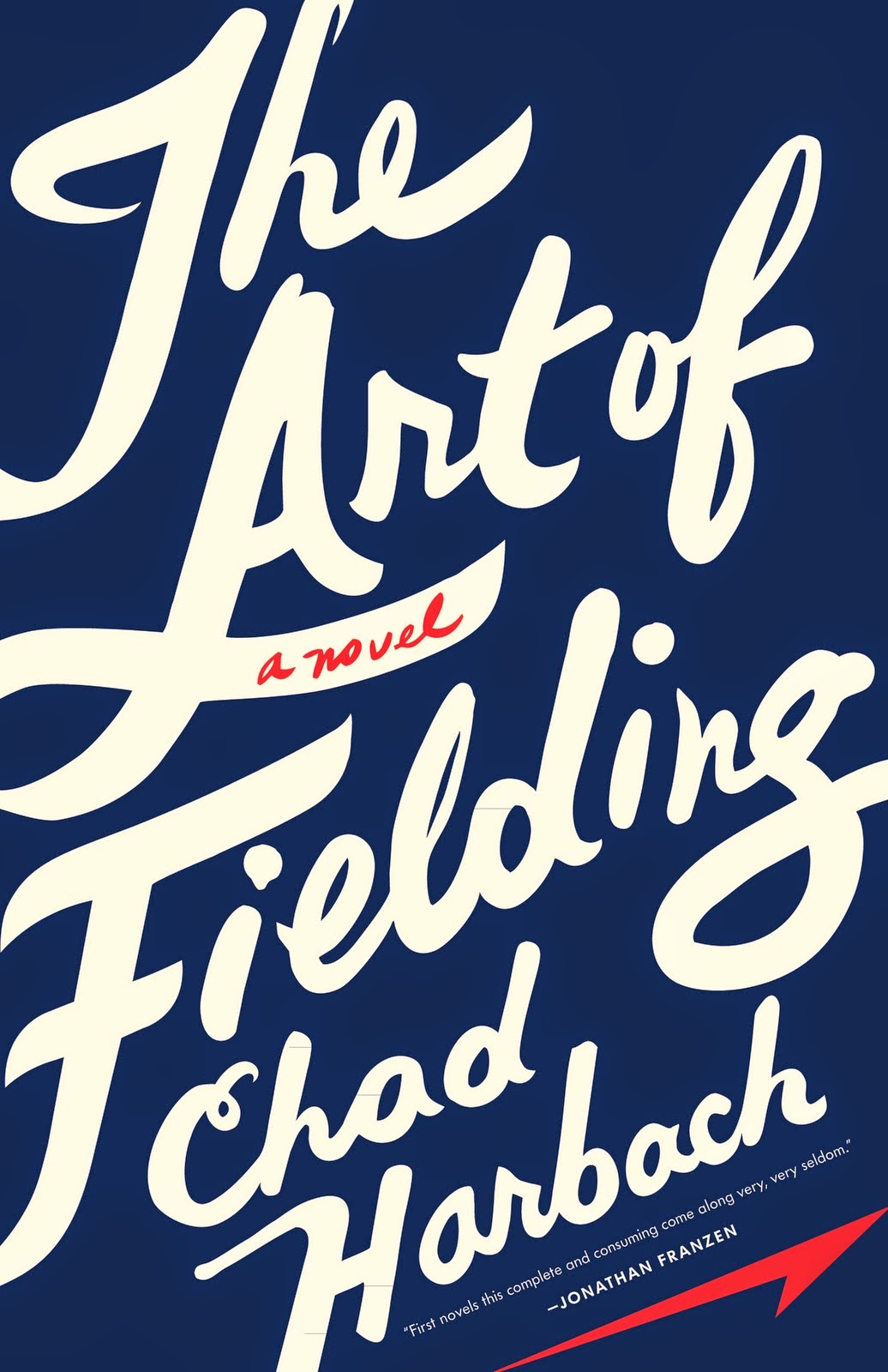
The Art of Fielding - Chad Harbach (2011)


I decided to read The Art of Fielding after it was recommended to me by the same anonymous poster that suggested The Love Affairs of Nathaniel P.  The comments are worth reading, but I will not re-post them in the body of this review.

Did I find this book truly amazing?  It may not surprise you, but, as is often the case: yes and no.  During the first 150-200 pages, I was flirting with adding it to the "best books" list (which can be found here) at the time, but then I foolishly checked what Entertainment Weekly had to say with its nifty letter grade.  They gave it a B+.  They said it was great, totally great--but the characters were a bit undeveloped.  I totally agree--but I would personally give it an A- because it is close to being a great book.

I am wary of spoiling this book by providing deeper detail to my criticisms, but I feel that I must.  Do not read below the asterisks if you don't like spoilers (I do know at least one person that actively seeks out spoilers).

This book is about a lot of things, but it's mainly about baseball.  It's the quintessential campus novel.  There are probably tons of references to Moby Dick, but I can't really be sure since I haven't read it yet.  The different themes in the novel work very well together, and nothing exactly feels out of place.  But after a couple hundred pages it's almost as if Harbach is content to finish the book on auto-pilot.  There are still wonderful, beautifully written passages, and some truly off the wall happenings, but the characters oddly seem less believable at the end than they do at the beginning.  It's almost as if their decisions are random, that Harbach outlined the plot of the novel and forced the characters to do things that feel unnatural.  Again this will be gotten into beneath the asterisks.

It's pretty easy to describe the plot.  Henry Skrimshander is an antisocial baseball nut who has obsessively read The Art of Fielding by Aparicio Rodriguez, a former shortstop for the St. Louis Cardinals who took a very philosophical approach to his profession and nearly became the President of Venezuela.  Henry is "discovered" by Mike Schwartz, who is one year older than him, and catches for the Westish Harpooners.  Mike recruits Henry for the college, and a "beautiful friendship" develops.

Westish is a small liberal arts college in Wisconsin not far off the shores of Lake Michigan.  At first I thought it was going to be a stand-in for Northwestern, but it's probably closer to Beloit College (though that is further from the lake).  The novel contains a series of unlikely events, and it starts with the school: the recruiting for the baseball team is all over the place.  They do find Henry, and a couple other players destined for big league franchises (*cough*cubsandcardinals*cough*), but then they have a bunch of random players that just seem to be on the team because they feel like it.

Obviously this is where I need to start in on Owen, who casually owns a copy of Henry's favorite niche-specific book and doesn't seem to care at all about the coincidence.

But quickly: the novel is not about Henry.  This is one of the more pleasant surprises of The Art of Fielding: it's not content to just sit with one or two characters, and sports a more classic approach to the novel.  There are five main characters, and their stories dovetail with one another up until the final scene.  They are Henry, Mike Schwartz, Owen Dunne, Guert Affenlight (the 60-year-old college president) and Pella Affenlight (his 23-year-old soon-to-be-divorced daughter).  Now I have said above that this is a great book, and that it should make the list of best books reviewed on Flying Houses, but really considering these characters I have to say that only the Affenlights are well-developed characters--and Pella should be qualified by a "barely."

Before we get to the spoilers (and my specific criticisms), I want to reiterate that I do recommend this book and cannot recall reading a better book about baseball.  It appears popular for authors to blurb that, while they don't love baseball, Harbach got them into it.  Baseball is an endlessly mythological game that has unfortunately been overshadowed by flashier athletic competitions in recent years, along with frequently being derided as "boring."  Personally, I have been watching and following baseball since roughly 1991, and I love the recent history that has defined the last couple generations.  Unfortunately again, today the words "baseball" and "steroids" will almost always be found together, and some of the more outlandish accomplishments (*cough*barrybondsrogerclemens*cough*) can't be celebrated like the 1998 home run race.  This is significant for Harbach's focus.  The star player of the Harpooners is not a power hitter, but an Ozzie Smith-esque shortstop whose landmark accomplishment is consecutive error-less games.

Another thing: why isn't Aparicio Rodriguez just called Ozzie Smith instead of being some pretend amalgam of Luis Aparicio and Ozzie Smith?  I understand if Smith hasn't written a book like Aparicio's Art of Fielding, but he played shortstop for the St. Louis Cardinals for his entire career, bolstered by flawless fielding--and I even think there is a reference somewhere to Aparicio performing a full flip on the field, as Smith once famously did.  Then again, there are bigger problems with the book than this.

***

The Art of Fielding has a terrific opening, and is relatively engrossing.  However, it becomes a "novel" when Affenlight betrays his inappropriate gay crush on Owen--and this is not very deep into it, maybe fifty pages or sixty pages.  It really comes out of nowhere and catches the reader off-guard (unless they like spoilers).  And to me, a reader that has gushed about Death in Venice, the references to that work are either eerily coincidental, or intentional.  I prefer to think they are intentional, the most obvious of which is Guert Affenlight's initials mirroring those of Gustav Aschenbach, not to mention their literary pedigrees, deceased wives, and middled-ages.  Even more noteworthy is the way Harbach describes the "silent crush"--until the novel makes its first of several missteps.

I understand, okay.  Unless Affenlight and Owen become an "item," the book lacks a certain profluence.  I don't think that's a problem, though, because there are three other characters that are pushing the action forward.  And I don't think I'm wrong, either, that this relationship is the most engrossing aspect of the novel.  Anyone that wants can come pick on me and say, oh, of course you would think that, but I truly believe that is the case for everyone.  The rest of the characters are pretty ordinary, but these two characters break out of the comfort zone of collective consciousness.

So when they kissed, I was like, okay, this is one-upping Thomas Mann, but it felt like a cop-out.  I personally think this novel would have been way more interesting if no consummation had ever happened.  And if at one moment it seems as if the book will also take a Lolita-like turn, then it is all the more impressive for awakening such references.  This is of course, the scene with Genevieve, Owen's mother, who seems to be overtly flirting with Affenlight, who even suggests that Owen might get turned straight by Pella, who also joins them for an informal dinner party.  This was one of the most memorable scenes in the novel for me, and made me think this could actually make a really entertaining, humorous film, but then again maybe not.

There are nice moments though that I think would be stronger if Affenlight kept constantly trying to think of ways to get Owen's attention, which maybe might not work until page 500 rather than page 200.  I would have liked that ending better than the actual one.  Some nice details emerge before both characters know exactly what is what:

"'Oh, I'm sure you do,' Owen said coyly.  'He was much better-looking than I am  He might even have been better-looking than you.' Owen scratched his chin, his tone evaluative and probably slightly teasing.  Affenlight blanched.  If Owen though Jason was slightly better-looking than Affenlight but much better looking than Owen, then Owen thought that Affenlight was better-looking than Owen.  Which was a compliment.  But to be compared unfavorably to an ex-boyfriend: that was a slight.  But the conditional had been used: might even have been.  It was like an SAT for gay flirting.  Not that gay flirting differed from straight flirting.  But if it didn't differ, why was Affenlight so bad at it? Genevieve had returned and was perusing Affenlight's bookshelves, her back turned, sipping her wine." (185)

I'm trying to find "beautiful" passages, but I can't seem to find them from pure memory.  They're all over the place, though I seem to remember at least a couple taking place during a game.  The sports sequences are well-written, as is the entire novel.  I've already expressed my displeasure to the "consummation" of the relationship above, but it's not that bad of a miscue compared to the relationship between Pella and Mike, then between Pella and Henry.  It feels cliched that Henry would hook up with his teammate/mentor/best friend's girlfriend, as it does when there is much commotion about it in the locker room.  Given the way the novel ends, I think it's unnecessary, except to show Pella as a "nurturer," which I don't really believe anyways.

Pella was married to David who was like ten years older than her and he comes back to visit at one part of the novel that was memorable but seemed sort of anticlimactic in relation to its build-up.  I found Pella the least interesting of the characters--though probably more interesting than Mike.  Mike's story is only notable in that he only applies to six law schools and gets rejected by them all.  It arouses suspicion that he didn't apply to any more realistic options, but I think his thought process is right on the money.  It feels unintentional, but this novel also offers helpful guidance on whether to attend law school.

Eventually, Henry develops an anxiety about throwing the ball:

"'Do you know who Steve Blass is?' Sarah asked.
'Never heard of him,' Henry lied.  Steve Blass was an all-star pitcher on the Pirates in the early 70's.  In the spring of 1973 he suddenly, inexplicably, became unable to throw the ball over the plate.  He struggled for two years to regain his control and then, defeated, retired.
'What about Mackey Sasser?'
'Never heard of him.' Sasser was a catcher for the Mets who'd developed a paralyzing fear of tossing the ball back to the pitcher.  He would double-, triple-, quadruple-, quintuple-pump, unable to believe it was okay to let go.  Opposing fans would loudly, gleefully count the number of pumps.  Opposing players would run around the bases.  Total humiliation.  When it happened to Sasser, they said he had Steve Blass disease.
'Steve Sax?  Chuck Knoblauch?  Mark Wohlers?  Rick Ankiel?'
If Sarah X. Pessel hadn't been a girl, Henry might have socked her in the face.  Her middle name probably didn't even start with X; she probably just liked the way it looked in her byline.  'None of those guys were shortstops,' he said." (215)

I remember Mark Wohlers being one of the great closers of his day, one of the guys who could throw really hard, like high 90's.  Then I remember him pitching against the Cubs one day after being injured for a while and how he could not throw a strike to save his life, and everyone knew it, and the Cubs just stood in the batter's box and waited to get walked.  Two or three runs were walked in before the manager pulled him.  He retired not long after.  I didn't know about the other guys, though.

I think the amount that Henry works out is unrealistic, as is his scene of jumping into Lake Michigan.  It just seems kind of counter-productive--when you work out as hard as he does, I think you enter territory where toning it down yields the same gains.  And then there is the matter of the ending.  I think it's a pretty cliched ending, the way Henry gets to go to the game, and join the team.  The manner in which he helps the team is not cliched in itself, however, so the last scene is good.  It's everything that comes after that stinks.  I mean, part of me is angry that, when asked to interpret a poem ("The Relic") by John Donne, for a British Literature I final exam, I wrote that Donne wanted the reader to go physically dig up his grave to see if he had really been buried in the same coffin as his wife.  I received an F.  So it seems incredible that at least this famous figure might have known where I was coming from:

"'I can't believe Affenlight's your dad,' he mused.  'That guy gives a hell of a speech.'
'I know.'
'He's the reason I came to school here.  Not that I had a lot of options.  But I drove up here for prefrosh weekend, and he gave a speech I'll never forget.  About Emerson.'
Pella nodded.  She knew the Emerson riff by heart, but Mike clearly wanted to tell it, and if that would cheer him up she was willing to listen.
'His first wife died young, of tuberculosis.  Emerson was shattered.  Months later, he went to the cemetery, alone, and dug up her grave.  Opened the coffin and looked inside, at what was left of this woman he loved.  Can you imagine?  It must have been terrible.  Just a terrible thing to do.  But the thing is, Emerson had to do it.  He needed to see for himself.  To understand death.  To make death real.  Your dad said that the need to see for yourself, even  in the most difficult circumstances, was what educa--'
'Ellen was nineteen,' Pella interruped to say.  She hated the namelessness of women in stories, as if they lived and died so that men could have metaphysical insights.  'One of the cures the doctors prescribed for tuberculosis back then was 'jolting.' Which meant going for high-speed carriage rides on deeply rutted roads.  Months, weeks before she died.  Coughing up blood all the way.'" (118)

This probably isn't everything I wanted to say about this book, but I think I've written enough.  You should know by now whether you want to check it out or not.  Just don't blame me if I spoiled it for you.  I warned you!

Saturday, January 25, 2014

Lawyer Boy: A Case Study on Growing Up - Rick Lax (2008)

"Write what you know."

That is the advice most writing teachers give.  Or at least that was the popular wisdom back in the late 90's/early 2000's.  Later on, there was a twist: you should write what you know, but also what you can learn and confidently write about as if you've experienced it yourself.  I do not think I will ever be able to do the latter, and for that reason I may never be a successful novelist--though that does not mean I will ever give up on my dream.  I know I wouldn't be able to write a law school memoir unless I went.

And it is a good idea, at this point in history, to publish a law school memoir.  Because the landscape has changed.  Rick Lax published Lawyer Boy in 2008, probably right around the moment the markets crashed.  Did he graduate in 2008?  I have no idea.  And one of my major complaints about Lawyer Boy is that it's only about the first year.

So it's basically very easy to sum up: One L but at a TTT turned TT set immediately before people started using those acronyms.

It could have been so much better.  As it is, it's pretty good.  It's definitely a page-turner.  But I don't think anybody who didn't go to law school or is planning on going to law school will find it very intriguing.  That is the problem with the law school memoir as a genre.  Still, I think Lax made better use out of his law degree than a lot of disappointed graduates nowadays.  At least it gave him good material for a book.

Then again, there is one non-nitpick critique I can make of this book: it loses steam in its second-half.  Lax seems to rush through the story of the spring semester.  Part of this is understandable: his school was not crazy and probably enrolled 1Ls in 3 credits of Constitutional Law and Contracts both semesters, instead of 5 credits in one semester.  So there's not a lot of new stuff to mention except Torts and Property.

But now we get to the fun part: comparing experiences.  Because it really is sad, how similar every law school is to every other one, regardless of ranking.  It's one of the reasons so many people criticize the proliferation of law schools today--because they are just so easy to plan.  There are too many of them and I have been saying for a couple years now that the ABA should limit the number of new graduates entering the workforce because that is the only way to prevent a highly-indebted unemployed glut of new graduates applying for the same few entry-level jobs that get posted.  The market will fix itself, some believe, and while overall enrollment has dropped, I think it's still way too high.  If it's unfair to close schools, then each should just be forced to reduce the size of their first-year class to a quota.  It might sound like a totalitarian regime, but it would be better for those choosing to enter the profession in the long run (it is really depressing to go through such hell for 3 years, take on a load of debt, jump through dozens of hoops, only to be laughed at because you're useless) and at the very least it would make for an interesting Supreme Court case.  I digress.

Rick Lax went to DePaul Law School.  I almost went there.  Now that I have chosen to live in Chicago, I wish I had gone there.  But I did get in and I could appreciate some of the details.  The book starts out very strong, with Lax describing why he wanted to go to law school in the first place, what it was like to take the LSAT, and what it was like to choose his school:

"I realized that my full-time immaturity shtick would one day inevitably turn from cute and charming to sad and creepy.  I realized that I couldn't live with my parents forever, that I needed a place of my own, and that magic wouldn't pay the bills--the ones I'd presumably have if I had a place of my own.  I realized that I had to go to law school...because it's not like I was going to get a job or anything." (9)

Of course, plenty of people on the internet will laugh at that paragraph as a supreme exercise in irony.  But this was in 2006 (or so).  Lax wanted to go to University of Michigan, which is where he went for undergrad, where his father went, and which was closest to home.  But he couldn't get in.  I could say the same thing about myself and NYU:

"Getting into the University of Michigan's undergraduate program was tough--I'd needed to transfer in.  Getting into their law school, I recognized, would be almost impossible.  The Supreme Court made that much clear in the 2003 case Grutter v. Bollinger.  The case's opinion begins: "The [University of Michigan] Law School ranks among the Nation's top law schools.  It receives more than 3,500 applications each year for a class of around 350 students."  In Grutter, the Supreme Court held that state universities have a compelling interest in obtaining the educational benefits that flow from a diverse student body, and that this interest justifies the use of race as a factor in admissions.  But even without affirmative action, plaintiff Barbara Grutter, who had a 3.8 GPA and 161 LSAT score, probably couldn't get into the University of Michigan Law School today.  In recent years, the average incoming University of Michigan Law School student has had a 3.7 GPA and a 168 LSAT score." (12-13)

Lax got the same score as me: 163 and we didn't get to go to our dream schools.  But this is pretty much where our stories diverge.  He also applied to UNLV, DePaul, University of Chicago, NYU and Columbia.  He got rejected everywhere except for the first two.  And it probably would have been better for him to go to UNLV in the long run since apparently he lives there now (I know this through Twitter and I will post this review @him and hope not to get trolled) and it is probably the best place to make a living as a magician--which is the "hook" of this book.

Because see--if I wanted to write a law school memoir, there wouldn't be a "hook."  It's that extra little something that makes a literary agent think that your book is going to be special or memorable or something.  And some of the magician anecdotes are funny, but sometimes it feels a bit like "padding."  First there's the appendix, which has a couple tricks that I am pretty sure you wouldn't be able to do just from reading it (I think with magic you need an in-person demonstration from someone willing to show the secrets).  Second there are the numerous jokes about how no self-respecting person chooses magic as a profession, which okay, was probably true in 2006, but in 2014 no self-respecting person chooses law as a profession, unless they are sure they're really, really smart and are going to be in the top 10% or going to one of the very best schools.  Sorry--must contain my cynicism.

But the details about DePaul are pretty priceless, and as a resident of Chicago, I can say the book is certainly true to life.  First, there is the t-shirt:

"As expected, the University of Las Vegas accepted me, and even threw in a $9,000 annual scholarship.  DePaul University College of Law in Chicago trumped that with an $18,000-a-year offer, accompanied by a 100 percent cotton XL school T-shirt."

I got the same one with a $20,000-a-year offer, four (?) years later.  So still, we're in the same boat.  However, there is a sad anecdote later on that I have trouble believing:

"On Monday, I wore my complimentary XL DePaul T-shirt to Con Law...as did Dan and two of the other serious students.  I figured we'd all run out of clean clothes at the same time.
'Lookin good, Rick,' said Dan.
'You, too.'  I turned to Nadeeka, who wasn't wearing a shirt, and said, 'It's DePaul T-shirt day.  You didn't get the memo?'
She hadn't.
'Congratulations,' Dan said.
'On what?'
'Your scholarship.  You got the shirt with the scholarship, right?'
The shirt went with the scholarship.  Ah.
'You mean they didn't make you pick between the two?'
At the start of the semester, everybody must have assumed a handful of Section 2 students just happened to buy the same ill-fitting DePaul law school T-shirt.  By the second week of class, most people had figured out what the T-shirts meant.  By that week, wearing the shirt was no longer considered just a fashion misstep; it was considered a statment about the wearer's refusal to hide or apologize for her intellectualism." (82-83)

I think it is just incredible that DePaul would be so callous as to give scholarship students T-shirts, and non-scholarship students nothing.  Perhaps the practice changed after a few years, but it just strikes me as a really cynical (maybe the wrong word?) thing to do.  I got mine, and I liked wearing it to class because it was sort of a message like "fuck you, I hate this place and wish I went to DePaul" but I don't think anybody got it (and truthfully I didn't hate my school--just my first year, and I hate myself for what happened after--I actually have ridiculously fond memories of my second and third years).

Which is why I felt like Lawyer Boy was missing something.  Of course, a lot of people say "1L is all that matters" and sure that's true for jobs--but I felt that the ending of the book was inaccurate.  Lax writes about people getting jobs at big firms as if they're working there the summer after their 1L year.  That's not the way it works!  It's misleading.  Maybe a couple of his friends got to do that, but I know basically no one that worked at firms during their 1L summer.  Then again our school gave out a (fairly generous, at the time) public service grant so maybe most people did that because it was close to a livable wage.  Basically this book ends like 1L is the end of law school and that's just not true--there's two more years of crap, and at least in my experience, the social aspect gets really interesting at that point because people stop spending 90% of their free time studying (maybe 90% is inaccurate but it felt like that for me) and start having social lives.

Still, it was funny to read about how similar our experiences were.  One notable example was this introductory exercise, a welcoming speech from the Dean:

"Head Dean Glen Weissenberger spoke last: 'You've heard a lot about us, the faculty, and you've heard a lot about DePaul, but now I'd like to talk to you about something else: you.  All two hundred and forty of you.  Some of you came here from state college; some of you came here from Harvard.  One of you has a Ph.D. in organic chemistry, another of you has one in materials engineering.  One of you even designed spacecraft parts for Boeing.
'One of you is the president of a gospel choir.  One taught English in Ghana.  One survived testicular cancer.  One lost over one hundred pounds in two years.  One was attached by sharks.  One worked for NATO in Kosovo as a counterintelligence agent with the U.S. Army.
'One of you is a professional magician, and that particularly excites me because I used to be a professional magician, too.'" (52)

Any of my classmates will recognize this ritual.  It is almost as if the law schools feel obligated to perform this tradition--just like the obligation to retain the same first year courses, though some of them (*cough*property) are basically niche areas filled with arcane nonsense.

Weissenberger was later dismissed from the law school in 2009, so apparently Lax used real names.  I'm not so sure about the other professors.  While most of the professors are generally treated quite well in the book, the Legal Writing professor seems like one of the biggest jerks on the planet.  I wouldn't be too surprised if this was an accurate portrait, but I'd be surprised if Lax didn't use a pseudonym.  While Legal Writing assignments are graded anonymously, there is a fair amount of discussion of how the professor knew which assignments Lax had turned in, and so maybe it wouldn't make a difference if Lax used a pseudonym or not: the professor obviously must have known it was written about him/her.  But apparently Devenpeck is a pseudonym.  This is only interesting to me because Turow used pseudonyms for his professors, and as I toy with the idea of writing a law school memoir, I tend to wonder about the "libel" aspect.  I wouldn't write anything bad about any of my professors, but I still feel weird writing about them, period, whether using pseudonyms or not, in a memoir.  But if you don't use pseudonyms, you're pretty much obligated to only say nice things.  Whatever.

The only other aspect I want to mention is that Lax seems to exhibit what a good percentage of my law school classmates also did: complete disregard for fiscal responsibility.  This is mainly due to where he chooses to live, and how his parents are able to pay for it.  Also I don't think he mentions taking out any loans.  So a very important part of the puzzle is also missing for aspiring law students.  This is also why I wish the 2L and 3L years were also included in this book.

One other thing I like about this book is that Lax provides snapshots of some of the cases he studied, and generally he picks out interesting ones (while also including a fairly concise summary of Marbury v. Madison, though I think someone else probably did a better job).

Finally, Justice Scalia is not mentioned until page 206.  At least he gets mentioned.  But any law school memoir in the late 20th or early 21st century has to say something about Scalia.  The thing I like most about him is that most law students hate his philosophy, but still love him because he can be a very witty writer.  Justice Douglas is not mentioned at all, and I will still persist in calling him my favorite.  He may not be the wittiest (though there is usually a humorous sentence or two in each of his opinions), but I still think he's one of the few who lived his life according to his judicial philosophy, and so he is automatically interesting.  

In the end, I can only give a lukewarm recommendation for this book.  I don't want to say "not recommended" because I think it does about as good a job as can be expected, and I shouldn't judge it because I wanted to see it do something differently.  However, I would be curious to know why Lax didn't want to include the 2L and 3L years.  Maybe that is a blessing, because perhaps the law school memoir that is an exhaustive account of the entire thing has yet to be written.  Perhaps I haven't really been looking for it, or just wouldn't want to read it, but I have to believe that a law school memoir published in 2010 or later from a non-T14 student/graduate could be a contender for the Pulitzer Prize due to tragic content.  I pray for all of us--that we make something of our lives, and that they are not cut short by psychosomatic tragedy.

Friday, December 20, 2013

The Big Short - Michael Lewis (2011)


The Big Short is a tough book to review for the same reasons it must have been a tough book to write.  On the one hand it is certainly well-written, brisk, entertaining, informative, and intriguing; on the other it tends to leave the reader in the dust.  It comes out of the gate with enormous energy--and the first 50 pages are about as good as any I've read.  It also ends very strongly (I wanted to write "on a high note" but that wouldn't be accurate, content-wise).  However, for the middle 180 pages or so it tends to run over the same ground with little or no development.  Thus while I highly recommend this book, I do so with reservations, which I hope I can adequately articulate.

First of all, I need to get something off my chest: this book made me depressed.  Okay, you say, the subject matter is depressing so no big surprise there.  And actually it's not that depressing--it's really an incredible success story.  However, I do not recommend this book for recent law school graduates who have mounting debt obligations and feelings of hopelessness with regard to their career prospects.  This book is all about betting against homeowners who signed up for subprime mortgages.  Of course, there is little reason to believe that people will be able to make their loan payments when the interest rate on their loan balloons after two years, but if these people knew what they were getting into, they must have believed that good things were going to come their way--that they would get a big enough raise two years from now to make much higher mortgage payments, or that the value of their home would continue to rise and they could refinance.  Alas, when millions of people are packaged together in an asset-backed security or collateralized debt obligation, the odds are not in their favor.  Such is life for law students, too, and people do not want to be sympathetic to our plight because we should have known better.  It wasn't like there was fine print that we neglected to read because nobody reads that stuff anyways--we were going to be trained to write that fine print.

So yes, the future appears hopeless for many of us, and five years ago, the future appeared hopeless for millions of Americans.  But things are gradually getting better, we're told.  Interest rates are low and home prices are rising and jobs are being created.  Unfortunately they are not getting better fast enough for many of us (law school enrollment rates are way down, finally).

So when you're poor and feeling hopeless, watching your bank account dwindle to the point where homelessness starts to feel inevitable, this is not a good book to be reading.  You can't really laugh along with it.

It's not supposed to be comic, though:

"Writing this book, I bumped up early and often against a new discomfort: the material would not allow me to do what I naturally would like to do with it.  It was as if I'd been asked to play basketball using only my right hand, or write a sonnet using only sight rhymes.  It took me a while to understand the problem: I was accustomed to writing stories that were, at heart, comic.  The story of the investors who made their fortunes from the collapse of the U.S. financial system had lots of funny bits to it, but it was, at heart, a tragedy." (265)

When I first started reading this book--the first ten pages or so--I mistook it for a work of fiction.  I thought maybe it was a roman a clef.  But it is non-fiction.  It is the story of three hedge funds (Frontpoint Partners, Scion Capital, and Cornwall Capital) and the quirky people that started them and made a boatload of money.  The story begins with Steve Eisman, and perhaps disaffected recent law graduates might seek a new path after reading about his:

"Eisman entered finance about the time I exited it.  He'd grown up in New York City, gone to yeshiva schools, graduated from the University of Pennsylvania magna cum laude, and then with honors from Harvard Law School.  In 1991 he was a thirty-year-old corporate lawyer wondering why he ever thought he'd enjoy being a lawyer.  'I hated it,' he says.  'I hated being a lawyer.  My parents worked as brokers at Oppenheimer securities.  They managed to finagle me a job.  It's not pretty but that's what happened.'" (1)

As a side note, since Lewis references himself in the first sentence (as well as during the excellent prologue and epilogue), his background bears mentioning.  I am straight-up jealous of Michael Lewis.  I have not read Liar's Poker, but I have heard it is a very good book, and he mentions a couple times that Ohio State University students read it is a "how-to" manual for making money on Wall Street.  It is apparently about his time working for the infamous Salomon Brothers partnership-turned-corporation in the 1980's.  One presumes he made a boatload of money himself working for that company, and also that he has made a boatload of money off the book, to say nothing of The Blind Side and Moneyball.  Now, apparently Brad Pitt owns the movie rights to The Big Short and I am sure that it will make for a great film that could potentially rival the iconic Wall Street.  In case Brad Pitt is reading this, I would like to ask him for the chance to audition for a small part in the movie because I think I have undiscovered acting talent.  I think I would like to play Charlie Leadley but maybe that is reserved for an A-lister.  But I see I am getting ahead of myself.

Steve Eisman started Frontpoint Partners.  There is a very interesting episode that takes place in 2002 involving Household Finance--a kind of prelude to the subprime lending boom.  He is also really into comic books, Spiderman in particular.  There is also a nice point about his political persuasion:

"In his youth, Eisman had been a strident Republican.  He joined right-wing organizations, voted for Reagan twice, and even loved Robert Bork.  It wasn't until he got to Wall Street, oddly, that his politics drifted left.  He attributed his first baby steps back to the middle of the political spectrum to the end of the cold war.  'I wasn't as right-wing because there wasn't as much to be right-wing about.' By the time Household's CEO, Bill Aldinger, collected his $100 million, Eisman was on his way to becoming the financial market's first socialist.  'When you're a conservative Republican, you never think people are making money by ripping other people off,' he said.  His mind was now fully open to the possibility.  'I now realized there was an entire industry, called consumer finance, that basically existed to rip people off.'" (20)

After Eisman is introduced, Michael Burry follows.  Burry started Scion Capital.  While Eisman is certainly quirky, Burry takes it to another level.  First, he only has one eye.  Second, instead of law school he went to medical school:

"Investing was something you had to learn how to do on your own, in your own peculiar way.  Burry had no real money to invest, but he nevertheless dragged his obsession along with him through high school, college, and medical school.  He'd reached Stanford Hospital without ever taking a class in finance or accounting, let alone working for any Wall Street firm.  He had maybe $40,000 in cash, against $145,000 in student loans.  He had spent the previous four years working medical student hours.  Nevertheless, he had found time to make himself a financial expert of sorts." (36)

What is interesting about Eisman and Burry is that they appear to disprove the Efficient Capital Markets Hypothesis, which basically states that you cannot "game" the stock market, because everyone else has the same information as you (the exception being insider trading).  I'm sure not just anyone can do what they did, but it is nice to see an "outlier" make good when the consensus says otherwise:

"Right from the start, Scion Capital was madly, almost comically, successful.  By the middle of 2005, over a period in which the broad stock market index had fallen by 6.84 percent, Burry's fund was up 242 percent and he was turning away investors.  To his swelling audience, it didn't seem to matter whether the stock market rose or fell; Mike Burry found places to invest money shrewdly.  He used no leverage and avoided shorting stocks.  He was doing nothing more promising than buying common stocks and nothing more complicated than sitting in a room reading financial statements.  For roughly $100 a year he became a subscriber to 10-K Wizard.  Scion Capital's decision-making apparatus consisted of one guy in a room, with the door closed and the shades drawn, poring over publicly available information and date on 10-K Wizard.  He went looking for court rulings, deal completions, or government regulatory changes--anything that might change the value of a company." (44-45)

Burry is also diagnosed with Asperger's Syndrome later in the story, and while Asperger's may be a difficult thing to live with, it seems like everyone who is a genius has Asperger's.  So maybe it is not the worst diagnosis to get.

Finally, the story features Jamie Mai and Charlie Leadley, who started Cornwall Capital:

"Jamie Mai was tall and strikingly handsome and so, almost by definition, had the air of a man in charge--until he opened his mouth and betrayed his lack of confidence in everything from tomorrow's sunrise to the future of the human race.  Jamie had a habit of stopping himself midsentence and stammering--'uh, uh, uh'--as if he was somehow unsettled by his own thought.  Charlie Leadley was even worse: He had the pallor of a mortician and the manner of a man bent on putting off, for as long as possible, definite action.  Asked a simple question, he'd stare mutely into space, nodding and blinking like an actor who has forgotten his lines, so that when he finally opened his mouth the sound that emerged caused you to jolt in your chair.  It speaks!" (108-109)

Basically, the human side of the story is told very well by Lewis, but again, most of the middle of this book seems to get repetitive.

You could sum up the middle of the book with one phrase: basically nobody knows what's in a CDO!

And that is my major complaint about this book.  It's very hard to write an interesting story about these ridiculously arcane financial instruments.  Lewis does the best job he can--and at times, he can be rather lucid:

"A couple years earlier, he'd [Burry] discovered credit default swaps.  A credit default swap was confusing mainly because it wasn't really a swap at all.  It was an insurance policy, typically on a corporate bond, with semiannual premium payments and a fixed term.  For instance, you might pay $200,000 a year to buy a ten-year credit default swap on $100 million in General Electric bonds.  The most you could lose was $2 million: $200,000 a year for ten years.  The most you could make was $100 million, if General Electric defaulted on its debt any time in the next ten years and bondholders recovered nothing.  It was a zero-sum bet: If you made $100 million, the guy who had sold you the credit default swap lost $100 million.  It was also an asymmetric bet, like laying down money on a number in roulette.  The most you could lose were the chips you put on the table; but if your number came up you made thirty, forty, even fifty times your money.  'Credit default swaps remedied the problem of open-ended risk for me,' said Burry.  'If I bought a credit default swap, my downside was defined and certain, and the upside was many multiples of it.'" (29)

However, after the instrument in question has been defined once, Lewis expects the reader to be fluent in what it means.  Of course it would be annoying and pedantic to keep reminding the reader what he was talking about, so it is a hard balance to strike.  Still, at a certain point in the middle, it almost seems as if he throws up his hands in the air and says, "No one knows what it means anyways!"

I am particularly sensitive to this problem because I had the same issue when I took a Corporate Finance course in law school.  True, I felt I learned a lot in it--but it was also my worst grade in law school (tied with two others).  I still don't really understand how "selling short" works, but I think it has something to do with options--calls and puts.

These instruments are complex, and part of the problem with Wall Street is the "doubletalk"--the hope that retail investors won't really understand what brokers are talking about, so they'll either stay away or invest blindly.  I personally don't have any money to invest.  I'd like to do it, but it seems very intimidating for this simple fact.

There are some nice moments in the middle.  For example, the chapter that details a subprime bond market convention in Las Vegas is particularly entertaining (and will probably make for the best sequence in the film).  But my criticisms stand.

Would it have been possible for Lewis to write a better book?  Maybe, but I can't say for sure.  You can get kind of lost in the characters (apart from the three principal hedge funds) and the financial lingo.  But if you really want to learn about this industry, and you take the time to read very slowly, you will probably get a lot out of it.  If you want to breeze through it, I think you will find it reasonably entertaining but it will all start to seem like a blur.

That's what I did.  I read the first 50 pages very slowly, and then read pretty quickly through the rest (though it took me a long time--almost two months--mainly because my life is pretty much a huge mess right now).  So maybe that colors my interpretation of the text.  And again, the recent law school graduate depression thing certainly affected my enjoyment.  If I had disposable income, I would probably like this book a lot more.

One other thing I found hilarious: Michael Lewis is married to Tabitha Soren.  I had completely forgotten about her until I saw the "take back MTV" episode in Portlandia and find it awesome that the house where Fred and Carrie went to recruit Tabitha was the house where Lewis lived.  All I have to say is that I still want to be a rich and famous author after reading this book.


Tuesday, September 24, 2013

God Bless You, Mr. Rosewater - Kurt Vonnegut, Jr. (1965)


I first read God Bless You, Dr. Rosewater when I was a junior or senior in high school, on the recommendation of a classmate.  I have not read it since.  I do not know why that classmate felt the need to recommend it so strongly, but perhaps it was because we both had something in common with Eliot Rosewater:

"Eliot had unremarkable academic careers at Loomis and Harvard.  He became an expert sailor during summers in Cotuit, on Cape Cod, and an intermediate skier during winter vacations in Switzerland." (15)

This could hardly be the reason, but the fact remains that I have never read another book whose main character went to the same high school as me.  And that high school should have been proud to put this book on its English course syllabuses--or at least assign it for summer reading for incoming freshman students rather than Clan of the Cave Bear.  Because this book has a very positive message, and is much more fun to read.  I'm afraid, however, that it might be considered "too racy" or "adult" even though it is comparatively tame.

But the book was worth reading in 2000 and it is worth reading today.  Oddly enough, I could appreciate it more after going through law school:

"No one ever went out to lunch with Mushari.  He took nourishment alone in cheap cafeterias, and plotted the violent overthrow of the Rosewater Foundation.  He knew no Rosewaters.  What engaged his emotions was the fact that the Rosewater fortune was the largest single money package represented by McAllister, Robjent, Reed and McGee.  He recalled what his favorite professor, Leonard Leech, once told him about getting ahead in law.  Leech said that, just as a good airplane pilot should always be looking for places to land, so should a lawyer be looking for situations where large amounts of money were about to change hands." (4)

This is how the novel opens up: Norman Mushari is a young attorney straight out of Cornell Law School working for a firm that represents an $87 million foundation headed by Eliot Rosewater.  Eliot also went to Harvard Law School but he does not work for anybody.  He oversees the foundation.  His father is a senator, representing Indiana.  Mushari hopes to have Eliot adjudged insane so that he may be removed as an officer of the foundation and that control may pass to Eliot's second cousin, Fred Rosewater.

The action of the book moves to Rosewater, Indiana.  Eliot's ancestors founded the town, and he returns to set up new headquarters for the foundation.  This part of the book details the breakdown of his marriage to Sylvia and the business that he carries out.  He has a black phone and a red phone.  The red phone is for the fire department, where he is a volunteer, and the black phone is for the foundation.  The foundation essentially takes phone calls from anybody that is having any kind of problem.  Eliot is a sort of therapist and philanthropist to everyone in town.  The people of the town are often referred to as idiots.

In my review of Slapstick, I said that book bears a passing resemblance to this book (though Vonnegut self-graded that novel a "D" and gave this one an "A") and that a theme of that book was "extended families."  God Bless You, Dr. Rosewater is a better book largely because its plot is not nearly as unbelievable.  Yes, the plot is sort of ridiculous, but it is not altogether implausible that a person could be impossibly rich and feel that they don't deserve the money and thus go out of their way to help people less fortunate than themselves.  It is a rather heartwarming conceit, and while I might label most of Vonnegut's novels "heartwarming," this might be his "most heartwarming novel."  Eliot Rosewater is also one of the best characters he created.  Rosewater shows up in a few of his other books, though not nearly as often as Kilgore Trout, who also makes an appearance in this novel.  

There is also some clever commentary on obscenity.  The Supreme Court was still trying to define obscenity in 1965, but Vonnegut offers his own parallel reality:

"The Rosewater Law was what the Senator thought of as his legislative masterpiece.  It made the publication or possession of obscene materials a Federal offense, carrying penalties up to fifty thousand dollars and ten years in prison, without hope of parole.  It was a masterpiece because it actually defined obscenity.
Obscenity, it said, is any picture or phonograph record or any written matter calling attention to reproductive organs, bodily discharges, or bodily hair.
'This psychoanalyst,' the Senator complained, 'wanted to know about my childhood.  He wanted to go into my feelings about bodily hair.' The Senator shuddered.  'I asked him to kindly get off the subject, that my revulsions were shared, so far as I knew, by all decent men.'  He pointed to McAllister, simply wanting to point at someone, anyone.  'There's your key to pornography.  Other people say, "Oh, how can you recognize it, how can you tell it from art and all that?" I've written the key into law!  The difference between pornography and art is bodily hair!'" (95-96)

The plot may be described as thus: Eliot gives advice to people who want to kill themselves in Indiana.  This is the heart of the book and as such I don't want to spoil these scenes.  But there is another segment to the book: the Rhode Island part.  The action switches to Pisquontuit, Rhode Island, where Fred Rosewater, the son of a suicide, sells life insurance and is generally sad about his life.  This is a rather strange part of the novel, though I could not quite call it a misstep.  It just seems to get into a lot of detail about all the people in Pisquontuit, while Fred mainly exists as Eliot's potential replacement.  Mushari is the villain of the novel (though sometimes Senator Rosewater seems like a villain, too) but the book is not about the plot.  It's about how society reacts to a modern-day "saint"--is he a lunatic or is he the sanest man in America?

Like any Vonnegut novel, however, this is pretty light reading, and mostly fun for the humor of it.  But it is still just as relevant in 2013 as it was in 1965:

"'Well--' and Trout rubbed his hands, watched the rubbing, 'what you did in Rosewater County was far from insane.  It was quite possibly the most important social experiment of our time, for it dealt on a very small scale with a problem whose queasy horrors will eventually be made world-wide by the sophistication of machines.  The problem is this: How to love people who have no use?
'In time, almost all men and women will become worthless as producers of goods, food, services, and more machines, as sources of practical ideas in the areas of economics, engineering, and probably medicine, too.  So--if we can't find reasons and methods for treasuring human beings because they are human beings, then we might as well, as has so often been suggested, rub them out.'" (264-265)

In short, more people could stand to be like Eliot Rosewater.  If they did so, the world will be a better place.  This is why whenever I receive a phone call from some random person who managed to get my number in some strange way (like, for example, an extraordinary voicemail greeting I left on a phone at the City of Chicago Department of Law in the summer of 2012 that laid out every possible way to contact me) that I listen to them and try to help them as best as I can, rather than saying, "I'm sorry, there is nothing I can do for you."  There is much that can be learned from this book, and even if you didn't go to Loomis, I think you will find it highly worthwhile.

Tuesday, August 20, 2013

A People’s History of the Supreme Court – Peter Irons (2006)


A People’s History of the Supreme Court is modeled after Howard Zinn’s A People’s History of the United States, a book I have not read but have often seen in the bookshelves of friends.  As such this review may be lacking.  It would be interesting to compare the books to one another and see which is more “readable.”  This book clocks in at 531 pages and covers the period between 1787 and 2006.  It mentions every single Supreme Court Justice, but it is less about the personnel of the Court than the cases brought before it.  There are glimmers of greatness in this book, but I must confess that it eventually began to bog me down.  This may be attributed to the fact that I have previously read and reviewed The Brethren, Wild Bill, and The Nine—three books which mine similar territory to this book’s final 130 pages.  Regardless, the first 400 pages were often more interesting than not, and Irons has created a largely admirable work. 

But first, I cannot resist tying in a personal connection.  Few readers of Flying Houses have been with us from the beginning (those inauspicious days of April through July of 2008), but it is worth noting that Irons’s literary agent was the subject of an early post.  “Finally, let me thank some of the people who helped make this book come to life.  My agent, Sandy Dijkstra, found my editor, Jane von Mehren, whose meticulous and thoughtful editing has improved the book immeasurably.” (xix) Now, there are not all that many literary agents.  There are the heavy hitters, and they keep large rosters of writers.  However, I found this mention quite ironic.  Ms. Dijkstra was the only agent to respond to my query on my first novel.  She rejected it, and I attacked her in the post linked to above, which mentioned her derision for the original title of The Joy Luck Club

First, let me note that I am not the same person I was in 2008.  Many changes have taken place and I would probably not be so critical of Ms. Dijkstra as I was in those impetuous days of my mid-20’s.  Second, let me note that my complaints have not abated, and that the publishing industry continues to irk me to no end.  I went to law school in a time of economic turmoil, and I felt that getting a job with a law degree would be easier than getting a first novel published.  My dreams remain intact, however, and soon it will be time to test those waters again.

With that out of the way, Irons opens up his book by explaining that he was an ex-con admitted to Harvard in his mid-thirties.  He went to jail, “serving a three-year sentence for refusing military induction in 1963.” (xvii)  He also was instrumental in reopening the wartime internment cases of Fred Korematsu, Min Yasui, and Gordon Hirabayashi.  In short, Irons mentions these facts in the introduction to the book as a way of setting up the reader’s expectations.  Yes, he is probably going to be taking a “liberal” stance on the cases to be discussed. 

This does not make the book any less valuable, however, because Irons is a very good researcher.  The book opens with what is probably its strongest point of coverage: the Constitutional Convention in Philadelphia, PA in 1787.  For the first 75 pages or so, Irons brings the real “framers” to life and makes it feasible for 21st century readers to understand them and maybe even identify with them.  This part of the book is truly special because there have been numerous debates about the “original intent of the framers” and how to decide cases from a “textualist” perspective.  Irons delves deeply into this material—but not so deeply as to make it a bore.  I have to believe that many Americans would find this portion of the book to be a “page turner,” even though it makes virtually no mention of the English court system or how the American court system would differ.  He does offer up a real stinger to the pro-gun lobby:

“In recent years, advocates on both sides of the ‘gun control’ issue have debated the ‘original intent’ of those who framed the Second Amendment.  Elbridge Gerry, Madison’s adversary in both Philadelphia and New York, offered this defense of the proposed amendment: ‘What, sir, is the use of a militia?  It is to prevent the establishment of a standing army, the bane of liberty.’  Arming the citizens who belonged to state militias, Gerry argued, would deter Congress from establishing a federal army that might oppress or invade the states.  Those who now advocate the constitutional ‘right’ of every citizen to ‘bear arms’ of any kind—from cheap handguns to assault rifles—are well advised to read the debates that led to adoption of the Second Amendment.  Not a single member countered Gerry’s argument that the ‘right to bear arms’ was limited to members of a state militia.  The current opponents of gun control legislation pay little heed to the Framer who spoke most clearly to the ‘intent’ of Congress on this controversial issue.” (75)  

From there, he moves into a discussion of George Washington’s first appointments to the Supreme Court.  This may well be the most hilarious portion of the text.  It is understandable that the Court seems “bush league” because it was in its infancy.  They barely have any work to do at first, and many of the Justices simply failed to show up for work.  Nobody really seemed to care, though.  The Supreme Court was in New York City in those early days.  It is worth noting that Irons writes with an eye towards entertaining “lay readers” (i.e. those that have not studied the primary materials themselves) and at times he writes with literary flair:

“The men Washington placed on the Court, in contrast [to Franklin Roosevelt], were a thoroughly undistinguished lot.  One spent time in debtors’ prisons for defaulting on loans; one returned his commission after five days to serve in state office; one never attended a single Court session; one was impeached for political bias on the bench; one was insane; and another was senile.” (86)

Things changed in 1801 when John Marshall took the post of Chief Justice.  Irons mentions that there are more than twenty books about Marshall and practically everything is praiseworthy.  Irons is careful, however, and keeps a critical eye on the Justices, primarily in regards to their views on slavery.  He is very tough on Marshall’s successor, Roger Brooke Taney, whom he denounces as a “racist” perhaps a dozen times, but he is more even-handed with Marshall:

“For almost two centuries, praise for Marshall as a judicial statesman has far outweighed criticism of his role as Chief Justice.  But the historical scale requires some balance.  Marshall was plain and humble in person, yet he was an aristocrat in outlook.  He came from a state [Virginia] that vigorously insisted on its ‘sovereign’ rights within the Union, but he favored the ‘General Government’ in almost every case he decided.  He read the Constitution broadly to protect the rights of property, but narrowly when he addressed individual rights.  Most important, Marshall disregarded his ‘feelings of humanity’ and looked at blacks as property, not as persons.  This last weight on the historical scale strips the mantle of ‘statesman’ from Marshall’s shoulders.” (141)

At this point it seems prudent to consider the usefulness of this book to law students.  There is probably no better book for incoming 1Ls to law school than this, for it covers almost every single case that will be encountered in any course on Constitutional Law.  This is what makes the book largely admirable.  While The Nine may be a more intriguing read because it covers events that most of us are not too young to remember, this book explains the foundations of the major doctrines of Constitutional Law—it is thorough on First Amendment cases and the Equal Protection Clause; it mentions substantive due process in passing; it covers the early Commerce Clause cases in fair detail (but unfortunately fails to mention Wickard, Lopez, Morrison, or Raich); it covers the “laissez-faire” period of the Court and the Lochner decision quite well; and it draws useful distinctions on the voting of certain Justices on the value of precedent and deference to the legislature against judicial “activism” and “voting from the gut.” And the Table of Contents will be useful for law students that wish to gain a more “human” grasp on what is actually being said in the opinions they are studying, for it includes all the cases mentioned.

The coverage of the major Marshall Court decisions is phenomenal.  Marbury v. Madison and Martin v. Hunter’s Lessee are brought to life, and Irons thankfully explains Marshall’s personal role in each, which some professors may mention but may just confuse law students, for the facts behind each case are so bizarre.

His coverage on Chief Justice Taney’s reign is focused squarely on the Dred Scott decision.  I had no idea how complicated the facts behind this case were, but while Irons explains that details on it are sketchy, he does an excellent job of telling the story of how Dred Scott came to bring his case before the Supreme Court.  This is a very long section of the book and probably has the most detailed analysis of any single decision.  This case is not a major point of study in law school, but it is interesting reading. 

He also covers the case Ex parte Milligan in good enough detail that it will prove helpful for law students.  This is a case that is studied more often, and it is these early cases (up through the Slaughterhouse Cases) that make for the most difficult reading in a law school course and accordingly prove to be the most valuable portions of the book.  But what comes across most clearly is Irons’s distaste for Taney:

“Lincoln correctly charged Taney with trying to ‘nationalize slavery’ by his twisted and tortured reading of the Constitution in Dred Scott.  That his opinion was ultimately reversed by constitutional amendment is no consolation to the hundreds of thousands of young men who died after the Supreme Court shot holes through the Constitution.  It is fitting to speak ill of the dead when they committed acts of infamy.  Taney wrote an infamous opinion in Dred Scott, and no later judgments of his judicial ‘greatness’ can remove that stain from the Court’s history.” (184)

Irons also does his best to define what “partisanship” meant in the 19th century, but I must confess that I still find what the parties stood for to be confusing:

“(The change in party labels requires a brief digression to avoid confusion.  The Federalists changed their name to the Whig Party between 1836 and 1856, when they became the second Republican Party, adopting the name of their former opponents.  The Jeffersonians who first called themselves Republicans abandoned that name in 1828—after using the hybrid title of Democratic-Republican for several years—to become the Democrats.  If this sounds confusing, it is.  But the nineteenth century saw a proliferation of party labels, including Free-Soil, Liberty, Union, American, and Anti-Mason.)” (122)

The next major point the book takes on is Plessy v. Ferguson.  This will be more useful than the coverage on the Dred Scott case because it is arguably more infamous for its precedential value.  (Irons also covers the Yick Wo v. Hopkins case and explains its facts quite well.) While the story of Homer Plessy is not quite as entertaining as that of Dred Scott, it is interesting to know that he could “pass” as a white man and that he actually wanted to get arrested so that he could challenge the separate accommodations for whites and blacks at the time.  Here, Justice John Marshall Harlan is the only dissenter in the case, and he emerges as one of the more noteworthy Justices and not just because his grandson would take up the post 44 years after he retired.  Again, Irons turns a critical eye on an apparently “liberal” justice that is worthy of praise:

“The notion of a ‘color-blind’ Constitution has enormous appeal as a guiding principle.  But there are dangers in substituting slogans for hard, realistic analysis.  Harlan’s famous sentence [‘Our Constitution is color-blind, and neither knows nor tolerates classes among citizens.’] has been ripped from its context by those—including Supreme Court justices—who have wielded it in recent years as a weapon against affirmative action and other ‘race-conscious’ remedial laws and programs.  Those who quote the ‘color-blind’ sentence invariably fail to quote the sentences that preceded it in Harlan’s opinion.  ‘The white race deems itself to be the dominant race in this country,’ he wrote.  ‘And so it is, in prestige, in achievements, in education, in wealth and in power.  So, I doubt not, it will continue to be for all time, if it remains true to its great heritage and holds fast to the principles of constitutional liberty.’
Harlan stated in these sentences the reality of race in 1896.  Whites held the reins of power, which they used to whip blacks into submission.  Harlan does not deserve scorn for acknowledging this reality, however much it reflected the ‘pride of race’ that he celebrated.  He had no more desire for ‘social equality’ with blacks than Justice Brown.  He was, after all, a man of his times, the son of slave owners and a man of superior prestige, education, wealth, and power.  But he was not a racist like Chief Justice Taney.” (230-231)

Irons makes a similar point about Abraham Lincoln, quoting from a speech where he says that he is not for social equality with blacks, though he is definitely against slavery.  This is surprising and some of these glimpses into the realities of the times are another factor that make this book worth reading. 
However, around this point, Irons switches his focus to the First Amendment, and Oliver Wendell Holmes, Jr. and the Schenk case in 1917.  He focuses on the “incitement” cases during World War I in First Amendment jurisprudence for quite a while, perhaps because of his own skirmishes with the law in the 1960s.  While this coverage is good, it is at this point that the Court’s decisions began to speak more for themselves than coverage on them.  There is quality coverage on Holmes as one of the greatest Justices in history, and also Louis Brandeis.  But, at least in my course in the First Amendment, our professor covered these cases in such fine detail that Irons’s descriptions amounted to little more than a nostalgia trip. 

He does cover the New Deal cases in excellent detail—the Schecter Poultry v. United States, West Coast Hotel v. Parrish, and National Labor Relations Board v. Jones & Laughlin Steel Company cases are quite important in defining the contours of the Commerce Clause, and law students are likely to find Irons’s emphasis of the importance of these decisions useful.  But it is also at this point that I began to lose interest in the book and “went through the motions.”  Of course, I was excited for the year 1939:

“Born in Minnesota in 1898 and raised in Washington state, William O. Douglas went east as a young man to Columbia Law School, where he taught after graduating at the top of his class [Not exactly—see Wild Bill review].  He moved to Yale’s law faculty in 1928, joining the ‘legal realists’ who looked behind judicial doctrine to explore the social, political, and economic forces that shaped the law.  Douglas staked a claim in the growing field of public and corporate finance, and Roosevelt picked the young professor to head the Securities and Exchange Commission.  Word got around that Douglas was a card shark, and he soon became one of the president’s ‘poker buddies’ and a New Deal insider.  Ironically, the only four senators who voted against his confirmation opposed Douglas as a ‘reactionary tool of Wall Street.’
William Douglas joined the Court at forty, the youngest justice since Joseph Story.  He stayed for thirty-six years, the longest tenure of any justice.  Douglas came to the bench without a well-defined judicial philosophy, and left as he came.  Much like the woodsman he was, Douglas avoided the beaten path and blazed his own trail.  Raised in poverty and struck by polio as a child, he developed a visceral sympathy for society’s ‘outcasts,’ including Communists and criminals.  He shared Frankfurter’s expansive view of due process and Black’s ‘absolutist’ devotion to the Bill of Rights.  Douglas was often criticized for failing to articulate a coherent judicial philosophy.  Certainly he never followed the narrow—but divergent—path from which Frankfurter and Black rarely strayed.  But there was an animating principle behind the twelve hundred opinions Douglas wrote over more than three decades.  ‘Our starting point has always been the individual, not the state,’ he wrote in 1958.  However far he wandered from the beaten path, Douglas never lost sight of his judicial lodestar.” (328-329)

So I really cannot complain about the coverage of Douglas, except that it is short and mentions nothing about his personal life.  There is also a nice quote about Justice Brennan:

“Perhaps the warmest tribute came from a former law clerk, Richard Posner, now a notably conservative federal judge.  Justice Brennan’s lasting influence, Posner wrote, stemmed less from his ‘commitment to a doctrine’ than from ‘the emanation of a warm, generous, and good-hearted person.’” (474)

There is not much else I can say about this book.  I think I have made my points relatively clear.  There are better books to read about the Court in the 20th Century, but I have not read anything as compelling as this on the 18th and 19th century Court (though I have not been very interested in reading anything about it also).  Irons chief focus seems to be racism and later on, affirmative action programs, sprinkled in with the two major gay rights cases in 1986 and 2003.  He ends in 2006, largely focusing on the Guantanamo Bay cases, and barely mentioning Chief Justice Roberts and Justice Alito.  As I mentioned in the review for How Judges Think, this book may be due for a revision.  It is unfortunate that Irons does not mention Buckley v. Valeo, but any description of the Court that includes 2010 will include Citizens United and any mention of that case requires reference to Buckley.  This book was already revised once, however, and it is unclear that much could be added, though the opinions handed down by the Court this past summer certainly fall in line with Irons’s predictions regarding the path of gay rights.  Jeffrey Toobin did an excellent job on Citizens United and the Affordable Care Act Cases in The Oath so there is at least good reading material out there.  Irons work as a scholar of the “ancient history” of the Court is what makes this book most special, and though I have not read Zinn’s famous volume, I am sure this stands up alongside it fairly well.