Showing posts with label The Stranger. Show all posts

Friday, June 5, 2015

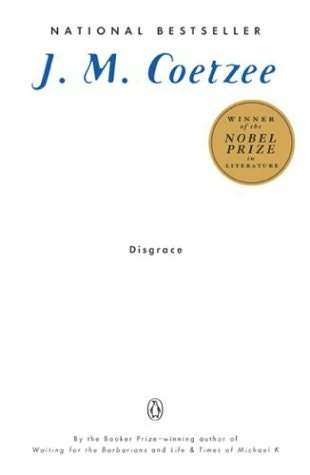
Disgrace - J.M. Coetzee (1999)


Oeuvre rule: the only other book I have read by J.M. Coetzee is Foe.  Foe is not generally referenced as one of Coetzee's major works--those would probably include The Life and Times of Michael K., Disgrace, and perhaps Waiting for the Barbarians--but I read it in 2003 for a class taken at the University of Paris - Nanterre, on pluralist readings of texts inspired by Freud, Marx and Derrida.  Coetzee won the Nobel Prize in Literature on October 2, 2003, but I do not recall our French professor (who taught in English) mentioning that fact.  Foe is basically the story of Robinson Crusoe, told from the perspective of a woman, whose name is Susan Barton.  Ironically, about three years after reading on this, I would work on a house that was owned by a woman named Susan Barton, but I never mentioned the coincidence to her (nor did I have the chance to tell another homeowner named Thomas Mann that I loved his work).  Essentially, Susan Barton is shipwrecked and marooned on an island with a native, Friday, who becomes her manservant.  But she survives and is rescued and returns to England, where she meets and copulates with Daniel DeFoe, inspiring the novel.  We read it and attached Freudian symbols to everything in the text.  It was a reasonably entertaining novel, but in hindsight it appears to me as extremely allegorical, like there is a second layer to it and the plot is ultimately secondary.  Disgrace is similar in this respect, but since I do not have the advantage of reading it in the classroom, the symbols and metaphors that may be present were not apparent to me.  Even without this potentially deeper significance, it was an enjoyable read and I recommend it to everyone, particularly those that enjoy The Stranger by Camus.

Basically, while the plot is not exactly the same as The Stranger, the whole style and tone of the novel renders it a spiritual sequel to that classic.  It seems like it's easy to spoil this book, but I think most will agree that the plot can be spoiled up to a point.

Professor David Lurie teaches at a university in Johannesburg, South Africa.  He is twice-divorced, and as the novel opens, he is detailing his trysts with a prostitute.  Soon thereafter, he becomes smitten with a student in one of his classes (Melani) and they enter into a sexual relationship, though he is more than 30 years her senior.  It falls apart after a short time, and almost immediately he is reported to the university.  He is given the chance to repent for his actions and take a leave of absence, but instead he chooses to resign permanently.  He then goes to visit his daughter (Lucy) in the countryside.  His daughter sells crops at a sort of farmer's market on Saturdays, and cares for dogs at a kennel on her property.  She sometimes volunteers at an animal welfare hospital, which is where her friend Bev Shaw works.  Bev Shaw is a sort of unlicensed veterinarian who euthanizes most of the sick or unwanted animals in the area.  Care and compassion for animals is one of the major themes of Disgrace, and it seems like this theme operates on a deeper metaphorical level, though in actuality it may just be a message unto itself.  Coetzee has recently spoken out on animal rights and it is not surprising given how heart-wrenching many of these scenes are.

Not long after he arrives to stay with his daughter, there is an incident.  I will not spoil what happens, but the incident itself is quite reminiscent of The Stranger.  What happens afterwards is not.  I believe this story is meant to symbolize the transitional period after apartheid in South Africa in the early 1990's, but I am not enough of a student of history to remark more specifically upon it.

Apart from the potential allegory, the novel itself is enjoyable and something of a page-turner.  It reads very quickly and is quite short at 220 pages.  The prose is very matter-of-fact, though because David Lurie is an academic that has studied the art of poetry, there are several "deeper" moments.  Lurie is obsessed with Lord Byron, and hopes to write an opera about a certain affair from the poet's life.  To a certain extent, I've never understood poetry, and the English courses I've taken have never properly instilled an appreciation for it.  I've written in the past about my problems with interpreting Donne, so some of Lurie's "mini-lectures" were illuminating:

"Look at line 599.  Wordsworth is writing about the limits of sense-perception.  It is a theme we have touched on before.  As the sense-organs reach the limit of their powers, their light begins to go out.  Yet at the moment of expiry that light leaps up one last time like a candle-flame, giving us a glimpse of the invisible.  The passage is difficult; perhaps it even contradicts the Mont Blanc moment.  Nevertheless, Wordsworth seems to be feeling his way toward a balance: not the pure idea, wreathed in clouds, nor the visual image burned on the retina, overwhelming and disappointing us with its matter-of-fact clarity, but the sense-image, kept as fleeting as possible, as a means toward stirring or activating the idea that lies buried more deeply in the soul of memory." (22)

Because this novel feels shorter than 220 pages, and restricts itself to such limited subject matter, there is not much else I can say.  I was going to excerpt a passage where David tells the story of a next door neighbor's dog (in the town of Kenilworth--presumably not the one outside of Chicago) who relentlessly humped every "bitch" he saw, and was beaten for it by his owners.  David says that a dog will accept the justice of a beating for having chewed on a slipper, but no animal will accept the justice of being punished for following its instincts.  The dog grows to hate itself, and David reflects that it would probably have preferred to be shot rather than "fixed."  Yet he feels the opposite--that desire is a burden we could well do without.

I've essentially paraphrased a page of the text in that paragraph, but this one particular anecdote feels meaningful.  There are a handful of moments in Disgrace that operate in a similar manner, and while David may appear at times to be a despicable figure, there is clearly "redemption" in this novel.  There was one moment near the end where I was struck by how beautifully his character had been developed.

Overall, this is a very fine novel that is subtle, yet occasionally overpowering in its raw imagery.  It is a pretty quick and easy read, and may nourish the reader through the method by which it analyzes humanity.

"It happens every day, every hour, every minute, he tells himself, in every quarter of the country.  Count yourself lucky to have escaped with your life.  Count yourself lucky not to be a prisoner in the car at this moment, speeding away, or at the bottom of a donga with a bullet in your head.  Count Lucy lucky, too.  Above all Lucy.
A risk to own anything: a car, a pair of shoes, a packet of cigarettes.  Not enough to go around, not enough cars, shoes, cigarettes.  Too many people, too few things.  What there is must go into circulation, so that everyone can have a chance to be happy for a day.  That is the theory; hold to the theory and to the comforts of theory.  Not human evil, just a vast circulatory system, to whose workings pity and terror are irrelevant.  That is how one must see life in this country: in its schematic aspect.  Otherwise one could go mad.  Car, shoes; women too.  There must be some niche in the system for women and what happens to them." (98)

In short, while this book should not be forgotten, it may be best appreciated by those who are familiar with recent South African history.  Apart from that, I am pretty sure that readers from any social milieu will find something worthwhile in it.

Tuesday, April 29, 2008

The Fall (La Chute) - Albert Camus

La Chute by Albert Camus was published in 1957. That is the same year that he was awarded the Nobel Prize for Literature. It is eleven years after L'Etranger, nine years after La Peste, trois annees apres L'homme Revolte, et deux annees apres Le Mythe de Sisyphe. Camus est un ecrivain super. Mais, ma francais, c'est fou. Vocabulary is much easier to summon in English.

We must situate Camus in a context. He was 44 when he won the Nobel. He died three years later in a car crash, and I remember reading somewhere that a "lost" manuscript was discovered amongst the wreckage of the vehicle. Is there an element to absurd reasoning we can cull from his end? It is not worth it. His literature should suffice for clues. One tends to consider The Stranger, the first and most popular book by him, a very influential text in terms of its literary style, (while in fact Camus had been influenced by early 20th century American "noir" writers, e.g. James Cain, which is where Meursault's style of speaking comes from) when seeking the heart of Camus's famous perspective. However, this is not about that inarguably classic text, nor is it about the rather difficult to follow Rebel or Sisyphus, one of which I've read and the other of which I always give up after three pages after I tell myself that this time, I am going to get it.

The Fall certainly needs to be situated in a context. I read it about three years ago in Hilton Head, SC to celebrate my graduation my college and because I had just started listening to the band the Fall, who I heard had gotten their name from the novel. Not to mention the fact that they named one album Bend Sinister after a Vladimir Nabokov novel. They are a very literary band. Their singer is more of a writer than a musician. But when I read The Fall the first time, I didn't really understand it. I got it out of the public library in SC and it was packaged in a stark, black volume without any explanatory comments beyond the text itself. I read it, and was totally mystified by it. I had no idea what was going on. I just remember that the ending was really good. It's short. It's only 140 pages. It's comparable length to The Stranger, but there is nothing of that novel's story in it. Whatever story is contained in The Fall, I think, is largely incidental.

This time I saw it and it was the regular Vintage International edition and I decided to give it another try because I've listened to significantly higher amounts of the Fall since then, and I am in a more solid position in life (though that statement is something of a joke as well!), able to take things slowly and consider the author's purpose more clearly. There was a lot of help this time.

First of all, there is the epigraph from Lermontov, in which Camus more or less defines the entire novel. I will quote the epigraph for your synopsis pleasures:

"Some were dreadfully insulted, and quite seriously, to have held up as a model such an immoral character as A Hero of Our Time; others shrewdly noticed that the author had portrayed himself and his acquaintances....A Hero of Our Time, gentlemen, is in fact a portrait, but not of an individual; it is the aggregate of the vices of our whole generation in their fullest expression."

One could say one dodges some individual bullets when they take up the task of taking humanity to task on their inexpiable guilt. However it is not fair to claim that, as Camus's method leaves some ambiguities up to the reader. There were many moments when I thought maybe Camus was seriously just talking about himself, because the main character (I will get to this in a moment) may be a little bit shady, but it is such a clear picture of a person's judgmental faculties that I do not think it can help but be somewhat personal for Camus. I don't think he ever saw the woman on the quay in Paris, or heard the laughter behind him, or even set up shop in Amsterdam, but I do think his pronouncements about the whole of humanity, about the instincts in every human being, ring true enough to be an individual opinion, and not some survey of past institutional transgressions. Yes, there are great parts, as when he describes the spitting chamber as being an invention of man, not God, or when he nonchalantly makes a reference to the Holocaust, "I was interned near Tripoli in a camp where we suffered from thirst and destitution more than from brutality. I'll not describe it to you. We children of the mid-century don't need a diagram to imagine such places. A hundred and fifty years ago, people became sentimental about lakes and forests. Today we have the lyricism of the prison cell." (123-124)

We must be very conscious of Camus's first words in the novel, so famous are the first words in The Stranger (need I repeat them or do I run the risk of talking down to my audience? As yourselves: Do you prefer the colloquial or the formal--Maman, ou ma mere?). In La Chute, it is "May I, monsieur, offer my services without running the risk of intruding?" (3) Given the context of the situation, this is one of the best opening lines in all of literature, too. I long to go to a bar alone and walk up to someone and say, "May I, M. or Mme., offer my services without running the risk of intruding?" It is much better than saying, "Do you mind if I sit here?" Of course, any normal person in 2008 would be like, "What?" They wouldn't be able to hear over the din of the music blasted for what purpose I know not, maybe to hide the fact that nobody in bars is capable of serious conversation beyond, eye contact, drink-buying, being impressive, and all those other things I hate to think about in connection with "going out to the bars." No, I'd much rather go to Mexico City, the bar where most of The Fall takes place.

Mexico City is in Amsterdam, one confusing instance of nomenclature that I am unable to deconstruct (and my old adviser used to always tell me, "Deconstructionism is dead," so maybe I won't try). And the man who utters the opening line, is the man who will utter every line in the book. Jean-Baptiste Clamence is his name, and he talks to some unknown character, which in the end the reader can only take to be himself, despite the fact that we are not generally in a bar in Amsterdam when we are reading The Fall. Thus, the structure of this novel is one of its most significant elements. It is delivered in one fell swoop monologue, but unlike any other first-person novel before it. The "you" being addressed sometimes says things that are not printed, and Clamence will respond to that action so you can fill in the blank yourself with what happened, but it retains the air of mystery as most all of the action of the novel is enshrouded by Clamence's duplicity.

You cannot be sure if he is telling the truth, and you cannot be sure if he is lying, and this is why The Fall is one of the more hidden gems in the recent history of Western Literature: the conceit mimics reality. Do you trust your friends? What about someone you meet in a bar and hangs on you for the next four days---but it even appears that you enjoy Clamence's company! Indeed, at the end of the novel, you even go to Clamence's house and have your final discussion with him while he is in bed! You go out of your way for him! But the mystery of Clamence, and why he says what he does, and why he feels the need to say all this, this is the closest thing you can find to "plot" in the novel. It may not even be called a novel! It might be more accurately described as a philosophical essay. I believe at heart it is interested in the question of whether or not a person can admit their own guilt in a situation. When do people talk about the bad things they've done in their past? Never! No one does that, except me. Perhaps that is why I like this novel. And Clamence does not so much talk about the bad things he's done in his past as he makes excuses for all of his bad behavior, most especially his attitude towards women. But then, you can never be sure if he is just saying something for effect, or if he is actually telling the truth. His story about being named the "pope" of the prison camp seems a tad absurd in the context of the story he tells about it, but the story of the woman jumping into the Seine to her death does ring true, as does the mysterious laughter that unnerved him. But the duplicity in the novel, while it is not far from authentic experience, also lends an element of frustration to it. Clamence sums it up himself near the end when he says, "You see, a person I knew used to divide human beings into three categories: those who prefer having nothing to hide rather than being obliged to lie, those who prefer lying to having nothing to hide, and finally those who like both lying and the hidden. I'll let you choose the pigeonhole that suits me." (119)

So you can never be sure, or rather, the novel can be read two different ways, but will inevitably read the third, and probably the only way. Regardless, the text is a treasure. Camus could barely have tried to write a more "punk rock" novel than The Fall while receiving the Nobel the same year. And it is not lacking in the profundity of his other work. Finally, before I wrap things up, it is worth noting Clamence's profession, which also serves as the "plot" of the novel. He is a judge-penitent. The second chapter opens up with, "What is a judge-penitent? Ah, I intrigued you with that business." So the reader anticipates finding out what a judge-penitent actually does and the answer may be less surprising than they realize. However, Clamence used to be a lawyer, and he mostly talks about his life outside that profession throughout the work. One other thing I want to do in bars after reading this: when people ask me, "what do you do?", I want to tell them, "I'm a judge-penitent." And when they say, "What's a judge-penitent?" I will try to explain myself appropriately.

Finally, why would the Fall name their group after this work? This is the question I sought to answer the first time reading it, when I was a Fall amateur and only had Bend Sinister, A World Bewitched (collection of 90's material) and This Nation's Saving Grace. Now I have like fifteen or twenty more albums than that and am a Fall fanatic.

It is not a coincidence that this book is reviewed on the day that Imperial Wax Solvent is released. This review is a dedication to that band and their singer. But really, why would MES name his group after the book? Well, for one thing I didn't realize, it was published the same year he was born. (Thus I should name my group The Language Perverts, but it doesn't quite have the same ring to it now does it?) The conceit of the book though is not far off from the conceit of their music. Their music is not necessarily accessible, but still catchy most of the time. Same goes for the book--it's really weird, but it's written in relatively simple language, betraying the complexity of its total meaning. Does MES mimic Clamence, in that the book is one long first person screed and the Fall's music sometimes looks like one person's long 30 year screed? Yes, MES is interested in taking the piss out of hypocrites, and The Fall can more or less be seen as a treastise on human hypocrisy. MES obviously has a far wider range of subject matter, but the foundations of his early artistic r'aison d'etre (on display through, say, Hex Enduction Hour) may have their seeds in this work by Camus. Regardless of whether you like that band, or Camus, The Fall is an interesting book to check out, but a difficult one to write about, and probably a hard one to talk about, but you cannot deny that it is perfect company for a barfly. And if you ever find yourself at a bar in Amsterdam by yourself, this is inevitably the situation you want to imagine yourself in.