Showing posts with label Thomas Mann. Show all posts
Sunday, December 27, 2015
Raymond Carver: A Writer's Life - Carol Sklenicka
Go back to the year 2000 with me, if you please. I'm in Wilmette, IL at my parent's house, home on break from school out east, getting ready to apply to college, sitting in an armchair in the living room (designated "the library") leafing through an anthology of American literature. I'm vaguely familiar with Raymond Carver from Roger Ebert's review of Short Cuts, which I read a few years earlier, and I see the story "Cathedral." I decide to read it, and it's beautiful, a sketch of a blind man being helped to draw a cathedral from an image in his mind of which he can have no reference. It's a pretty quick read, but enormously moving, and I decide this might be a writer worth checking out.
Fast forward a year and I'm at NYU in a Prose Composition class and our professor gives us a xeroxed copy of Carver's poem "Fear," a list poem about things he fears. I've seen Short Cuts at least a time or two by now (even going so far as to call my favorite movie at the time (Magnolia) a rip-off), and I go to one of those used book tables in Greenwich Village and pick up a copy of Where I'm Calling From and I read the stories sporadically throughout the course of my freshman year, all the while hearing praise of Carver from anyone the least bit connected to any creative writing class. I pick my oldest sister for Secret Santa for Christmas that year, and though she has never really expressed an interest in so-called literary fiction, give her a copy of Where I'm Calling From, asterisking all the stories in particular that I think she should read.
So yes, I love Raymond Carver, and this biography easily makes the list of the Best Books reviewed on Flying Houses. It's not a perfect biography, but it's very close. It's so painstakingly researched that a reader can almost observe Carver's movements on a day-to-day basis.
Also, Carver went to the same high school as Justice Douglas. So two of the graduates of Yakima High School would go onto lives worthy of biographies listed as Best Books on FH. Therefore I believe my friends Byron Johnson and Erin Ecklund will be moving on to live great lives (though I think they went to a different high school). Boarding school was a waste of money. Families should move to Yakima to go to this school. Then again, it would be inadvisable to base one's child's future on a career in the arts, or the law...
***
The book is subtitled "A Writer's Life" and indeed the first half of the book lays out in excruciating detail all of the obstacles that Carver had to overcome to become an author worthy of publication in The Best American Short Stories series and The New Yorker. He marries quite young to Maryann Burk and they have their first child before he turns twenty. Even before then, he had developed enough of an interest in creating writing that he paid $25 to the Palmer Institute of Authorship in Hollywood at the age of 16. Sklenicka cannily observes that some of the correspondence has a ring of destiny about it--the first lesson is aimed squarely at the short story and reads:
"In becoming a Palmer student you are taking an important step in establishing yourself in a profession that enjoys the respect and esteem of all classes of people, a profession you may be proud to claim as your own...This may be the vital turning point in the course of your life...." (39)
Later, Ray goes to the Writer's Workshop at the University of Iowa, several times, in varying guises--never quite earning an MFA, but sometimes taking credit for it. In the meanwhile, he works at sawmills and barely earns enough to support their family. Their continual poverty is a constant theme of the biography. However, what struck me most about their family was Maryann. She just seems awesome. This is a biography of Raymond Carver--but there is so much Maryann in here that it might as well be a biography of her, too. And this was the surprisingly compelling aspect of the book to me: they have this beautiful relationship, but also an extremely difficult one, and they stick it out for so long. He owed his early career to her. He would not have accomplished what he accomplished without her.
His first stories were published in the late 1950's and early 1960's, but he seemed to hit his first stride in 1964 with "Will You Please Be Quiet, Please?" Eventually that would be the title story for his first collection, which would be released thirteen years later. More than any other book I've read, this truly depicts the "writer's life" of living your life for your work and spending a considerable amount of time submitting to journals and magazines for publication. The "second stride" probably came with the publication of "Neighbors" in Esquire, where Gordon Lish served as fiction editor.
There are several literary friendships depicted here. First there is John Gardner as Carver's writing professor at Iowa (though he is only a few years older). Second, there is Lish, who certainly comes across as one of the more entertaining (and ruthless) characters in the book. Third, there is Tess Gallagher, and later Tobias Wolff and Richard Ford. There is also an entertaining and sad section where a 61-year-old John Cheever drinks and teaches alongside Carver at Iowa in 1973 (Chapter 18 "Drowning," which is not quite rock bottom for Carver, but very close).
Alcoholism is another major theme of the book, and it is written about with such precision and empathy that I thought Sklenicka must have battled demons of her own on that score. He would drink for three more years after the episodes with Cheever up until the publication of Will You Please Be Quiet, Please? Roughly a year after that was published he would become sober and remain sober. It is quite harrowing to read about his plight during these times, all in the "Celebrated and Homeless" chapter.
One quick side note: one of his earlier stories is called "Are These Actual Miles?" This is just an awesome title for a story:
"One of those new stories configured the rock-bottom days of the Carvers' lives in Sacramento when they were forced to sell their convertible. 'Are These Actual Miles?' is about bankruptcy, suspections of infidelity, and suicidal depression. Ray pushed into new territory with this story, and it proved to be exactly what Lish was waiting for. Late in November, Lish telephoned to say that Gingrich and Hayes were 'wild' about the story. Not only that, but Lish planned to include both 'Neighbors' and 'Miles' in an anthology of fiction from Esquire that he was editing for Doubleday." (214)
But they change to the title to "What is It?" Worst title change ever! Ray is upset about it and Maryann calls him a "whore" for selling out, but Esquire gives them another boost in credibility and they accept it.
I really shouldn't give away the whole story--I'll speak in generalities. It is an impressive story. You know, people think that writer's lives are boring. This is anything but a boring life, but I do not think anybody in their right mind would ever want to live it. It is filled with so much uncertainty and chaos and desperation that no one should set their sights on a literary career unless they are willing to sacrifice almost everything in favor of that pursuit.
***
This is a really hard review to write because there's so much to say. This is a big book--not quite as big as the Ernest Hemingway biography that holds the record for longest gestation time on FH--but at 496 pages a hefty read. I tore through it. It took me less than 2 months. Maybe a month and a half. It was a little slow going in the beginning, but within the first 100 pages Carver is publishing his first stories. It seems that the period up until say, Cathedral, is very tightly documented, and that the last five years of Carver's life, when he finally began to taste the fruits of literary success, pass a bit more quickly.
It is worth telling how I found this book, because it is quite fortuitous. I live in a very bad apartment building, but we do have a free washer and dryer in the basement. The machines themselves leave something to be desired. The room is disgusting. No one ever cleans it, except for me the one time my landlord took $40 off my rent one month when I agreed to do it. Despite this atmosphere, it also becomes a kind of dumping ground for unwanted items that could be used for other tenants passing through. You see, my landlord does not rent out three, 3 BR apartments--he rents out 9 rooms. Each of them is around $600, so he is making over $5000 per month off us. But we live in relative squalor. Some of this is the doing of my roommates, but it is mostly the doing of the 1st and 2nd floor tenants, over the years.
Sometimes though, a treasure appears. I had noticed a very good book collection laying on the ground. Sometimes I would flip through the Williams S. Burroughs compilation Word Virus while waiting a few extra minutes for a garment to be dried. But this one particular day in late October or early November, I saw the Raymond Carver biography and I thought it was such a quirky book to have that I had to seize the opportunity and read it quickly and return it in case the person that owned it moved out. Finally I talked to two of the basement neighbors and asked whose it was and they said somebody who had moved out had left it and I could keep it. That took the pressure off, but I read it quickly regardless. At a certain point I read "Fires" out of Fires (which is the only Carver collection I own) and a description of a scene in a laundromat stands out as imminently moving:
"The dark heart of 'Fires' is a two-page anecdote about doing his family's wash at a laundromat in Iowa City. The laundromat was on the corner of Burlington and Gilbert, around the corner from the writers' favorite beer joints. Canadian writer Clark Blaise sometimes chatted with Ray while their clothes spun at this laundromat, as Blaise and his wife, the novelist Bharati Mukherjee, struggled to keep up with their baby's diapers. But Carver is alone in the laundromat epiphany he reports. Maryann is at work, the kids are at a birthday party, and Ray is waiting for a dryer. It's Saturday afternoon and crowded, so he is becoming frantic. Another dryer has stopped, and Carver is moving toward it, ready to replace the other clothes with his own, when the owner of the clothing decides to let it go for another cycle:
....I remember thinking at that moment....that nothing could come anywhere close, could possibly be as important to me, could make as much difference, as the fact that I had two children. And that I would always have them and always find myself in this position of unrelieved responsibility and permanent distraction.
Like that it came to me. Like a sharp breeze when the window is thrown open. Up to that point in my life I'd gone along thinking...that things would work out somehow--that everything in my life I'd hoped for or wanted to do was possible.
Is Carver writing fiction here? Could this one moment encompass so much? The essay dramatizes a situation that had smoldered for years. Carver admits in the essay that many writers have overcome 'far more serious impediments to their work, including imprisonment, blindness, the threat of torture or death...'" (96-97)
Later, Carver's children come to resent him for "Fires" and a few other stories and poems throughout the years. Perhaps he should have kept his mouth shut, but you know, we all need little anecdotes about the petty frustrations involved with laundry. Most strikingly though, Scklenicka adds that, in this scene, Carver is 25 and halfway through his life.
***
This review is getting long as it is. There are just too many little details that I'd like to reference. One of the cutest, for me, is Ray's favored non-alcoholic beverage:
Okay unfortunately that's not in the index so I can't find it, but at one point his children notice that he always drinks RC Cola. He likes it because his initials are R.C. The image of him sitting around drinking R.C. and presiding, like, "Yep, that's my cola," is hilarious.
There are several details about other writers, but the big gaping hole in this biography that we've left so far is Gordon Lish. Lish's anecdote about J.D. Salinger is worth excerpting (as is almost any anecdote about that controversial legend). I also wish Obama/whoever wins in 2016 cared more about people like us:
"No project Lish undertook was too humble to become a vehicle for his prodigious personality. For the Job Corps, a Kennedy-era program for unemployed young men, he created a box set of reading folders called Why Work. Instead of gathering already published materials, Lish sent telegrams to thirty writers he admired. One of these telegrams went to J.D. Salinger, who had been in seclusion for more than a decade. Lish followed his telegram with letters--numerous letters--to Salinger that show Lish inventing himself as a literary impresario. A few months later, he received a telephone call at work from Salinger himself. When he understood who was calling him, Lish reports, 'I was grinning so hard that my brain could not have had any room left over in it for one speck of business.' As Lish tells it, Salinger said, 'I'm calling because I was worried about you.' Salinger again refused to write for Why Work. But Lish was not unhappy: 'I mean, forget that it was animating him all four months later, it worked! had worked!--because there he was, J.D. Salinger, the impeccably reclusive J.D. Salinger, calling me--.'" (151)
It is necessary to take a detour into Lish, and relate one final personal anecdote in two pieces. First, on the day I finished this biography, the Winter 2016 edition of the The Paris Review (#215) arrived at our apartment (I don't subscribe to it; my roommate does--one of several reasons why I will be sad to see him go). One of the interviews was of the now 82-year-old Gordon Lish, who is cantankerous as ever. Lish donated his papers to Indiana University, and he encourages all Carver fanatics to visit this collection to see just how responsible he is for Carver's acclaim. Now it is very true that Carver is widely imitated and extremely influential, and Lish's labors cannot be diminished. However, Lish makes it seem like Carver is a stumbling drunk who can barely form a sentence, who spits out a couple dozen pages of gibberish, which Lish then cuts by more than 50% to emerge with a prize-winning story. Lish is just a very heavy editor, and other writers, such as Barry Hannah, acknowledge how deeply he changed their work for the better. Carver, on the other hand, was sheepish about this, and fought the accusations that he was really just Lish's puppet.
For Christmas, I got my mother a copy of Beginners, which is the manuscript Carver sent Lish of the stories that would comprise his second book, What We Talk About When We Talk About Love, which is certainly one of the most famous short stories he wrote. I haven't read it yet, but it's one of those gifts where you are really getting something for yourself--though I know my mother loves literature and I was just trying to turn her on to Carver. Maybe it will be weak, though. I am afraid. I looked at the opening of "What Is It?" from Will You Please Be Quiet, Please? in the Barnes & Noble and it starts off like a rocket--"First thing, we have to sell the car," or some other such opening. Lish would remove characters, remove names from characters, cut out whole scenes, remove neat conclusions and leave stories to end on an ambiguous or dark note. Carver is often defined as a minimalist, but I think it is quite clear that Lish is responsible for that reputation. Reading this biography reignited my interest in his work, and I hope to read the Lish-edited books and then perhaps Beginners once my mother is finished with it. Really one would need to read them side-by-side--or at least focus on the story "Beginners" itself--to determine if that 2009 volume, positioned by Tess Gallagher as truer versions of the stories, is responsible in the least for Birdman, which I feel like put Carver back into the national consciousness. To be sure, Birdman is an achievement all on its own--but would it really have been the kind of Best Picture type film it was without the Carver motif? I'm sure plenty of people watching didn't know a thing about "WWTAWWTAL," but those that did understand why the film is such a powerful statement on artistry and fame.
Carver never became "famous" until he stopped drinking, though it was his many drunken misadventures that became the stories of "Bad Ray" which "Good Ray" would then write in his sober years. There are so many little things in this book that are just hilarious; there are just as many that will break your heart.
A brief word on domestic violence: Ray beat Maryann, and Sklenicka does not shy away from describing it, though she does perhaps whitewash it a bit--but understandably so! Because Maryann would beat him back, too, and often drank as much as he did. There is one shocking incident though, where Maryann is nearly killed by a bottle of wine broken on her neck, which opens an artery. They have a volatile, tempestuous relationship, and it nearly kills them. One does not get the sense that Ray is the typical abuser and Maryann is the typical victim. It never seems like she is "scared" of him, though she is remarkably loyal to him. I will not spoil what happens when they finally divorce, and the alimony arrangement they reach, but let's just say, as I've intimated above already, that Carver owes his career to Maryann. He owes a debt to Lish as well, but Maryann most of all--because she nourished and cared for him and supported him through the worst times most human beings are ever made to suffer.
Amidst all the messiness of life, Carver eventually succeeds. Really, here we have someone--in the generation of the "post-Beats" or the New Journalism (or "the New Fiction" Lish curated)--who grew up wanting to be a writer, who did all the things that people still do nowadays (like go to Iowa, submit to journals, etc.) and who made it, but not without extreme difficulty. It's just such a true story that it has to be one of the Best Books. Even with a few weird moments--I admit that a few of Sklenicka's rare exclamation points are quirky--this is an incredibly valuable tome for anyone that wants to be a writer. You cannot help but smile at certain passages.
Okay I had a good one to end with, but we have to keep Thomas alive, too:
"In Zurich, a friend secured them entry to Thomas Mann's archives and Mann's large study with its fine mahogany desk, parquet floor, couch, and easy chairs. They opened Mann's books and handled his fountain pens and Asian figurines. 'Who couldn't work well with a study like this?' Ray wrote on a postcard, before grumbling that Zurich had 'more Japs than Swiss' and more gays than straight people. Tess's journal indicates that Ray felt anxious about getting meals at specific times and taking a nap in the afternoon. Those difficulties were somewhat offset for him by the availability of Swiss chocolate. After making their third visit to the cemetery where James Joyce is buried and studying several funerary sculptures there, they dined at Kronenhalle, which Joyce had frequented. Lectures and meetings with publishers in Rome and Milan closed the trip at the end of April. Weary of media attention and foreign food and foreign languages, Ray gratefully returned to Port Angeles." (456)
But it's a scene from Syracuse with his son, Vance, that may have touched me more than anything else:
"When Vance took Tobias Wolff's survey course in the short story, he said to Wolff, 'My dad's really good, isn't he?' Wolff said, 'Vance, your dad is one of the greatest short story writers who ever lived!' And that had some meaning for him because he was learning about this art form that his father pursued so single-mindedly. He could see him in this landscape of art." (365-366)
Biographies can be tedious and disappointing. They can also make you love their subject even more. Raymond Carver was far from a perfect human being. In fact, he is downright dastardly at times, but it's the humanity peaking through such moments that give this book its heart. Not everyone will love it--it seems targeted at Carver's fans, of which there are many--and though there are many writers one might care to emulate if they hope to "make it" in short fiction (Joy Williams comes to mind as she pops up throughout the book as a sort of contemporary female counterpart to Carver), one ultimately must find greatness within themselves. This book portrays that process beautifully.
Friday, June 5, 2015
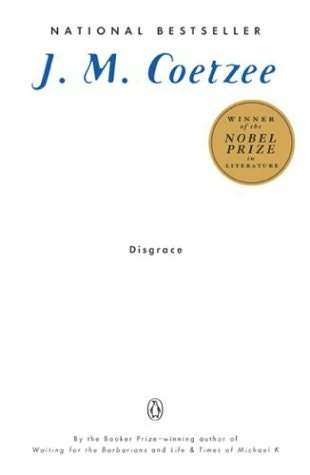
Disgrace - J.M. Coetzee (1999)
Oeuvre rule: the only other book I have read by J.M. Coetzee is Foe. Foe is not generally referenced as one of Coetzee's major works--those would probably include The Life and Times of Michael K., Disgrace, and perhaps Waiting for the Barbarians--but I read it in 2003 for a class taken at the University of Paris - Nanterre, on pluralist readings of texts inspired by Freud, Marx and Derrida. Coetzee won the Nobel Prize in Literature on October 2, 2003, but I do not recall our French professor (who taught in English) mentioning that fact. Foe is basically the story of Robinson Crusoe, told from the perspective of a woman, whose name is Susan Barton. Ironically, about three years after reading on this, I would work on a house that was owned by a woman named Susan Barton, but I never mentioned the coincidence to her (nor did I have the chance to tell another homeowner named Thomas Mann that I loved his work). Essentially, Susan Barton is shipwrecked and marooned on an island with a native, Friday, who becomes her manservant. But she survives and is rescued and returns to England, where she meets and copulates with Daniel DeFoe, inspiring the novel. We read it and attached Freudian symbols to everything in the text. It was a reasonably entertaining novel, but in hindsight it appears to me as extremely allegorical, like there is a second layer to it and the plot is ultimately secondary. Disgrace is similar in this respect, but since I do not have the advantage of reading it in the classroom, the symbols and metaphors that may be present were not apparent to me. Even without this potentially deeper significance, it was an enjoyable read and I recommend it to everyone, particularly those that enjoy The Stranger by Camus.
Basically, while the plot is not exactly the same as The Stranger, the whole style and tone of the novel renders it a spiritual sequel to that classic. It seems like it's easy to spoil this book, but I think most will agree that the plot can be spoiled up to a point.
Professor David Lurie teaches at a university in Johannesburg, South Africa. He is twice-divorced, and as the novel opens, he is detailing his trysts with a prostitute. Soon thereafter, he becomes smitten with a student in one of his classes (Melani) and they enter into a sexual relationship, though he is more than 30 years her senior. It falls apart after a short time, and almost immediately he is reported to the university. He is given the chance to repent for his actions and take a leave of absence, but instead he chooses to resign permanently. He then goes to visit his daughter (Lucy) in the countryside. His daughter sells crops at a sort of farmer's market on Saturdays, and cares for dogs at a kennel on her property. She sometimes volunteers at an animal welfare hospital, which is where her friend Bev Shaw works. Bev Shaw is a sort of unlicensed veterinarian who euthanizes most of the sick or unwanted animals in the area. Care and compassion for animals is one of the major themes of Disgrace, and it seems like this theme operates on a deeper metaphorical level, though in actuality it may just be a message unto itself. Coetzee has recently spoken out on animal rights and it is not surprising given how heart-wrenching many of these scenes are.
Not long after he arrives to stay with his daughter, there is an incident. I will not spoil what happens, but the incident itself is quite reminiscent of The Stranger. What happens afterwards is not. I believe this story is meant to symbolize the transitional period after apartheid in South Africa in the early 1990's, but I am not enough of a student of history to remark more specifically upon it.
Apart from the potential allegory, the novel itself is enjoyable and something of a page-turner. It reads very quickly and is quite short at 220 pages. The prose is very matter-of-fact, though because David Lurie is an academic that has studied the art of poetry, there are several "deeper" moments. Lurie is obsessed with Lord Byron, and hopes to write an opera about a certain affair from the poet's life. To a certain extent, I've never understood poetry, and the English courses I've taken have never properly instilled an appreciation for it. I've written in the past about my problems with interpreting Donne, so some of Lurie's "mini-lectures" were illuminating:
"Look at line 599. Wordsworth is writing about the limits of sense-perception. It is a theme we have touched on before. As the sense-organs reach the limit of their powers, their light begins to go out. Yet at the moment of expiry that light leaps up one last time like a candle-flame, giving us a glimpse of the invisible. The passage is difficult; perhaps it even contradicts the Mont Blanc moment. Nevertheless, Wordsworth seems to be feeling his way toward a balance: not the pure idea, wreathed in clouds, nor the visual image burned on the retina, overwhelming and disappointing us with its matter-of-fact clarity, but the sense-image, kept as fleeting as possible, as a means toward stirring or activating the idea that lies buried more deeply in the soul of memory." (22)
Because this novel feels shorter than 220 pages, and restricts itself to such limited subject matter, there is not much else I can say. I was going to excerpt a passage where David tells the story of a next door neighbor's dog (in the town of Kenilworth--presumably not the one outside of Chicago) who relentlessly humped every "bitch" he saw, and was beaten for it by his owners. David says that a dog will accept the justice of a beating for having chewed on a slipper, but no animal will accept the justice of being punished for following its instincts. The dog grows to hate itself, and David reflects that it would probably have preferred to be shot rather than "fixed." Yet he feels the opposite--that desire is a burden we could well do without.
I've essentially paraphrased a page of the text in that paragraph, but this one particular anecdote feels meaningful. There are a handful of moments in Disgrace that operate in a similar manner, and while David may appear at times to be a despicable figure, there is clearly "redemption" in this novel. There was one moment near the end where I was struck by how beautifully his character had been developed.
Overall, this is a very fine novel that is subtle, yet occasionally overpowering in its raw imagery. It is a pretty quick and easy read, and may nourish the reader through the method by which it analyzes humanity.
"It happens every day, every hour, every minute, he tells himself, in every quarter of the country. Count yourself lucky to have escaped with your life. Count yourself lucky not to be a prisoner in the car at this moment, speeding away, or at the bottom of a donga with a bullet in your head. Count Lucy lucky, too. Above all Lucy.
A risk to own anything: a car, a pair of shoes, a packet of cigarettes. Not enough to go around, not enough cars, shoes, cigarettes. Too many people, too few things. What there is must go into circulation, so that everyone can have a chance to be happy for a day. That is the theory; hold to the theory and to the comforts of theory. Not human evil, just a vast circulatory system, to whose workings pity and terror are irrelevant. That is how one must see life in this country: in its schematic aspect. Otherwise one could go mad. Car, shoes; women too. There must be some niche in the system for women and what happens to them." (98)
In short, while this book should not be forgotten, it may be best appreciated by those who are familiar with recent South African history. Apart from that, I am pretty sure that readers from any social milieu will find something worthwhile in it.
Wednesday, September 18, 2013
The Confessions of Felix Krull, Confidence Man: The Early Years - Thomas Mann (Transl. Denver Lindley) (1954)
For the past few years I looked forward to the day when I could return to my work here and review the last novel by Thomas Mann that I was truly excited to experience. Of course, Royal Highness, The Holy Sinner, and The Black Swan remain out there--to say nothing of Joseph and his Brothers--but I believed that The Confessions of Felix Krull was the last work I had yet to read that could stand shoulder-to-shoulder with the previous classics that had been reviewed on this blog.
Oeuvre Rule: the first-ever review on Flying Houses was Doctor Faustus; Buddenbrooks was reviewed twice (owing to a faulty internet connection and my mistaken belief that phrases from drafts would be intriguing to readers); The Magic Mountain contains no shortage of brilliance; and Death in Venice is every bit as troubling and beautiful as when it was published 101 years ago. Where then, to rank Felix Krull?
[The bottom?] (!)
Of course, Felix Krull is not a bad book. But it is an unfinished one. Unfortunately it suffers from the same problem as Fitzgerald's would-be late-era masterpiece The Love of the Last Tycoon--the untimely passing of its author. Of course Mann lived a much longer life than Fitzgerald. He died at age 80 rather than 44. But it is a dangerous thing to begin a novel near the end of one's life when one bears the risk of disappointing the scores of readers that one has worked so hard to cultivate. And while there are certainly flashes of genius that make the above-mentioned works such absolute pleasures, Felix Krull ultimately is not on their level. I will submit, however, that had Mann finished this novel (if it were not only "The Early Years"), it would probably be closer to being in that exalted category of "classic." As such we must mourn for what could have been--like Fitzgerald but in a different guise--and wonder whether some younger writer may "take up" Felix's story and attempt to finish it in a way that Mann would have found pleasing. That would be no easy task.
Perhaps it is best to read Felix Krull after reading "Felix Krull," the short story from which it was derived. I have not done that, however, and I can only say that if you happen upon a collection of Mann's stories that you check this one out before moving onto the book. The book is 375 pages long. It would probably be about 800 pages long in its proper finished form.
It opens up, as it must in a first-person narrative bearing such a title, with Felix's early childhood. He grows up in an unnamed town along the Rhine Valley, near Mainz. His father is a purveyor of champagne. He has one sister (Olympia) and a godfather (Schimmelpreester) that opens up certain doors for him. His parents like to have parties. They often have people over, and apparently for this reason his family is held in low repute in their town. Or not quite:
"It was mostly these social affairs that provoked the town gossip that called our household disreputable, but I learned early that it was the economic aspect of the situation that was principally in question. For it was rumoured (and with only too much justification) that my poor father's business was in desperate straits, and that the expensive fireworks and dinners would inevitably furnish the coup de grâce." (15)
There are several fantastic scenes early on in this book that made me feel it was on its way to
greatness. And truly, the first "book" in it (there are three: Book I is about 50 pages, Book II is about 130 pages, and Book III is about 200 pages) may be close to perfect. Near the end of Book I, his father suffers an unfortunate end (and if I were Elizabeth Warren, I would include this passage in a casebook to complement a certain passage from A Man in Full):
"Our financial collapse was complete; it became clear why my poor father had put it off so long and involved himself so deeply in the toils of the usurers, for he was aware that when the crash came, it would reduce him to total beggary. Everything went under the hammer: the warehouses (but who wanted to buy so notoriously bad a product as my father's wine?), the real estate--that is, the cellars and our villa, encumbered as they were with mortgages to two-thirds of their value, mortgages on which the interest had not been paid in years--the dwarfs, the toadstools and earthenware animals in the garden--yes, even the mirrored ball and the aeolian harp went the same sad way. The inside of the house was stripped of every pleasant luxury: the spinning-wheel, the downy cushions, the glass boxes and smelling salts all went at public auction; not even the halberds over the windows or the portieres were spared; and if the little device over the entrance door that played the Strauss melody as the door closed still jingled unmindful of its desolation, it was only because it had not been noticed by its legal owners." (51)
Felix then moves with his mother to Frankfurt, where the charming second part of the novel takes place. Schimmelpreester tells each member of the family what they are supposed to do, and they follow his orders. Felix is supposed to go to Paris to meet with a hotelier, but he also must worry about his military service. In the meantime, he enjoys his time in Frankfurt, though he is reduced to sleeping on a kitchen bench, and often tries to summon carriages for people leaving the theater, sometimes receiving a tip.
Now, Book One is very good, but it takes 80 pages to get to Chapter V of Book II, which is probably the first "great" scene in the novel: Felix's first attempt at "conning." He hopes to avoid military service, and his manner of completing this task is unlikely. He expresses great enthusiasm and tells all of the presiding officers that he considers himself in excellent shape for service. They find this rather hard to believe, as he makes subtle movements that betray a weaker constitution. They tell him that the barracks is not a health resort, and laugh at him when he asks if he could just try because he might improve.
After this, we come to Felix's encounter with a prostitute named Rozsa. While there is a scene in Book One that briefly details an affair he carries on with a housemaid who is perhaps fifteen years older than him, the scene with Rozsa is more remarkable because she seems to love him regardless of the fact that he has no money. At this point it may be prudent to mention a criticism that I have read of this book: the main character is unsympathetic. He is extremely good looking and he charms everyone he meets within a few minutes and everything comes much too easy for him. Well, I hope my review indicates otherwise. I do not share this criticism with others. I think there are plenty of signs that most of the other characters find Felix annoying, and it is only through these "love scenes" that certain readers may scoff in disbelief. However, the scene with Rozsa is practically rated PG compared to what comes later. Felix also gives a nice defense of his relationship with her, and why he should not be considered a pimp despite the fact that sometimes he shares in what she gets from her customers:
"For my own part I am in agreement with folk wisdom which holds that when two persons do the same thing it is no longer the same; yes, I go further and maintain that labels such as 'drunkard,' gambler,' or even 'wastrel' not only do not embrace and define the actual living case, but in some instances do not even touch it. This is my point of view; others may judge differently about this confidence--in respect to which it should be remembered that I am making it of my own free will and could quite easily have passed over it in silence." (112)
Finally, then, in Chapter VII of Book II, about 115 pages in, the "action" of the novel seems to pick up, for Felix is taken out of his home element and put on a train destined for Paris. He has a number of adventures on the train, but he is primarily entertained by acting extremely politely with the commissaire, even going so far as to wish his wife and children well after he takes his ticket. The language of the book switches, in stretches that are nearly too long to subsist in untranslated form, to French. I would not be surprised if newer editions of the book translated the French into English, or at least provided footnotes I could understand most of what was being said, but I think I have a decent "foundation" in French. Regardless, even if you do not know French, I do not think you will miss all that much if your edition does not translate it. Also of note during this section is an unlikely event: a woman "dropping" certain valuable jewelry into Felix's bag during a customs check--his second act of "conning."
Felix finds his way to the hotel where he is supposed to work, and to the dormitory where he is to sleep, along with his bunkmate, Stanko. Stanko finds the jewelry and tells him to go to a certain shopkeeper to trade it in for cash. Felix does so the next day after speaking to Stürzli, the general director of the Hotel Saint James and Albany, after being told that he will take over for Armand, the elevator operator who is quitting that day. The scene with the shopkeeper Pierre Jean-Pierre is as memorable as the military service coup, particularly in the way the negotiations are carried on rather disagreeably until the deal is struck, at which point Jean-Pierre turns into a much nicer person.
The last scene worth noting in Book Two is the experience Felix (now Armand--and it is strange the way everyone calls him Armand, not even thinking he has a different name) has with a certain middle-aged woman--the same one that dropped her jewelry into his bag on the train. She is a novelist who is staying in the hotel, and she takes Felix into her room where she asks him to defile her. Now this may very well be the most unrealistic scene in the book. Perhaps it is pure fantasy, or perhaps it is Mann trying to write a "modern 1954 novel" complete with blunt intimations:
"'Perversion! Love is perversion through and through, it can't be anything else. Probe it where you will, you will find perversion...But it's admittedly sad and painful for a woman to be able to love a man only when he is quite, quite young, when he is a boy. C'est un amour tragique, inadmissible, not practical, not for life, not for marriage. I, I married Houpflé, a rich businessman, so that in the shelter of his riches I could write my books, qui sont énormément intelligents. My husband can do nothing, as I told you, at least with me. Il me trompe, as they say, with a theatrical demoiselle. Perhaps he is some good with her--I should rather doubt it. It's a matter of indifference to me--this whole world of men and women and marriage and betrayal is a matter of indifference. I live in my so-called perversion, in the love of my life that lies at the bottom of everything I am, in the happiness and misery of this enthusiasm with its heavy curse that nothing, nothing in the whole visible world equals the enchantment of the youthful male. I live in my love for all of you, you, you the image of desire, whose beauty I kiss in complete abnegation of spirit. I kiss your presumptuous lips over the white teeth you show when you smile. I kiss the tender stars of your breast, the little golden hairs on the dark skin of your armpits. And how does that happen? With your blue eyes and blond hair, where do you get this coloring, this tint of light bronze?'" (172-173)
That final question is a reference to Felix's physical appearance--at once both "light" and "dark." This scene with Madame Houpflé is somewhat difficult to square with the rest of the novel. It is certainly unrealistic, but perhaps not so much given that Felix is extremely good-looking (one may wonder about what unlikely events befall those blessed with such looks). At least it is entertaining and humorous when she asks Felix to beat her and when he confesses that he took her jewelry and that she finds it charming and asks him to steal more from her while she pretends she is asleep. But there is also question mark #1 that I have about this book:
"She came. We came. I had given my best, had in my enjoyment made proper recompense. But how could I fail to be annoyed that at the very climax she had been stammering about degradation and had called me a stupid little slave?" (170)
Does he mean what I think he means? It is impossible to think otherwise. Perhaps question mark #1 is not such a puzzle, but question mark #2, I must admit, is a doozy....
But before we get there there is almost 200 pages of action. I will cover it shortly. "Armand" is serviceable as a "lift-man" but soon he moves on to work as a waiter in the hotel. In the meantime he sells more of the jewelry that he "stole" from his ladyfriend, and he and his colleague Stanko enjoy an evening at the circus. As a waiter he meets a fair number of interesting characters, but three in particular: Eleanor Twentyman, Lord Strathbogie and the Marquis de Venosta.
In keeping with a theme of the novel, Twentyman and Strathbogie become entranced by "Armand." This happens at the same time, roughly. I would go so far as to say that this little section, from pages 200-217, is the single best part of the entire book. It is contained like a perfect short story. Felix needs to tell both that, charmed as he is by their infatuation with him, he cannot do what is asked of him.
Eleanor is 17 or 18, staying at the hotel with her parents. It is humorous to see her fall in love with a waiter, who must be kind and gracious all the while. She comes down to breakfast by herself when her parents are still asleep and tries to "woo" "Armand" until he is eventually made to deflate her advances:
"'It's abnormal, too, for you not to ignore me, as would be natural and as your Mummy quite properly demands, but instead to come down secretly to breakfast and talk to me about "love" while your parents are prevented by their peaceful slumbers from coming to the defence of the social order. This "love" of yours is a forbidden love which I cannot approve, and I am forced to reject any pleasure of my own in the fact that you like to see me. It's all right for me to like to see you, if I keep it to myself, that's quite true. But for you, Mr. and Mrs. Twentyman's daughter, to like to see me, that's impossible, that's contrary to nature...What you call "love" is something that happens to people on trips and at the sight of tail-coats like mine. When you have left, as you will very soon, you'll forget it before you get to the next station.'" (205)
This mention of love being something that happens to people on trips may perhaps remind the reader of Death in Venice, and I can only say that the description of what happens with Lord Strathbogie is the ultimate "reverse Death in Venice" and that Mann must have intended it as such. "Armand's" conversations with the Lord seem to have greater weight, as the man, who is about 50, desires to take him away and make him his personal valet, and maybe even adopt him and make him his heir. Felix, as a person who is destined to wear many masks throughout life, finds this idea somewhat appealing, but ultimately cannot accept:
"'Please--I don't want to wound you or minimize the honour you have paid me, but if someone precisely like me occurs only once--each of us, of course, occurs only once--there are nevertheless millions of young men of my age and general physique, and except for the tiny bit of uniqueness, one is made very much like the other. I knew a woman who declared that she was interested in the whole genre without exception--it must be essentially that way with you, too. The genre is present always and everywhere.'" (216)
Finally, after the novel reaches its high point (in my opinion), Felix meets the Marquis de Venosta, who is about his age, and whom he finds to be a pleasant person to serve. The Marquis is from Luxembourg, and he has been staying in Paris and seeing a woman named Zaza. His parents do not approve of this relationship and they believe that a world tour will do him some good and take his mind off of Zaza.
On his nights off from the hotel, "Armand" sometimes goes to the theater or has dinner at nice restaurants, and on one of these evenings he runs into the Marquis, who is very garrulous and drinks very much wine and causes "Armand" to miss the theatrical performance that night. During this dinner scene, it begins to become obvious why the Marquis has become such a major character. Of course, Felix is plotting his next "con," which will be impersonating the Marquis on this world tour while the real Marquis stays behind in Paris and rents out an apartment with Zaza. His first stop will be in Lisbon, Portugal.
And it is here that the novel ends. This is the longest single portion of the book, and perhaps a bit tiresome. However, on the train ride to Lisbon, Felix (now "Louis" or "Loulou") meets one Professor Kuckuck, a man with "starry eyes." The Professor speaks of celestial subject matter and this proves enchanting for "Loulou":
"There was no question, he said, that life on earth was not only an ephemeral episode, but Being itself was also--an interlude between Nothingness and Nothingness. Being had not always existed and would not always exist. It had had a beginning and would have an end, and with it space and time; for they existed only through Being and through it were bound to each other. Space, he said, was nothing but the order of material things and their relationship to one another. Without things to occupy it, there would be no space and no time either, for time was only the ordering of events made possible by the presence of objects; it was the product of motion, of cause and effect, whose sequence gave time its direction and without which there would be no time. Absence of time and space, however, was the definition of Nothingness. This was extensionless in every sense, a changeless eternity, which had only been temporarily interrupted by spatio-temporal Being. A greater duration, by aeons, had been vouchsafed to Being than to Life; but some time of a certainty it would end, and with equal certainty the end implied a beginning..." (266)
This conversation goes on for about ten pages and is probably the highlight of the "Lisbon" section of the novel. This is a strange moment in the novel and I can only conjecture that Mann wrote this knowing that he would not complete the rest of the novel, and that he was not very far from meeting Being and Nothingness himself. As such it is a powerful moment, and probably the most profound single piece of the novel.
Once "Loulou" settles in town, he goes the Museum of Natural History, where Professor Kuckuck is a director. Then he meets the Professor's family, which includes a wife and a daughter. The daughter is named Zouzou, and the irony of "Loulou" meeting his very own Zaza is not lost on the character. There is also a strange section where "Loulou" meets the King of Portugal and tells raucous stories about his parents' two dogs, and this is all conveyed in a long letter "Loulou" writes to the Marquis de Venosta's actual parents.
His stay in Portugal is longer than intended by a month, and perhaps predictably, he falls in love with Zouzou, while playing tennis with her often. Zouzou is a fairly interesting character--she is very "forthright" and believes that "silence is unhealthy" and that "things must be called by their real names." She is very cynical, in a word, and she does not believe in "love"--she believes that love (in keeping with another theme of the novel) is but a pretext for sexual longing, and this makes it a perversion in a certain sense. "Loulou" tries very hard to persuade her otherwise in a long speech near the very end.
However, before we get to question mark #2, I must add finally that at a certain point, I became upset that this novel was not going to provide closure. I was distracted from this final set of events, and did not really care how things turned out. In fact, if it has not been made clear above, I consider this the weakest section of the novel. The "Paris" section is certainly the strongest, and this part might only have been better if we saw what became of "Loulou" in Argentina, or the United States--other stops that he was to make on his world tour. Also we never see Felix go to jail, as he mentions in passing at earlier points in the novel.
Nor do we find out how the matador that he sees during a bullfight in the penultimate scene of the novel comes back into the story. All we see is that he gives Zouzou a stack of pictures that he had made--nude sketches of Zaza with Zouzou's curls--and how she is disgusted by them, but how she then kisses him passionately--and then we finally get to question mark #2.
Zouzou's mother sees what happens, and she reproaches "Loulou":
"'You can thus realize what stupidity you were guilty of when, in your need for love, you followed a childish course and formed the capricious notion of turning a child's head. That was not choosing or acting like a man, but like an infant. Mature reason had to intervene before it was too late.'" (377)
But then, finally, question mark #2--does she fall under his spell, too?
"'Once when we were conversing you spoke to me about the graciousness of maturity and the graciousness with which it speaks of youth. To encounter it successfully requires, of course, a man's courage. If an agreeable youth only showed a man's courage instead of seeking satisfaction in childishness, he would not have to run off like a drenched poodle, uncomforted, into the wide world....'
'Maria!' I cried.
And: Holé! Heho! Ahé' she exclaimed in majestic jubilation. A whirlwind of primordial forces seized and bore me into the realm of ecstasy. And high and stormy, under my ardent caresses, stormier than at the Iberian game of blood, I saw the surging of that queenly bosom." (377-378)
Perhaps that is not quite a puzzle either, but it is a very strange way to end this novel. I have said all I can about The Confessions of Felix Krull. I recommend it for Mann-obsessives, but there are finer "closure-producing" compositions in his oeuvre if one has not exhausted it.
Tuesday, August 13, 2013
How Judges Think - Richard A. Posner (2007)
Oeuvre rule: I have read dozens of judicial opinions by Judge Posner of the 7th Circuit and almost every one of them has been a good read. I even remember reading one obscure bankruptcy decision which was very entertaining because he went out of his way to highlight the frivolity of the litigant's claims. He has been a federal judge for more than 30 years. He has written a formidable number of books and law review articles. His name is synonymous with "economic analysis" and "law." He was made to serve on the Supreme Court, but was never nominated because he could not be counted on to "vote along party lines." He also teaches at the University of Chicago Law School and blogs at http://www.becker-posner-blog.com/.
Last year I applied to be his law clerk. I applied to about 100 other judges. Almost all of them sent rejection letters. A couple actually sent invitations to interview. Judge Easterbrook (Posner's colleague on the 7th Circuit) sent a postcard rejection. Posner was the only judge who failed to respond.
And who could blame him? After all, I sent him my rejected 40 page note on the plight of temporary workers in the wake of the Great Recession, and added, at the end of my mail-merged cover letter, that I was a huge fan of his. I've heard he likes to have clerks with backgrounds in engineering and science. So I completely understand. And I would not be so petty as to criticize How Judges Think based on the mere failure of a response.
But this is not going to make the "best books of Flying Houses" list for one reason and one reason only: it has very limited appeal for a mass audience. This book is made for law students, professors, law school administrators, judges, lawyers, and anyone who has been faced with the thankless task of poring over law review articles. Occasionally, it is interesting enough for lay readers, but the proof is in the acknowledgments:
"I have incorporated material from the following articles of mine, though with much revision and amplification: "The Role of the Judge in the Twenty-First Century," 86 Boston University Law Review 1049 (2006) (chapters 3 and 4); "Judicial Behavior and Performance: An Economic Approach," 32 Florida State University Law Review 1259 (2005) (chapter 5); "Reasoning by Analogy," 91 Cornell Law Review 761 (2005) (chapter 7)...." (379)
And six other articles. So while yes, Judge Posner is an extremely hard worker and probably one the most (if not the most) prolific writers in the history of American law, it appears that he writes his articles with an eye towards incorporating them into a book (though I did read one funny article by him called "Goodbye to the Blue Book" that may not have found its way into a book). As one recent law graduate told me when I was a 1L, "Posner writes with an eye to being published in casebooks."
Posner begins the book by discussing 9 theories of judicial behavior (attitudinal, strategic, sociological, psychological, economic, organizational, pragmatic, phenomenological, and legalist) and whether judges's decisions are best explained by the political preferences they bring to their cases, largely focusing on the idea that "liberal" judges are appointed by Democrats and "conservative" judges are appointed by Republicans. Some of this is confusing because it may be difficult to say what separates a "liberal" decision from a "conservative" one. Of course there are easy cases like Goldberg v. Kelly (a Justice Brennan-authored decision requiring evidentiary hearings prior to the termination of public assistance benefits) and Citizens United (a Justice Kennedy-authored decision allowing corporations to make virtually unlimited expenditures in the area of campaign finance), but as noted in my previous review, certain areas such as criminal procedure do not always allow for such neat "left/right" categorization.
Posner then goes on to discuss the judge as a labor-market participant. While Posner's reasoning on the matter is sound, it underscores how esoteric this book can get:
"Each bit of information the judge received that bore on that truthfulness [of a witness] would be likely to alter his prior probability [a pre-inquiry estimate of a witness's truthfulness], but not erase it; the prior probability would affect the posterior probability [a post-inquiry assessment of a witness's truthfulness], as in Ω(H/x) = p(x/H)/p(x/~H) x Ω(H), the simplest version of Bayes's theorem.
Ω is odds; the left-hand side of the equation is the posterior odds that some hypothesis, H, is true; the last term on the right-hand side of the equation, Ω(H), is the prior odds; x is the new information obtained in the course of the inquiry; p is probability, and p(x/H)/p(x/~H), the first term on the right-hand side of the equation, is the ratio of the probability that x would have been observed even if H was false (~H). (So if those two probabilities were the same, the new information would not alter the odds; it would be a case of multiplication by 1.)" (66) (brackets mine)
While I may have made that more confusing with my bracketing, it was the simplest way I could sum up what is unquestionably the most unreadable portion of the book. Thankfully, Posner does bring it down to a more human level:
"Suppose the hypothesis is that the witness--let us say the plaintiff in a sex discrimination suit--is testifying truthfully, and that before she begins to testify the judge sets (almost certainly, unconsciously) the odds that she will be telling the truth at 1 to 3, which is equivalent to a probability of 25 percent (1 out [1+3]). She testifies, producing new information, x. Suppose the probability that x would be observed if she was telling the truth is .6, that while the probability that it would be observed if she was not telling the truth is .3, so that the ratio of the two probabilities is 2. When this "likelihood" ratio is multiplied by the prior odds of 1 to 3, the result is posterior odds of 2 to 3 (1:3 x 2 = 2:3), which is equivalent to a 40 percent probability (2 out of 5) that the witness is telling the truth." (66)
I will not comment any further on Bayesian theory.
I could go through the rest of the chapters and summarize what each one is about, but that would be boring and a needless waste of time. You may read the Introduction or the Conclusion to the book if you would like a bite-sized morsel of it. Like any good law review article, it is systematically and structurally precise. Posner does not exactly come out and say, "I am a pragmatist," but it seems clear that he favors the "pragmatic" behavioral model of the judge over the others.
Sadly, as I often mention when discussing Vladimir Nabokov's thoughts on Thomas Mann, Posner does not have kind words for my favorite Supreme Court Justice:
"Law is a methodologically conservative profession, and 'bad boy' rhetoric such as [Jerome] Frank's advocacy of psychotherapy for judges or Fred Rodell's proposal that the practice of law be made a crime and courts be replaced with administrative agencies including a 'Killing Commission to apply its laws about what are now called murder and manslaughter,' like the antics of the 'crits,' ensured that these scholars would not receive a fair hearing. That the only avowed legal realist to become a Supreme Court Justice--William O. Douglas--flouted perfectly sensible norms of judging (FN 46) also helped to give realism a bad name." (112-113)
("Here is a sampling of criticisms of Douglas--none by conservatives. 'His [Douglas's] opinions were not models; they appear to be hastily written; and they are easy to ignore.' L.A. Powe, Jr., 'Justice Douglas after Fifty Years: The First Amendment, McCarthyism and Rights,' 6 Constitutional Commentary 267, 269 (1989). The carelessness of Douglas's opinions was rooted in his 'indifference to the texture of legal analysis, which arises from an exclusively political conception of the judicial role.' Yosal Rogat, 'Mr. Justice Pangloss,' New York Review of Books, Oct. 22, 1964, p.5. 'Douglas was the foremost anti-judge of his time.' G. Edward White, 'The Anti-Judge: William O. Douglas and the Ambiguities of Individuality,' 74 Virginia Law Review 17, 80 (1988). Douglas 'refus[ed] to judge in tax cases.' Bernard Wolfman, Jonathan L.F. Silver, and Marjorie A. Silver, 'The Behavior of Justice Douglas in Federal Tax Cases,' 122 University of Pennsylvania Law Review 235, 330 (1973))." (FN 46)
Posner is generally a very witty writer, but it can be difficult at times to mine through the seeming intellectual elitism of his prose to realize that what he is writing is actually funny. But other times, he frames the law in a way that laypersons will understand:
"Versions of judicial modesty include [James Bradley] Thayer's principle that statutes should be invalidated only if they are contrary to any reasonable understanding of the constitutional text and Holmes's 'can't helps' or 'puke' test: a statute is unconstitutional only if it makes you want to throw up." (288)
I will make one final point about How Judges Think: while it is probably going to attract little interest from those outside of the "profession," it is good reading for law students, and it will probably be slightly more interesting than your average law review article or casebook reading assignment. Most law students will probably find the final section of the book, where Posner discusses the political nature of the Supreme Court, to be most entertaining. He gives brief (but always intriguing, given the level at which his mind is operating) remarks on most of the Justices then sitting in 2007, and delivers a pretty thorough review of Justice Breyer's book Active Liberty. He also criticizes Justice Kennedy's constitutional philosophy:
"Justice Kennedy's opinions in Lawrence v. Texas (the homosexual sodomy case) and Roper v. Simmons [the juvenile death penalty case] make only limited efforts to ground decision in conventional legal materials. They could not do more, operating with nondirective constitutional provisions and in the teeth of adverse precedent. They are appeals to moral principles that a great many Americans either disagree with or think inapplicable to homosexuals or juvenile murderers. The approach is consistent, however, with the judicial philosophy that Justice Kennedy expressed in the interview from which I quoted in chapter 9, when he said that 'all of us have an instinctive judgment that we make...You make these quick judgments...Judges do the same thing...But after you make a judgment, you then...have to see if that...accords with your own sense of ethics and morality. And...[you have to understand] that you have the opportunity to shape the destiny of this country. The framers wanted you to shape the destiny of the country. They didn't want to frame it for you.' This is the most powerful judge in America speaking, and, if we may judge from his decisions, meaning what he says--that the framers of the Constitution wanted Anthony Kennedy to shape the destiny of the country in accordance with his own sense of ethics and morality, though it strikes many as quirky." (310-311) (first brackets mine)
While the book reads fairly well from beginning to end, its genre likely falls into "legal theory," and so most readers may pass a chuckle when Posner goes off for five pages about Chief Justice Roberts's "umpire analogy" to judging, but few will stick it through to the end. Through no fault of its own is the book dated (there are at least four major cases, involving Anna Nicole Smith, the Affordable Care Act, Campaign Finance, and gay marriage, on which Posner likely has something to say), but it is one that is a prime candidate for a "new edition."
Posner opens up the book with an exclamation point--one of the few in the text--and closes on a powerful salvo, which nicely summarizes his raison d'être:
"For that recognition [that legalism is not the path to reform] to take hold, however, will require a change in the way in which law is taught in law schools. Realism about judges is sorely lacking there. Law is taught as if judges were second-class professors, professors manqué--legal analysts lacking the specialized knowledge of the law professor. The motivations and constraints operating on judges, and the judicial mentality that results, are ignored, as if judges were computers rather than limited human intellects navigating seas of uncertainty. As a result students are not taught how to present a case to a judge in a way that will strike a responsive chord. The curious judicial passivity that results from judges' being accustomed to simply decide whatever is brought to them to decide, rather than to initiate anything, has made most judges shy about telling lawyers how they should be presenting cases to maximum effect, thus helping themselves by helping the judges. The nation needs a better bridge between bench and bar, and its construction must be largely the work of the law schools." (377)
Ultimately that is who will get the most out of this book: law school administrators and practicing lawyers. While it is highly doubtful that every judge possesses as masterful an intellect as Posner's, I am sure they would find many of his comments to be accurate. I am sure that by reading this book, and taking out some of the "pro tips" he offers, one could become a better attorney. Or you could at least learn how not to screw up an amicus curiae brief if you happen to teach at Yale.
Monday, February 18, 2013
How Literature Saved My Life - David Shields
Recently I went to the post office to pick up a package, and the woman behind the counter said, "We've been holding this one since January 1, is this for you?" It was a big, flat manila mailing package--a book. "Oh yes, that's mine." It said 184 Clinton St and it said Flying Houses (I live at 148 Clinton, f.y.i.)
This was the first piece of mail I received for Flying Houses from a major book publisher (Random House/Knopf/Borzoi Books). I was expecting it to be Taipei by Tao Lin (from Vintage). I had requested that book. I did not request How Literature Saved My Life.
Regardless, I took this to be a moment of divine inspiration: slowly but surely, Flying Houses was turning into a reputable media outlet. I would not pass up the opportunity. Unfortunately I wish I had because I fear this review will satisfy no one.
David Shields (not James Shields, the pitcher for the Kansas City Royals formerly of the Tampa Bay Rays, who has also written a book) has written thirteen books, the most prominent of which appear to be Reality Hunger and Remote. They also appear to be written in a "collage" style that eschews traditional forms of character and plot development in favor of a sort of stream-of-consciousness. How Literature Saved My Life is also written in this style. I have many problems with this book so I will enumerate them.
#1: Shields does not really discuss how he was about to lose his life
This is not The Noonday Demon: An Atlas of Depression by Andrew Solomon. It will not make you feel better if you are sleeping 20 hours a day and eating something and worry that you have no purpose to fulfill on earth. He does describe some moments of ennui at a famous MFA program:
"I remember hearing my highly alliterative short story 'The Gorgeous Green of the Hedges' gently demolished in class and, upon returning to my apartment, eating bowl after bowl of mint chip ice cream until the room spun. I remember admiring how some of my classmates (Elizabeth Evans, Mike Hutchison, Walter Howerton, Michael Cunningham, John Hill, Jan Short, Peter Nelson, Sarah Metcalf, Bob Schacochis) had figured out how to get their own personality onto the page.....I remember people saying that nothing ever happened to anyone in Iowa City and me wondering what in the world they were talking about. I remember, above all, during the five years I lived in Iowa City, believing that what mattered more than anything else in your life was writing as well as you possibly could." (119-120)
He also later described being unemployed at age 30 and sleeping on his father's apartment couch in San Francisco and watching a uni-cyclist juggler on television, and how that had moved him to tears--and how, had he seen the feat in person, he would not likely be moved anywhere near as much. This was a nice vignette.
The book is separated into more than a hundred of such vignettes, but the vast majority of them focus on Shields's engagement with a text or other such work of art. In a sense this is prime material for Flying Houses because it gives us the very exciting opportunity of comparing his opinions to my own.
"Marcel Proust, Remembrance of Things Past. The book that I think of as mattering the most to me ever, but I read it more than thirty years ago and I find that I have trouble reading it now. Seems sad--do I still love it, did I ever love it? I know I did. Has my aesthetic changed that much? If so, why? Does one resist that alteration? I think not. The book still completely changed me, still defines me in some strange way. Proust for me is the C.K. Scott Moncrieff translation in paperback, all the covers stained with suntan oil, since I read all seven volumes in a single summer, supposedly traveling around the south of France but really pretty much just reading Proust. I came to realize that he will do anything, go anywhere to extend his research, to elaborate his argument about art and life. His commitment is never to the narrative; it's to the narrative as such as a vector on the grid of his argument. That thrilled me and continues to thrill me--his understanding of his book as a series of interlaced architectural/thematic spaces." (152-153)
I could not read Swann's Way four years ago, and it is one of the three posts of Flying Houses that is (incomplete), though I did remark that,
"When I first heard about him, I thought it lied very close to the same aims I hoped to produce in my own work--the inexplicable singularity of a life, with all of its attendant idiosyncrasies, which thereby educates an audience more as to the total "meaning of existence." Lofty ambitions indeed, and I will say, after 60 pages, that I am sure Proust succeeds on his own philosophical level, but that 21st century American readers will find it extremely difficult to 'dig.'"
This does lead to the next topic, which is adapting literature to new forms of technology, but I would pause to remark that the above quotation may shed light on why I did not like How Literature Saved My Life: we seem to have a similar philosophy when it comes to creating literature that is "useful," but we go about it in different ways. I do not like the "collage" method, though I did employ it in the past. That method is popular with writing group peers and the so-called "MFA Contingent" but I prefer to take cues from modern masters and not try to invent new forms when society itself is enough of a spectacle that it bears relating in plain language, without the jumping around from topic-to-topic, channel surfing, twitter news-feed scanning, etc. While I recently joined twitter about a week ago, and plan to use it sparingly, for marketing purposes (or to record funny incidents in my Tax Law class) I hope to fight against this urge to make literature more "user-friendly" for the "Me Generation."
#2: This is not Taipei
I requested a galley copy of Taipei, which is Tao Lin's 3rd novel, from the author himself. He told me that he would forward my information onto Vintage Books and that "hopefully" they would send one in January. When nothing arrived, I cursed Vintage and major publishing houses (Melville House had sent my Tao's 2nd novel Richard Yates) and then went to pick up the package in early February. It looked like they had come through! Then I opened the package, incredibly, to find that it was this book and not Taipei. Perhaps this is some elaborate trick or "test" being played on me (since Flying Houses may be "famous" for excerpting large sections of text), but I am sad that I will not be able to keep up with Tao's oeuvre. However, while I don't necessarily disagree with Shields' statement, "I don't want to read out of duty," (167) I do want to read out of duty if people want my opinion on something.
But Tao is a good entry-way into the next point about technology. For those unaware, Tao Lin is the foremost writer of my generation (we graduated in the same class from NYU) and has built his following entirely on his own through the various forms of social media. His evolution as a writer has been fascinating to observe, and perhaps with this book he may actually enter some "year end best lists," as Mr. Shields apparently has. And the strongest part of this book, for me, are its comments on the current literary world:
"The individual has now risen to the level of a minigovernment or minicorporation. Via YouTube and Twitter, each of us is our own mininetwork. The trajectory of nearly all technology follows this downward and widening path: by the time a regular person is able to create his own TV network, it doesn't matter anymore that I have or am on a network. The power of the technology cancels itself out via its own ubiquity. Nothing really changes: the individual's ability to project his message or throw his weight around remains miniscule. In the case of the web, each of us has slightly more access to a mass audience--a few more people slide through the door--but Facebook is finally a crude personal multimedia conglomerate machine, personal nation-state machine, reality-show machine. New gadgets alter social patterns, new media eclipse old ones, but the pyramid never goes away....New artists, it seems to me, have to learn the mechanics of computing/programming and--possessing a vision unhumbled by technology--use them to disassemble/recreate the web." (188-189)
The only other point worth mentioning about Tao is usage of the term "scare quotes":
"Updike: 'I loathe being interviewed; it's a half-form, like maggots.' Gertrude Stein: 'Remarks are not literature.' Um is not a word, but I like how people use it now to ironize/mock/deflate put scare quotes around what comes next. The moment I try not to stutter, I stutter. I never stutter when singing to myself in the shower." (133-134)
"Scare quotes" are not a component of literature that has been accepted by the public on a mass scale by any stretch. Tao Lin is largely responsible for the excessive use of "scare quotes" (and the reason I must put it in quotes, regarding Shields's failure to do so as a "hipper than thou" mistake) in new books, but Shields point is well taken nonetheless. I confess this is a minor quibble but "scare quotes" deserve at least a moment of clarification.
#3: Recommended Reading
In order to fully appreciate this book, I really think you have to have read all of the books that Shields references--and there are many:
(1) Leaving the Atocha Station by Ben Lerner
(2) Dead Languages by David Shields
(3) The Thing About Life Is That One Day You'll Be Dead by David Shields
(4) Spiderman (2002 film)
(5) Prometheus Bound - Aeschylus (?)
(6) Reality Hunger - David Shields
(7) Shortbus (2006 film)
(8) Laura (1944 film)*
(9) Love and Pain and the Whole Damn Thing (1973 film)
(10) Le Gout des Autres (2000 film)
(11) Anagrams by Lorrie Moore*
(12) "Weekend" by Amy Hempel*
(13) Chronic City by Jonathan Lethem
(14) The Last Studebaker by Robin Hemley
(15) Tree of Codes by Jonathan Safran Foer
(16) Built to Spill - Perfect From Now On (1997 album)
(17) In Bruges (2008 film)
(18) Calendar of Regrets by Lance Olsen
(19) The Guardians by Sarah Manguso
(20) The Name of the World by Denis Johnson
(21) Out of Sheer Rage by Geoff Dyer
(22) Zona by Geoff Dyer
(23) Elizabeth Costello by J.M. Coetzee
(24) This Is Not a Novel by David Markson
(25) "This is the Life" by Anne Dillard
(26) Butterfly Stories: A Novel by William Vollman
(27) History of a Suicide: My Sister's Unfinished Life by Jill Bialosky
(28) The Brothers by Frederick Barthelme
(29) The Unbearable Lightness of Being by Milan Kundera
(30) Remote: Reflections on Life in the Shadow of Celebrity by David Shields
(31) "The Dead" by James Joyce
(32) Sherman's March (1986 film)
(33) Speedboat by Renata Adler*
(34) Shit My Dad Says by Justin Halpern
(35) Although of Course You End Up Becoming Yourself by David Lipsky
(36) Now and Then by Joseph Heller*
(37) The entire oeuvre of J.D. Salinger
* books I actually want to read after this.
Note that this does not include the "55 works I swear by" section, along with perhaps a handful of other texts that are mentioned more briefly.
You do not need to read all of these books to "get" How Literature Saved My Life, but the book tends to function as a collection of books that inspired it. While the book is marketed as "blending confessional criticism and anthropological autobiography," there is decidedly a focus on the former.
There are three parts worth noting where Shields slams Toni Morrison for complaining that her book didn't win an award and where Shields admits that he is actually kind of like George W. Bush and where Shields talks about Bryan Singer sitting next to Bush in first class where Bush confesses that he has been on Ambien "for years." These are probably the "sexiest" parts of the book, though other parts do indulge in vague-erotica.
#4: Been There, Done That
The big takeaway from this book (for me, at least) is the "collage" as the new form of literature--and I don't buy it. My zine "Autointoxication," (2003) flirted with this medium, and while some viewed it rather charitably, I am mostly embarrassed by it in retrospect.
Bite-size chapters (like in, oh say, Cat's Cradle by Kurt Vonnegut) may be something else entirely, but blending a work of creative non-fiction by mixing in one's own patina with the aggregate of artistic cultural linguistics amounts to a book of aphorisms that may serve as a nice collection of potent quotables (things to write on a piece of paper that you tape to the wall in your "writing station") but does not compel me to run out to my friends and tell them to read.
Shields has written 13 books and has been quite successful, it appears. However this book leaves the impression that he has given up on fiction as a method towards reaching psychological realism. He is, as he notes, an extremely ambivalent person, and I am quite ambivalent about this book. On the one hand, I am quite honored that someone decided to send it to me, and it has certainly opened up my mind a bit when it comes to literary experimentation (while I doubt that I will return to the "collage" form anytime soon) and there are a few nice passages, such as this one:
"Some people seemed to think I was the Antichrist because I didn't genuflect at the twin altars of the novel and intellectual property (there's an oxymoron if ever there was one). I became, briefly, the poster boy for The Death of the Novel and The End of Copyright. Fine by me. Those have become something close to my positions. The key thing for an intellectually rigorous writer to come to grips with is the marginalization of literature by more technologically sophisticated and thus more visceral forms. You can work within these forms or write about them or through them or appropriate the strategies these forms use, but it's not a very good idea to go on writing in a vacuum. The novel was invented to access interiority. Now most people communicate through social media, and everyone I know under thirty has remarkably little notion of privacy. The novel is an artifact, which is why antiquarians cling to it so fervently. Art, like science, progresses. Forms evolve. Forms are there to serve the culture, and when they die, they die for a good reason--or so I have to believe, the novel having long since gone dark for me..." (129, emphasis mine)
Even in this comparatively pristine paragraph Shields make a comment with which I take issue: I am under thirty (for another 60 days, at least) and I think I have a notion of privacy.
There is also a nice part about him working at a law firm:
"My entire twenties, I lived on practically nothing, slept on my father's couch for ten months. At thirty-one, I was a proofreader for Pillsbury, Madison & Sutro (PMS), a San Francisco law firm that represented the wrong side of every case. The lawyers hated their jobs. I loved mine, though, since I spent my entire time there finishing my second novel. All the other subalterns were as bored as I was, and they were happy to print out copies of drafts for me, retype pages for me. It was Team Shields. We also discovered something new called a fax machine. Very exciting. I'd arrive before anyone else, and the lawyers would thank me for being such an eager beaver." (163)
That passes the LSAT Test! A newly formulated test on Flying Houses that says any mention of legal culture on page 163 in any book passes the test (163 was my LSAT score).
But on the other hand, I just get annoyed when people write D.F. Wallace or DFW. Sure, he is literature's answer to Kurt Cobain, but I think he's put up on a bit of a pedestal. Sure, I've yet to review Infinite Jest here, but I will, I will...I just can't put him on the same level as FSF--and no one refers to that master as F.S. Fitzgerald. In my opinion, David Foster Wallace is occasionally great, but more often tedious, and it can be quite difficult to derive pleasure from reading his work--he has about a 10% success rate and a 90% fail rate, though admirers of his will slap me for saying this, and I may disagree with myself whenever I get around to reading Infinite Jest (2013 or 2014--that's a promise!).
It's a petty thing but people that abbreviate him DFW are part of the larger problem of the "MFA contingent," who like to wax philosophical about Amy Hempel and Barry Hannah and maybe occasionally Nabokov but never Mann. These are new 20th-21st century writers that have taken the short story form as far as it can go while still being recognizable as a prose piece. I don't intend a blanket criticism of everything they've ever done--I just shudder at the thought that the new way to write is to get an MFA, get published, and just keep writing really good short stories--forget about a novel--takes too long--with the weird middle coming in "linked-short stories."
I guess I am like Kafka "who was unusually susceptible to textual stimuli, [and] read only a couple of pages of a book at a time" (182) and just don't have the time to go to the library, on a full stomach, and sit there for hours devouring literature in a huge chunk. I want to check my e-mail and worry about some more "real" urgency ahead of me.
In summary, this book reads like a law review article. It's not particularly enjoyable, there are tons of citations to authority (sadly without footnotes--but happily with a Cf. or two that I believe means "indirect support), and a reform is (sort of) proposed. However, I am afraid that I have not gotten deeply enough into the mind of David Shields to fully appreciate his comic-linguistic asides. Fans of his may love this, but as a newcomer and as a neutral critic, I can only regard this work as a "virginity loss" type experience--but laypersons generally don't receive galley copies.
Subscribe to:
Posts (Atom)