ORIGINS
I have been aware of Tao Lin for approximately four years. The first instance of our relationship began when I left a comment on his blog about an interview he had done for Bookslut. This comment is still on his blog and I look back on it and feel embarrassed since it is one of only 2 comments on a link still prominently displayed.
That post attempted to engage Mr. Lin for our similar educational backgrounds, similar age, and similar vocational practices. I do not think we have much in common otherwise. However, one of my best friends once shared a dorm room with him.
GENEROSITY
One of my favorite things about Tao is his generosity. After my first abortive attempt at contacting the iconoclast, I applied to MFA programs, became a reject, finished my first novel, moved to L.A., wrote 70% of a second novel, and returned to my home. Boomeranged, broken. I didn’t know what I was going to do anymore. I finished that second novel, and then I started doing NaNoWriMo. Halfway through November, I got a temp job, which was nice. Then, right as I was about to finish NaNoWriMo, call it a case of “chemically-unbalanced-writer’s-excitement/manic part of manic depression,” I decided to ask Tao if I could review his first novel, Eeeee Eee Eeee for my blog, which I had started in L.A. He said yes and sent me the book for free and I read it and asked him if I could interview him and he said yes. I finally wrote that review on Thanksgiving morning, 2008.
Later I would lend it to my friend who is a tough critic. Tao passed that test.
Later I would ask if I could do the same for Shoplifting from American Apparel. This was in August of 2009. Tao agreed again. More generosity.
A few days ago I asked if I could receive a galley copy of Richard Yates. My request was honored. Generosity again. I hope to have that review up in August 2010. And I hope to do a few more interview questions.
I am not a book critic for the Chicago Tribune or New York Times, and while I am sure Tao would love their coverage, I appreciate his ability to make this complicated job called “fiction writer in 21st century” a little more transparent for all of us. I don’t know if I want to be a writer anymore when I read his blog posts about how little money he earns from writing. I keep doing it regardless, and I don’t think clearly about prospects for my future. Perhaps I am missing the point: my blog. Flying Houses is not even HTML Giant or MOBYLIVES, but Tao gave me a chance, and I am happy with having a few more readers that could potentially find something else they like on it.
NETWORKING
All my Dad ever talks about is networking. I hate networking. I hate going to cocktail parties, because I get too wasted, and whatever connections I might make, well, people just think I am a drunk, and therefore unstable, and therefore not worth their networking time. That’s in person. Networking on the internet is different. For one, it is scarier. If anyone wants, they can go cycle through all my old posts on this blog, or on the messageboard at pw.org. and find something I said that is terribly stupid and deserving of hardcore condemnation. It happens. Cyberbullies exist. But on the other hand, networking on the internet is so easy. Add a friend on Facebook. Talk to someone about what they tweeted about. It’s all well and good and nice and fun. But what about when you want to “get serious” and meet in person? What do you have to say that is of any import? How do you not come off sounding like a total vulture?
No more ruminations on the internet, though the internet plays a huge role, I would argue, in Tao’s literature. I have not read Richard Yates but I want to because I liked both his first novel and his first novella. I have not read Bed and it would be nice to have a copy.
SHORT STORY
Here is a short story about what happened to my copies of Eeeee Eee Eeee and Shoplifting from American Apparel: I met a girl through an online dating site and we went out a few times and she seemed like one of the coolest girls I had ever met in my life. We would go out to lunch or dinner, and we would get stoned and listen to indie rock, and we would watch movies, or else walk nearby Barack Obama’s house in Kenwood. In short that is what I like to do with my time. She was cute and I was willing to look past the fact that she was a Starbuck’s barista and generally unreliable when it came to comprehensive assessments of life. As is the case with most of the girls I have dated, she broke up with me in a very passive-aggressive manner. This was not before I had leant her some CDs, and these two books by Tao Lin. She did invite me back once, so she could give me the CDs. But she had not finished both books. She loved them. She wrote on her Facebook wall that they “made her feel schizophrenic” and that she “couldn’t stop reading.” She also wrote that Tao was apparently a “friend of a friend.” Not anymore, because a couple weeks later, she de-friended me. This after I sent her random text messages asking her if she planned to give the books back. She said, in her text message, “I never intended to keep the books.” Well, she still has them. The copy of Eeeee Eee Eeee had a personal inscription from Tao to me that I cherished deeply. And now it sits in whatever sordid living room she inhabits, corrupt, wrong, inappropriate for her to own.
HIPSTERS
My feelings about this girl are roughly commensurate with my feelings about hipsters in general and Tao’s fans. That is, on the surface, they are fun, they are cool, they are the type of people I want to befriend and hang out with, but underneath, once you get to know them, you realize they are weird and mean and don’t give good reasons for the fucked-up things they do to you. I’m not trying to give them a bad name—I’m just talking from personal experience, and leaving open the opportunity for someone to prove me wrong.
RICHARD YATES, THE NOVEL
Richard Yates, I believe, will be Tao’s best book yet. I don’t want to get too crazy since I haven’t read it yet, and I don’t want to say, “I was wrong!” in my upcoming review. But each of his first two novels showed a progression, and Richard Yates is a more serious title than either of the first two, and Richard Yates was a very good writer (so I’ve been told), and I know Haley Joel Osment and I share at least two things in common and I don’t know why Tao chose to use celebrity names as main character names, but I happened to do the same thing in my third novel (in progress) and I wonder if it has to do with the fact that nobody reads anymore and everybody goes to the movies (or if it is to make casting an adaptation easy).
(By nobody obviously I mean “95% of the American populace does not read, or would not recognize the name Tao Lin” and by everybody I mean “95% of the American populace will not have seen The Runaways but will know who Dakota Fanning is and everybody saw The Sixth Sense, etc.)
MEETING TAO
I have suggested that Tao visit Quimby’s book shop in Chicago so I could see him on tour. I thought that would be so cool. Then I see he has set a date there. Have fun there, Tao! If you moved from Williamsburg to Wicker Park, you’d be like, the coolest person since Stephanie Kuehnart. But now I will be unable to see that glorious moment, as I will be entrenched within new legal studies. Still, I will be in Brooklyn, and I hope I will meet Tao eventually.
He is like a legend, a ghost. But he exists. Who made that “I am Carles” t-shirt? I don’t know, but I saw one person wearing one at the Pitchfork Festival last weekend. Whatever Tao’s army is, it grows. It grows because literature, as we know it, the ability to make our voices heard, to be paid for our time spent actively opening up our worlds for strangers to inhabit and learn from experience, is dead or dying. I suffer, and wait to kill myself until I am 40 because that’s about the time most people realistically publish their first novel these days. But as I suffer, Tao’s army grows, and I attempt to join it, and do not feel like a full-fledged member, but still feel as if I am “part of something.” Tao’s detractors may say that his work is meaningless or immature or just plain stupid (all critiques are understandable, too), but they are just looking for a way to assert their dominance in literary games. They don’t break the same rules as him. They think the rules he breaks are sacred.
DEATH OF LITERATURE
No rules are sacred when literature is dying. I will persist in saying literature is dying until an agent speaks with me personally about why my work is bad. Tao is not going to save literature. And he may not even have found a way for it to pay his own rent yet, but he updates his blog mercilessly, I know he works very hard, and one day it will have to pay off. It will have to pay off or else you have to start challenging anyone who dreams of being a writer: what do you have to say, why is it so important to say, why are you special, and can you figure out the secret combination to unlock a publishing contract?
I don’t like challenging people on their dreams. Society in general is at fault here, but Tao is doing what he can to make things right, and for that I will always read his books.
Sunday, July 25, 2010

Tuesday, July 20, 2010
Pitchfork Music Festival - July 16-18, 2010 (Redux)
Welcome to my review of the 2010 Pitchfork Festival. I posted this yesterday, but there were many technical difficulties, so I decided to redo it with pictures of every band reviewed.
To be fair, reviews can never be authoritative. There were 54,000 other people there that all had different experiences than me. Due to my own idiosyncrasies, my experience may appear inaccurate, or incorrect, but I will attempt to maintain a subjective stance so when I diss Chicagoans or Pitchfork you will know that not everyone agrees with what I have to say.
Let us begin on Friday, with Liars, the first set I saw.

Liars played a satisfactory set, focusing heavily on material from Sisterworld. I have only seen Liars once before, during the They Were Wrong, So We Drowned tour at a free NYU show in 2004, which interestingly enough, is the only previous concert I have attempted to bootleg--and I have about thirty minutes on my camcorder from that which is so much better than the quality I was able to get out of my digital camera this weekend-- but I digress. Now, Liars are not as much of a "bait and switch" act as they used to be, but I have pretty much the same problem as before. They played material from every album except their debut--and the only songs I really wanted to hear were off their debut. This is basically the problem with every set at Pitchfork. These aren't headlining sets. They're supposed to pick their best or newest songs to play in forty-five minutes. Liars were satisfactory. I have no major complaints beyond not getting to hear "Grown Men Don't Fall in the River Just Like That" or "We Live NE of Compton."
 Broken Social Scene was the next band I saw, after getting a couple beers and glancing briefly at the Comedy Stage, where someone was doing a bit about Medieval Times, as if no one had heard of it before. I read in the Tribune's review of the fest that Michael Showalter apparently abandoned his set early? I am sure it wasn't as dramatic as they made that seem---but I kind of get it. The denizens of the Pitchfork fest are notoriously snobby and sarcastic and unable to be impressed. I mean, indie rock fans in general are just moody and quiet, not given to loud, boisterous, stupid laughter. So I can understand why some comedians might have felt they were not "killing it" or getting huge audience reactions. I did hear some laughs, and it actually did look like a nice place to spend the evening, with everyone sitting down, looking relaxed. Two beers, ten bucks, a cigarette, a seat for a few minutes, a couple pages of my new book about the life of Ernest Hemingway, and then BSS.
To be fair, reviews can never be authoritative. There were 54,000 other people there that all had different experiences than me. Due to my own idiosyncrasies, my experience may appear inaccurate, or incorrect, but I will attempt to maintain a subjective stance so when I diss Chicagoans or Pitchfork you will know that not everyone agrees with what I have to say.
Let us begin on Friday, with Liars, the first set I saw.

Liars played a satisfactory set, focusing heavily on material from Sisterworld. I have only seen Liars once before, during the They Were Wrong, So We Drowned tour at a free NYU show in 2004, which interestingly enough, is the only previous concert I have attempted to bootleg--and I have about thirty minutes on my camcorder from that which is so much better than the quality I was able to get out of my digital camera this weekend-- but I digress. Now, Liars are not as much of a "bait and switch" act as they used to be, but I have pretty much the same problem as before. They played material from every album except their debut--and the only songs I really wanted to hear were off their debut. This is basically the problem with every set at Pitchfork. These aren't headlining sets. They're supposed to pick their best or newest songs to play in forty-five minutes. Liars were satisfactory. I have no major complaints beyond not getting to hear "Grown Men Don't Fall in the River Just Like That" or "We Live NE of Compton."
 Broken Social Scene was the next band I saw, after getting a couple beers and glancing briefly at the Comedy Stage, where someone was doing a bit about Medieval Times, as if no one had heard of it before. I read in the Tribune's review of the fest that Michael Showalter apparently abandoned his set early? I am sure it wasn't as dramatic as they made that seem---but I kind of get it. The denizens of the Pitchfork fest are notoriously snobby and sarcastic and unable to be impressed. I mean, indie rock fans in general are just moody and quiet, not given to loud, boisterous, stupid laughter. So I can understand why some comedians might have felt they were not "killing it" or getting huge audience reactions. I did hear some laughs, and it actually did look like a nice place to spend the evening, with everyone sitting down, looking relaxed. Two beers, ten bucks, a cigarette, a seat for a few minutes, a couple pages of my new book about the life of Ernest Hemingway, and then BSS.
They opened with "World Sick" and didn't play the last three minutes of that song, which was a good move. Their second song was "Stars and Sons," which had a few variations and reminded me of seeing BSS play Pitchfork in 2005, where they put in one of the best sets of the then 2-day Intonation Festival (only Les Savy Fav remains fonder in my memory). They played "Superconnected" and "Shoreline" and "Forced to Love" and "Ungrateful Little Father" and "Cause = Time" and "All to All" --but no "Chase Scene." That would have ruled. They did close with "Meet Me in the Basement" which Kevin Drew introduced by saying it was their "killer anthem." I thought they were going to play "It's All Gonna Break," but they proved my point about "Basement" being the best song on Forgiveness Rock Record--if only it had words. This definitely wasn't one of the greatest highlights of the weekend, but BSS continue to grow in popularity and people seemed very happy here.
 For Modest Mouse, I went to the bathroom and then got a couple more beers. I could not get a good spot. They opened up with "Tiny Cities Made of Ashes" while I was in line for beer and I was all upset that I was missing it. They played a few new songs, which sounded okay, but I do miss Johnny Marr being in the band. They played what you would expect them to play--thankfully avoiding "Float On." A solid set, but I did not have the best spot. Much more engaging than Built to Spill, who played at the same position last year. "Dashboard" was a particular highlight, and everyone around me was dancing and getting crazy and having fun even though we weren't very close to the stage and that made it a bit more fun for me.
 The next day I came around 1:3o in the afternoon and saw Free Energy from a distance and didn't really think it was worth it to try to get closer. Their set was almost over, and I decided to give Real Estate a try. Now, I love Sunny Day Real Estate, but I have never heard Real Estate before, and they are perfectly fine. They are no SDRE, that is for sure, but they don't aspire towards that. They're pretty mellow, but sometimes they get a little loud and fast. They're from New Jersey, unpretentious, and winsome. If there were any new album I would get from a band I saw, it would be theirs. Or the new Titus Andronicus.
 I have never seen Titus before, but people were way into them. Like, they seemed to have more fans than a band of their years should rightfully have. It seems like they have a bright future. I have The Airing of Grievances on my iPod, and I like it fine. I've never heard The Monitor, but judging from the sound of the set, I would guess most of those songs sound similar to their previous album, whether concept or not. The set was fun for everyone. Patrick Stickles came on saying "Let's have the best afternoon of our lives!" And they tore through everything. There weren't any laid back songs. I put this in the second category of sets from this weekend. It wasn't an absolute can't miss highlight, but it was a damn good show, and I'd see them again on the basis of it.
Now we get to the depressing part of the story. Here is a picture of Raekwon. I was waiting for Wolf Parade during Raekwon's set. I sat indian-style and dozed, leaning forward, bad posture. Raekwon started late, there was all of that endless "pumping up" prevalent at hip-hop shows, which led me to a realization: I don't like bands that force you to participate. Like, Kevin Drew, at Broken Social Scene, was like, "Everybody scream so you know you are alive!" Maybe I am being a sourpuss but I'll sing along if I like your lyrics enough. I don't know any Raekwon songs, but it was a relatively painless experience, though the weekend was about to get really depressing.
 For Modest Mouse, I went to the bathroom and then got a couple more beers. I could not get a good spot. They opened up with "Tiny Cities Made of Ashes" while I was in line for beer and I was all upset that I was missing it. They played a few new songs, which sounded okay, but I do miss Johnny Marr being in the band. They played what you would expect them to play--thankfully avoiding "Float On." A solid set, but I did not have the best spot. Much more engaging than Built to Spill, who played at the same position last year. "Dashboard" was a particular highlight, and everyone around me was dancing and getting crazy and having fun even though we weren't very close to the stage and that made it a bit more fun for me.
 The next day I came around 1:3o in the afternoon and saw Free Energy from a distance and didn't really think it was worth it to try to get closer. Their set was almost over, and I decided to give Real Estate a try. Now, I love Sunny Day Real Estate, but I have never heard Real Estate before, and they are perfectly fine. They are no SDRE, that is for sure, but they don't aspire towards that. They're pretty mellow, but sometimes they get a little loud and fast. They're from New Jersey, unpretentious, and winsome. If there were any new album I would get from a band I saw, it would be theirs. Or the new Titus Andronicus.
 I have never seen Titus before, but people were way into them. Like, they seemed to have more fans than a band of their years should rightfully have. It seems like they have a bright future. I have The Airing of Grievances on my iPod, and I like it fine. I've never heard The Monitor, but judging from the sound of the set, I would guess most of those songs sound similar to their previous album, whether concept or not. The set was fun for everyone. Patrick Stickles came on saying "Let's have the best afternoon of our lives!" And they tore through everything. There weren't any laid back songs. I put this in the second category of sets from this weekend. It wasn't an absolute can't miss highlight, but it was a damn good show, and I'd see them again on the basis of it.
Now we get to the depressing part of the story. Here is a picture of Raekwon.
 I was waiting for Wolf Parade during Raekwon's set. I sat indian-style and dozed, leaning forward, bad posture. Raekwon started late, there was all of that endless "pumping up" prevalent at hip-hop shows, which led me to a realization: I don't like bands that force you to participate. Like, Kevin Drew, at Broken Social Scene, was like, "Everybody scream so you know you are alive!" Maybe I am being a sourpuss but I'll sing along if I like your lyrics enough. I don't know any Raekwon songs, but it was a relatively painless experience, though the weekend was about to get really depressing.
But not before getting really awesome with the Wolf Parade set!
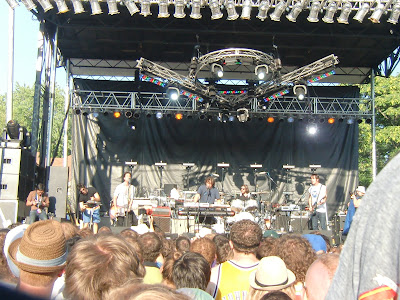 It was difficult to wait 50 minutes in between Raekwon and Wolf Parade, and to listen to Jon Spencer Blues Explosion play at the other stage. They seemed to be going totally crazy. But the wait was worth it, the spot was worth it, and the band played a fantastic set. It was my second time seeing them and this time it was much better. I just had chills running up and down my spine the whole time--the opener "Cloud Shadow on the Mountain," the crowd-pleasing "Dear Sons and Daughters of Hungry Ghosts" and "I'll Believe in Anything" and "This Heart's on Fire." A particular note about this set: my previous post about Expo '86 asserts that Spencer Krug (and to a lesser extent Dan Boeckner) have mind-reading abilities, and Spencer set up directly in front of me with his keyboard and seemed to make eye contact with me a couple times which made me swoon. My point is this: after a few songs, I started thinking that they had read my review on this blog, and tailored their setlist to make some kind of point. I know that's not what happened---but witness the first two songs they played--"Cloud Shadow.." and "Soldier's Grin"--which I mention the opening parts of in comparison to a Sunset Rubdown album opener--and witness the argument about which is the better closing track, "This Heart's on Fire" or "Cave-O-Sapien," which they played back-to-back--and witness Boeckner choosing to play "Ghost Pressure" instead of "Pobody's Nerfect" which I would have preferred reversed, but proved to me "Ghost..." is a good song too. The only thing I would have liked to hear would have been "California Dreamer" or "Grounds for Divorce" or "You are a Runner..."--but those are all Spencer songs, and he seemed to sing more as it was.
Here is Dan Boeckner, playing "Little Golden Age," I think, which was also prescient.

Spencer has long hair now and is less shy than in the past, it seems.
 Now we get to the sad part.
 You can see Panda Bear in the back right of that picture. He was playing his set, and we were waiting for LCD Soundsystem. It wasn't that long of a wait, really, just over an hour, but it was a very long hour. I have decided that I am going to leave my previous post up because this is taking way too long to write two reviews. You will be able to read there about the crowd-surfing annoying me, the six square inch space to stand within, the inability to move, or sit, but I did not mention the pot smoking this weekend. More than in the past, EVERYONE around me was smoking pot, smoking cigarettes, and drinking gallon water jugs. It made me jealous, and it made me realize why people have negative opinions of music festivals.
 It was difficult to wait 50 minutes in between Raekwon and Wolf Parade, and to listen to Jon Spencer Blues Explosion play at the other stage. They seemed to be going totally crazy. But the wait was worth it, the spot was worth it, and the band played a fantastic set. It was my second time seeing them and this time it was much better. I just had chills running up and down my spine the whole time--the opener "Cloud Shadow on the Mountain," the crowd-pleasing "Dear Sons and Daughters of Hungry Ghosts" and "I'll Believe in Anything" and "This Heart's on Fire." A particular note about this set: my previous post about Expo '86 asserts that Spencer Krug (and to a lesser extent Dan Boeckner) have mind-reading abilities, and Spencer set up directly in front of me with his keyboard and seemed to make eye contact with me a couple times which made me swoon. My point is this: after a few songs, I started thinking that they had read my review on this blog, and tailored their setlist to make some kind of point. I know that's not what happened---but witness the first two songs they played--"Cloud Shadow.." and "Soldier's Grin"--which I mention the opening parts of in comparison to a Sunset Rubdown album opener--and witness the argument about which is the better closing track, "This Heart's on Fire" or "Cave-O-Sapien," which they played back-to-back--and witness Boeckner choosing to play "Ghost Pressure" instead of "Pobody's Nerfect" which I would have preferred reversed, but proved to me "Ghost..." is a good song too. The only thing I would have liked to hear would have been "California Dreamer" or "Grounds for Divorce" or "You are a Runner..."--but those are all Spencer songs, and he seemed to sing more as it was.
Here is Dan Boeckner, playing "Little Golden Age," I think, which was also prescient.

Spencer has long hair now and is less shy than in the past, it seems.
 Now we get to the sad part.
 You can see Panda Bear in the back right of that picture. He was playing his set, and we were waiting for LCD Soundsystem. It wasn't that long of a wait, really, just over an hour, but it was a very long hour. I have decided that I am going to leave my previous post up because this is taking way too long to write two reviews. You will be able to read there about the crowd-surfing annoying me, the six square inch space to stand within, the inability to move, or sit, but I did not mention the pot smoking this weekend. More than in the past, EVERYONE around me was smoking pot, smoking cigarettes, and drinking gallon water jugs. It made me jealous, and it made me realize why people have negative opinions of music festivals.
 I didn't mention the girl who LOVED Panda Bear, and was standing nearby me, waiting for LCD. She screamed about how beautiful he was and how she wanted to have his babies, and she started freaking out during the second song he played. Now, I have not heard that song before, which made me think it will be something off Tomboy, and that song sounded really awesome. But that was it. If you read the other post, you will hear about the kid who said "Animal Collective was the worst experience of my life." And you will hear about how LCD was the worst experience of my life.

See! I was actually pretty close! But I was in significant trouble. Their setlist was almost perfect. "Us V Them," "Drunk Girls," "Pow Pow," "Daft Punk is Playing at My House," "All My Friends," "Trials and Tribulations," and "Movement." I lasted through all of those, and during "Yeah" I couldn't take it anymore. I left, and then heard "Someone Great" and "Losing My Edge" (which was the most crestfallen moment of the weekend for me) as I exited the grounds. They also played "New York, I Love You...." apparently, but who knows if they did the whole "Empire State of Mind" medley. James Murphy turned in an excellent performance, but he did not pay attention to the welfare of the "happy" people in front. Granted, everyone was happy, and only about three or four people in front of me left before I did. But I hated that crowd-surfing, and I hated not being able to move one way or another, and the sweat started to become too much for me tolerate. But like I said, it wasn't even the atmosphere of the set that bothered me so much, but WALKING OUT OF IT, which was like some horror-show obstacle course.

See! I was actually pretty close! But I was in significant trouble. Their setlist was almost perfect. "Us V Them," "Drunk Girls," "Pow Pow," "Daft Punk is Playing at My House," "All My Friends," "Trials and Tribulations," and "Movement." I lasted through all of those, and during "Yeah" I couldn't take it anymore. I left, and then heard "Someone Great" and "Losing My Edge" (which was the most crestfallen moment of the weekend for me) as I exited the grounds. They also played "New York, I Love You...." apparently, but who knows if they did the whole "Empire State of Mind" medley. James Murphy turned in an excellent performance, but he did not pay attention to the welfare of the "happy" people in front. Granted, everyone was happy, and only about three or four people in front of me left before I did. But I hated that crowd-surfing, and I hated not being able to move one way or another, and the sweat started to become too much for me tolerate. But like I said, it wasn't even the atmosphere of the set that bothered me so much, but WALKING OUT OF IT, which was like some horror-show obstacle course.
Still, by most accounts, this was highlight of the weekend.
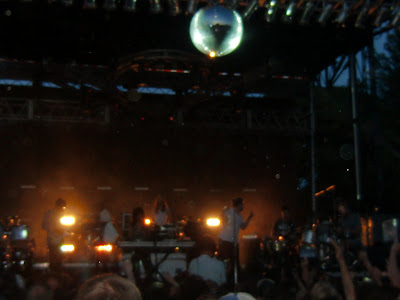 After painful memories of Saturday, I resolved to change my approach on Sunday. I had a couple Stella Artois before leaving Old Town and hitting the El, and that may have made the earlier part of the day better.

Girls were the first band I saw Sunday, overall it was a very good time. I wasn't very close to the stage, but the sound was decent, and I got to see the cool noise jam between "Hellhole Ratrace" and "Morning Light," which was definitely an homage to MBV's "You Made Me Realise." They ended their set with "Big Bad Mean Motherfucker" which sounded good too, though I had already left for the beer line. 
I waited until 4:45 to see Surfer Blood. I don't think there was any other band that I was looking forward to seeing as much as them. Just because I got more into their album than any other new album this year.
 They opened up with "Fast Jabroni," which ruled, but no one crowd-surfed or went crazy or anything. My thoughts of their entire set may be read in the previous post, but let me just add that they seemed, restrained in some way. Still, a great setlist, with "Floating Vibes," "Take it Easy," "Swim," "Anchorage," "Twin Peak," "Harmonix," their new song "I'm not Ready," and the one thing I forgot to mention: "Catholic Pagans." Now, this is a good song. But on the album I don't go too crazy for it. This was the only song that sounded way better live than on the album. They made it heavier and it was cooler.
 Neon Indian followed Here We Go Magic, who followed Surfer Blood. I sat and dozed during Here We Go Magic. They sounded okay. But I have a negative opionion of a girl I used to know who was into Here We Go Magic like back in February, so I don't need to see them. They did sound okay, to be fair. But I was tired. Neon Indian changed that.
 They played almost everything off Psychic Chasms and "Sleep Paralysis," which was my first time hearing it, but I knew what it was ("No sleep! No sleep!") and it made me dance. Overall, I have to say "Terminally Chill" and "Ephemeral Artery," the two songs they played on Late Night with Jimmy Fallon months ago, the first time I became aware of their live presence, were the highlights. But they opened up with "Local Joke" and that was cool. They suggested some audience participation for "Deadbeat Summer" and it was the only time I didn't find that sort of thing corny. This was definitely one of the can't miss highlights of the weekend, one of the best atmospheres.
Before Pavement there was Sleigh Bells. There was this Asian kid standing with his girlfriend next to me and he just kind of annoyed me with all of his talk about how hot the singer in Sleigh Bells is and how she is a school teacher and how he wondered if maybe she was the sort of teacher to hit on her boy students--now granted, there is a lot of random eavesdropping at music festivals, but this kid, and some other kids around me, actually, were just talking about how Sleigh Bells were going to be the best set of the day, and how no one even came close, and how they had no qualms about missing a good spot for Pavement, and it just annoyed me. I like Sleigh Bells, don't get me wrong! But there's more than a little hype to them. At first I couldn't figure out who to compare them to. Then I realized they sound like a rockier version of Crystal Castles. Their singer is pretty cute, and she does have a certain presence onstage, but without all of the vocal modulation on the album, she sounds a bit pedestrian. But she does know how to stir up the crowd.
I left after two songs. Because Pavement rules.

Malkmus said something about how he lost his voice for a moment, but overall, their execution was good. There was a radio shock-jock DJ who is also on the Slow Century DVD introducing the band. It was funny to see him in person. He talked for like 15 minutes about Q101 and the "original alternative nation" and trying to "break" Pavement and all this weird crap, like you couldn't tell if he was being really sarcastic or not, but obviously he is way into the band. They opened with "Cut Your Hair" and then played, oh what can I remember, "Kennel District" second? "Silence Kit," which was nice. "Stop Breathing" and "Stereo," which were a bit altered. "Shady Lane," obviously. "Range Life" and "Unfair." I guess that's a lot of stuff off Crooked Rain. "Range Life" was a great moment, when Malkmus said, "Out on tour with Chicago's Pumpkins" and the crowd screamed. Playing "The Hexx" as the last song of the festival was also a pretty badass thing to do. But as previously mentioned, I thought an encore was coming, and it was not.
 If you have never been the Pitchfork festival, I'm sorry, but now too many people go and it's kind of a claustrophobic experience. That said I still recommend it over Lollapalooza any year.
 After painful memories of Saturday, I resolved to change my approach on Sunday. I had a couple Stella Artois before leaving Old Town and hitting the El, and that may have made the earlier part of the day better.
Girls were the first band I saw Sunday, overall it was a very good time. I wasn't very close to the stage, but the sound was decent, and I got to see the cool noise jam between "Hellhole Ratrace" and "Morning Light," which was definitely an homage to MBV's "You Made Me Realise." They ended their set with "Big Bad Mean Motherfucker" which sounded good too, though I had already left for the beer line.
Note that I only spent $40 on beer this weekend. 20 tickets, twice. 8 beers. Heinekens mainly.
I also got to hear "Lust for Life," so even though I missed almost half of their set, I saw everything I wanted.
Here is a slightly-zoomed in photo of Girls.
Here is a slightly-zoomed in photo of Girls.
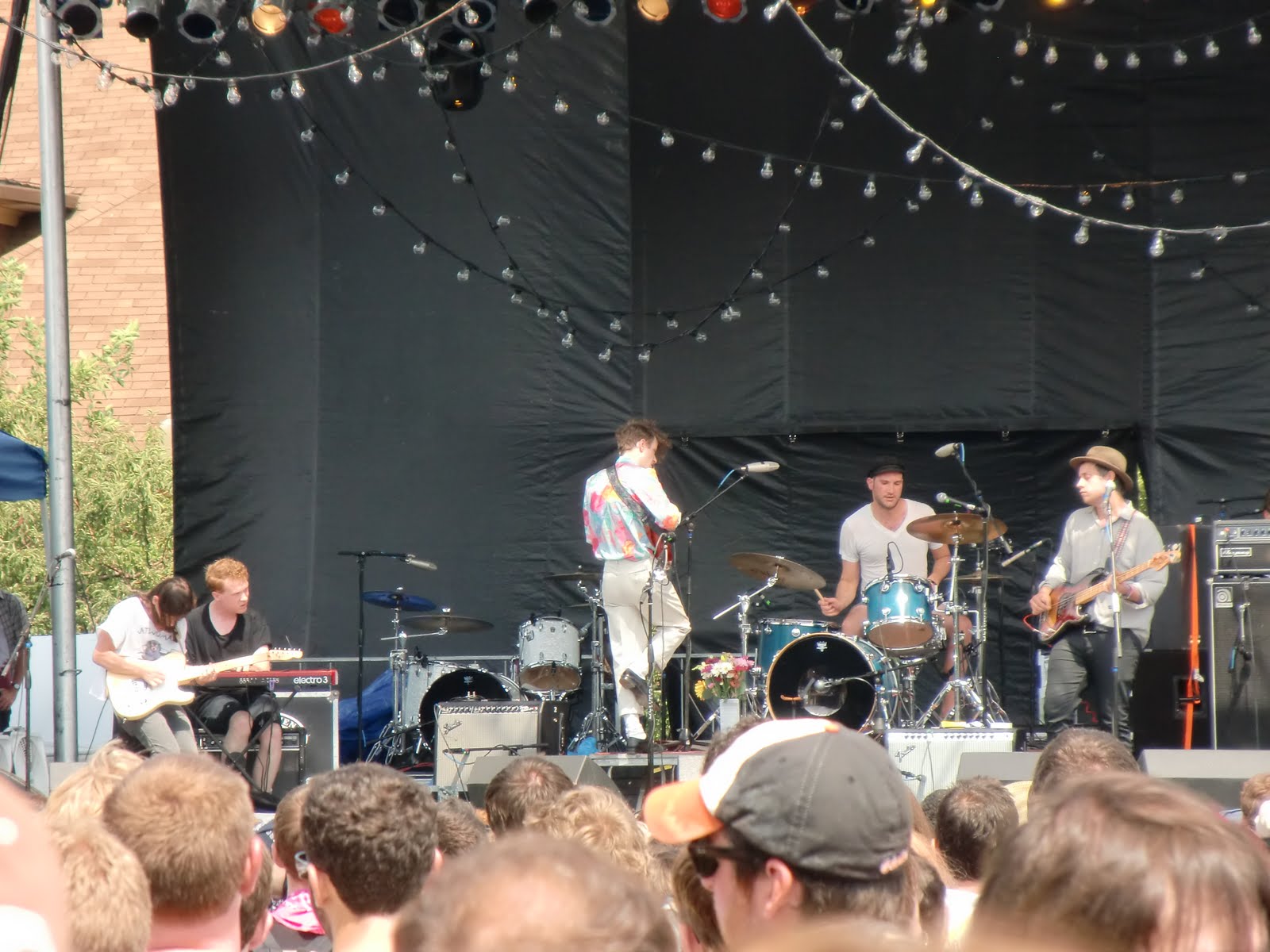
I waited until 4:45 to see Surfer Blood. I don't think there was any other band that I was looking forward to seeing as much as them. Just because I got more into their album than any other new album this year.
 They opened up with "Fast Jabroni," which ruled, but no one crowd-surfed or went crazy or anything. My thoughts of their entire set may be read in the previous post, but let me just add that they seemed, restrained in some way. Still, a great setlist, with "Floating Vibes," "Take it Easy," "Swim," "Anchorage," "Twin Peak," "Harmonix," their new song "I'm not Ready," and the one thing I forgot to mention: "Catholic Pagans." Now, this is a good song. But on the album I don't go too crazy for it. This was the only song that sounded way better live than on the album. They made it heavier and it was cooler.
 Neon Indian followed Here We Go Magic, who followed Surfer Blood. I sat and dozed during Here We Go Magic. They sounded okay. But I have a negative opionion of a girl I used to know who was into Here We Go Magic like back in February, so I don't need to see them. They did sound okay, to be fair. But I was tired. Neon Indian changed that.
 They played almost everything off Psychic Chasms and "Sleep Paralysis," which was my first time hearing it, but I knew what it was ("No sleep! No sleep!") and it made me dance. Overall, I have to say "Terminally Chill" and "Ephemeral Artery," the two songs they played on Late Night with Jimmy Fallon months ago, the first time I became aware of their live presence, were the highlights. But they opened up with "Local Joke" and that was cool. They suggested some audience participation for "Deadbeat Summer" and it was the only time I didn't find that sort of thing corny. This was definitely one of the can't miss highlights of the weekend, one of the best atmospheres.
Before Pavement there was Sleigh Bells.
 There was this Asian kid standing with his girlfriend next to me and he just kind of annoyed me with all of his talk about how hot the singer in Sleigh Bells is and how she is a school teacher and how he wondered if maybe she was the sort of teacher to hit on her boy students--now granted, there is a lot of random eavesdropping at music festivals, but this kid, and some other kids around me, actually, were just talking about how Sleigh Bells were going to be the best set of the day, and how no one even came close, and how they had no qualms about missing a good spot for Pavement, and it just annoyed me. I like Sleigh Bells, don't get me wrong! But there's more than a little hype to them. At first I couldn't figure out who to compare them to. Then I realized they sound like a rockier version of Crystal Castles. Their singer is pretty cute, and she does have a certain presence onstage, but without all of the vocal modulation on the album, she sounds a bit pedestrian. But she does know how to stir up the crowd.
I left after two songs. Because Pavement rules.

Malkmus said something about how he lost his voice for a moment, but overall, their execution was good. There was a radio shock-jock DJ who is also on the Slow Century DVD introducing the band. It was funny to see him in person. He talked for like 15 minutes about Q101 and the "original alternative nation" and trying to "break" Pavement and all this weird crap, like you couldn't tell if he was being really sarcastic or not, but obviously he is way into the band. They opened with "Cut Your Hair" and then played, oh what can I remember, "Kennel District" second? "Silence Kit," which was nice. "Stop Breathing" and "Stereo," which were a bit altered. "Shady Lane," obviously. "Range Life" and "Unfair." I guess that's a lot of stuff off Crooked Rain. "Range Life" was a great moment, when Malkmus said, "Out on tour with Chicago's Pumpkins" and the crowd screamed. Playing "The Hexx" as the last song of the festival was also a pretty badass thing to do. But as previously mentioned, I thought an encore was coming, and it was not.
 If you have never been the Pitchfork festival, I'm sorry, but now too many people go and it's kind of a claustrophobic experience. That said I still recommend it over Lollapalooza any year.
 Monday, July 19, 2010
Pitchfork Music Festival 2010 - July 16-18, 2010
Welcome to what will surely be one of the longest posts ever on Flying Houses--and certainly the most technological: my review of the Pitchfork festival. To be fair, reviews themselves can never be authoritative. There were 54,000 other people there that all had different experiences than me. Due to my own idiosyncrasies, my experience may appear inaccurate, or incorrect, but I will attempt to maintain a subjective stance so when I diss Pitchfork or Chicagoans you will know that not everyone agrees with everything I have to say.
 Liars played a satisfactory set, focusing heavily on material from Sisterworld. I have only seen Liars once before, during the They Were Wrong, So We Drowned tour at a free NYU show, which, interestingly enough, is the only previous concert that I have attempted to bootleg--and I have about 30 minutes on my camcorder from that which is so much better than the quality I was able to get out of my digital camera this weekend--but I digress. Now, Liars are not as much of a "bait and switch" act as they were in 2004, but I have pretty much the same problem with them. They played material from every album except their debut--and the only songs I really wanted to hear were off their debut. This is basically the problem with every set at Pitchfork. These aren't headlining sets. They're supposed to pick their best songs to play in 45 minutes, or newest songs, whatever. Liars were satisfactory. I have no major complaints beyond not getting to hear "Grown Men Don't Fall in the River Just Like That" or "We Live NE of Compton."

They opened with "World Sick," didn't play the last three minutes of that song, and then went into "Stars and Sons." Now, when they played this, it reminded me of seeing Broken Social Scene at the Pitchfork fest in 2005. I had a serious deja vu moment, and realized Broken Social Scene were way better back then. No offense--if you read my review of Forgiveness Rock Record, you'll know I still thought they'd be a good live band, and for the most part, they were. They played a bunch of their hits ("Cause = Time," "Superconnected," "Shoreline") which made me think they consider S/T their best work. Then they ended with "Meet Me in the Basement" which re-affirmed my belief that it would be the best song on the new album if it had words. In general, a weaker performance than I've seen in the past from them, but I'm sure no one else was disappointed.
I seem to be having a difficult time adding pictures to this post. So I will stop with them. Only videos from here on in. Here are the two last pictures that were such a pain in the ass to move.
One is of Real Estate and the other is of Titus Andronicus. Both are from New Jersey


I would add a video of Titus Andronicus, but the Broken Social Scene one is taking forever. I guess I am learning lessons about utilizing technology, massive file sizes for upload. Real Estate was the first band I saw on Saturday. I did not know any of their songs. And I still do not know any of their songs, but they won me over. They were unpretentious, vaguely interesting, and skilled. Titus Andronicus, however, definitely won me over. I have not heard The Monitor (only The Airing of Grievances) but from the sound of their set, most of their songs sound the same. They always get bombastic, and Patrick Stickles always loses it. I was surprised by how dedicated their fan base is. They are a relatively new band, and for so many people to be so into them, well I think they have a bright future.
Then I had my horrible idea about camping out for a good spot for Wolf Parade. The camp out in this moment was not that bad, when I was sitting down indian-style during the Raekwon set, dozing. It was brutal when Raekwon ended, and it was time to get up, and it was time to stake out a position close to the stage for Wolf Parade, and it was time to wait the entire 50 minutes of the Jon Spencer Blues Explosion set, which sounded awesome and which I regret missing in retrospect. Then, Wolf Parade started.
I had a cool video of "Cloud Shadow on the Mountain" which was their opening song, but this video upload is not cool. Of all the sets I saw all weekend, I have to say Wolf Parade was my single favorite. It was probably because the spot in the crowd was pretty good, and because they just brought it. I only saw Wolf Parade once before, but this was a much better show. Their setlist was impeccable. The only thing that hampered my enjoyment was the crowd-surfing, which made "Cave-O-Sapien" more nerve-wracking than blissful.
Then we get to the reason why Saturday was so bad for me, which was LCD Soundsystem. Now, I love LCD Soundsystem. But so do a whole lot of other people. I planned to stand in place to wait for them, while Panda Bear played at the other stage. I heard some kid say, "Don't go see Panda Bear. I saw Animal Collective last year and it was the worst experience of my life." Well kid, what happened to me at LCD Soundsystem was probably not the worst experience of my life, but one of them.
It was the crowd dispersal after Wolf Parade, which did not happen. Everybody who was close for Wolf Parade had the same idea as me. Wait for LCD, and have a good spot. What a mistake! I should have known when Panda Bear started, and everyone around me sat down, except for the people that didn't have room to sit down, one of which was me. I stood on my tiptoes to try to see some of Panda Bear, and I felt wobbly and felt like I might fall on someone. It was terrible. There were six square inches within which I could stand, and I could not change my position, and I panicked and eventually, someone behind me stood up, which allowed me to sit down briefly. Panda Bear's set did not sound that exciting, but I still expect Tomboy to be really awesome.
LCD came on, after much anticipation from everyone around me, since we were all so miserably packed together. Something else happened that annoyed me: during Wolf Parade, someone had moved the garbage can close to the stage, and people were jumping off it to crowd-surf, which made me have to keep glancing back to make sure I wasn't about to be kicked in the head. Someone sat on the garbage can to wait for LCD, and it seemed like a very nice spot to have. Later, people would get up on it and dance during the set, also causing nervousness from me. At one point my calves were brushing up against the plastic bag attached to the front of it, and there was no way to get away from it, and I thought, wow, this is really a terrible spot to have. Later there was a bit of pushing and I did get away. I did not have fun at LCD. I wanted to have fun, but I did not. "US v Them," "Drunk Girls," "Pow Pow," "All My Friends..." --the performance was fantastic. I have no complaints about the performance. Only my experience. "All My Friends" was particularly ironic, as everyone seemed to think this was the apex of the weekend, and it was the point at which I broke and decided I couldn't stay. "Daft Punk is Playing at My House" caused crowd-surfing again, and the only time I got kicked in the head, it was incredibly gentle. But I was sweating horribly. I had to leave.
And leaving, was one of the worst experiences of my life. Because everyone was there. And packed deep. Once I thought I was out of the woods, there were more people to get around. And it would absolutely amaze me how stupid people were, they they wouldn't move aside to let me leave--and that even some of them would look at me like I was getting in their way and make a face at me like I was so disgusting for sweating that much. They played "Someone Great" and I was like, "Wow, I'm glad that I left!" and then they played "Losing My Edge" later, which I could hear from the El platform, and I was very upset because it's one of my favorite songs ever.
The next day I resolved to not be so crazy about getting the best possible spot. I saw Girls first, and they were excellent. I had a cool video that showed the noise jam as a segue between "Hellhole Ratrace" and "Morning Light," but now I think I'm even going to cancel the BSS video because it's still uploading! Girls were excellent and I should have bought their t-shirt, but I only saw the last twenty or thirty minutes of their set.
I was very excited for Surfer Blood. I had to wait through some of Local Natives, which marked my first stop at the Connector Stage, which was probably the place to be all weekend. I had a good time Sunday hanging out there most of the day. Surfer Blood played an excellent set, including a new song called "I'm Not Ready," which was similar to stuff off Astro Coast. I did feel vaguely disappointed, as if it could have been louder, or angrier, or something. Basically, let me say this: I still love Surfer Blood, but on record, their execution is so flawless that in person, they inevitably could not live up to themselves. They did change the line "You and me/could it be meant to be?" to "You and me/it's fucking anarchy," but I still felt they were too nice and seemed a bit more like Vampire Weekend Jr. than the Dinosaur one.
Neon Indian is probably the opposite of Surfer Blood. Psychic Chasms may be a very good album, but I prefer Astro Coast for air-guitar purposes. But, while Surfer Blood could not quite match the sound of their album (it is perhaps worth noting that Liars could not do that with Sisterworld either), Neon Indian exceeded all expectations. Their live show is better than their album. They have so many gadgets. And Alan Palomo is a magnetic performer. They had a great spot on the schedule, warming up the crowd for the big finale, and they did an almost perfect job.
Sleigh Bells came after, and they were okay. I like them. But I only stayed for two songs and then went to Pavement.
Pavement was everything I hoped it would be, but no more. If you look at the tracklist of Quarantine the Past you can pretty much guess their setlist. There were maybe three surprises ("Debris Slide" and "Kennel District" and "The Hexx"). "Stereo" and "Stop Breathing" featured some variations that made it more interesting. I had a spot very far back, and I wished I could have been at the front for "Conduit for Sale!" (definitely the best moment of the set), and I feel I belonged at the front where everyone knows every lyric and sings every lyric and you don't feel like a loser if you're singing along, but I learned this weekend that sometimes the dedication required to have that sort of concert experience isn't always worth it. Pavement was good, but I would have liked to hear "Carrot Rope" or "Speak, See, Remember" or "AT&T" or "Flux = Rad" or "Fight this Generation." But we can't have sets tailored to our specifications.
I did want to say this, before the final rankings: I saw Superchunk on June 20, 2010 at the Taste of Randolph. I had ten times more fun during Superchunk than I did during any single set at Pitchfork, with Wolf Parade the only one even coming close. Pitchfork is too crowded now. It's been happening slowly, but they finally reach their critical mass this year. They did do a good job with the water. They handed it out for free, thinking of the people that camped, and they cut the price drastically as the weekend went on. They need to work on crowd control though. If everyone at LCD had taken two or three steps back, I probably could have stayed. But James Murphy is not Ian Mackaye. The people there were still cool in general, but it just seemed more unbearable for me this time.
How about we end the story with the way it ended, when I left Pavement, after waiting for an encore that looked like it would happen and then didn't (no "Summer Babe?"), and when I tried to get home. The El had a line down the stairs, out the exit, and the platforms were jam-packed. I was not going to wait 15 minutes to move inside the staircase. I kept walking north, at 300 N needing to get to 1600 N, with a huge group of concert-goers. The bus came, but I could not get on it because it did not stop because it was too full. I finally got a cab coming off one of the sidestreets, and I felt like he took an indirect route. When it was over, I was glad. However, I was looking forward to my totally awesome blog post with all those videos in it, and now it won't happen.
I still recommend anyone go to Pitchfork over Lollapalooza. But I don't recommend camping out for a good spot, and I don't recommend going alone.
Liars: 7/10
Broken Social Scene: 7/10
Modest Mouse: 7/10 (not written, but not worth describing said experience)
Real Estate: 7/10
Titus Andronicus: 8/10
Wolf Parade: 9/10
LCD Soundsystem: (Performance: 9/10; Experience: 1/10)
Girls: 8/10
Surfer Blood: 7.5/10
Neon Indian: 9/10
Sleigh Bells: 8/10
Pavement: 8.8/10
Let us begin on Friday, with the Liars, the first set I saw.
(clip review: I had a clip of "Scissor" that was longer, but I felt this was one of the most crisp video images I was able to capture, short and sweet as it is)
Liars played a satisfactory set, focusing heavily on material from Sisterworld. I have only seen Liars once before, during the They Were Wrong, So We Drowned tour at a free NYU show, which, interestingly enough, is the only previous concert that I have attempted to bootleg--and I have about 30 minutes on my camcorder from that which is so much better than the quality I was able to get out of my digital camera this weekend--but I digress. Now, Liars are not as much of a "bait and switch" act as they were in 2004, but I have pretty much the same problem with them. They played material from every album except their debut--and the only songs I really wanted to hear were off their debut. This is basically the problem with every set at Pitchfork. These aren't headlining sets. They're supposed to pick their best songs to play in 45 minutes, or newest songs, whatever. Liars were satisfactory. I have no major complaints beyond not getting to hear "Grown Men Don't Fall in the River Just Like That" or "We Live NE of Compton."They opened with "World Sick," didn't play the last three minutes of that song, and then went into "Stars and Sons." Now, when they played this, it reminded me of seeing Broken Social Scene at the Pitchfork fest in 2005. I had a serious deja vu moment, and realized Broken Social Scene were way better back then. No offense--if you read my review of Forgiveness Rock Record, you'll know I still thought they'd be a good live band, and for the most part, they were. They played a bunch of their hits ("Cause = Time," "Superconnected," "Shoreline") which made me think they consider S/T their best work. Then they ended with "Meet Me in the Basement" which re-affirmed my belief that it would be the best song on the new album if it had words. In general, a weaker performance than I've seen in the past from them, but I'm sure no one else was disappointed.
I seem to be having a difficult time adding pictures to this post. So I will stop with them. Only videos from here on in. Here are the two last pictures that were such a pain in the ass to move.
One is of Real Estate and the other is of Titus Andronicus. Both are from New Jersey
I would add a video of Titus Andronicus, but the Broken Social Scene one is taking forever. I guess I am learning lessons about utilizing technology, massive file sizes for upload. Real Estate was the first band I saw on Saturday. I did not know any of their songs. And I still do not know any of their songs, but they won me over. They were unpretentious, vaguely interesting, and skilled. Titus Andronicus, however, definitely won me over. I have not heard The Monitor (only The Airing of Grievances) but from the sound of their set, most of their songs sound the same. They always get bombastic, and Patrick Stickles always loses it. I was surprised by how dedicated their fan base is. They are a relatively new band, and for so many people to be so into them, well I think they have a bright future.
Then I had my horrible idea about camping out for a good spot for Wolf Parade. The camp out in this moment was not that bad, when I was sitting down indian-style during the Raekwon set, dozing. It was brutal when Raekwon ended, and it was time to get up, and it was time to stake out a position close to the stage for Wolf Parade, and it was time to wait the entire 50 minutes of the Jon Spencer Blues Explosion set, which sounded awesome and which I regret missing in retrospect. Then, Wolf Parade started.
I had a cool video of "Cloud Shadow on the Mountain" which was their opening song, but this video upload is not cool. Of all the sets I saw all weekend, I have to say Wolf Parade was my single favorite. It was probably because the spot in the crowd was pretty good, and because they just brought it. I only saw Wolf Parade once before, but this was a much better show. Their setlist was impeccable. The only thing that hampered my enjoyment was the crowd-surfing, which made "Cave-O-Sapien" more nerve-wracking than blissful.
Then we get to the reason why Saturday was so bad for me, which was LCD Soundsystem. Now, I love LCD Soundsystem. But so do a whole lot of other people. I planned to stand in place to wait for them, while Panda Bear played at the other stage. I heard some kid say, "Don't go see Panda Bear. I saw Animal Collective last year and it was the worst experience of my life." Well kid, what happened to me at LCD Soundsystem was probably not the worst experience of my life, but one of them.
It was the crowd dispersal after Wolf Parade, which did not happen. Everybody who was close for Wolf Parade had the same idea as me. Wait for LCD, and have a good spot. What a mistake! I should have known when Panda Bear started, and everyone around me sat down, except for the people that didn't have room to sit down, one of which was me. I stood on my tiptoes to try to see some of Panda Bear, and I felt wobbly and felt like I might fall on someone. It was terrible. There were six square inches within which I could stand, and I could not change my position, and I panicked and eventually, someone behind me stood up, which allowed me to sit down briefly. Panda Bear's set did not sound that exciting, but I still expect Tomboy to be really awesome.
LCD came on, after much anticipation from everyone around me, since we were all so miserably packed together. Something else happened that annoyed me: during Wolf Parade, someone had moved the garbage can close to the stage, and people were jumping off it to crowd-surf, which made me have to keep glancing back to make sure I wasn't about to be kicked in the head. Someone sat on the garbage can to wait for LCD, and it seemed like a very nice spot to have. Later, people would get up on it and dance during the set, also causing nervousness from me. At one point my calves were brushing up against the plastic bag attached to the front of it, and there was no way to get away from it, and I thought, wow, this is really a terrible spot to have. Later there was a bit of pushing and I did get away. I did not have fun at LCD. I wanted to have fun, but I did not. "US v Them," "Drunk Girls," "Pow Pow," "All My Friends..." --the performance was fantastic. I have no complaints about the performance. Only my experience. "All My Friends" was particularly ironic, as everyone seemed to think this was the apex of the weekend, and it was the point at which I broke and decided I couldn't stay. "Daft Punk is Playing at My House" caused crowd-surfing again, and the only time I got kicked in the head, it was incredibly gentle. But I was sweating horribly. I had to leave.
And leaving, was one of the worst experiences of my life. Because everyone was there. And packed deep. Once I thought I was out of the woods, there were more people to get around. And it would absolutely amaze me how stupid people were, they they wouldn't move aside to let me leave--and that even some of them would look at me like I was getting in their way and make a face at me like I was so disgusting for sweating that much. They played "Someone Great" and I was like, "Wow, I'm glad that I left!" and then they played "Losing My Edge" later, which I could hear from the El platform, and I was very upset because it's one of my favorite songs ever.
The next day I resolved to not be so crazy about getting the best possible spot. I saw Girls first, and they were excellent. I had a cool video that showed the noise jam as a segue between "Hellhole Ratrace" and "Morning Light," but now I think I'm even going to cancel the BSS video because it's still uploading! Girls were excellent and I should have bought their t-shirt, but I only saw the last twenty or thirty minutes of their set.
I was very excited for Surfer Blood. I had to wait through some of Local Natives, which marked my first stop at the Connector Stage, which was probably the place to be all weekend. I had a good time Sunday hanging out there most of the day. Surfer Blood played an excellent set, including a new song called "I'm Not Ready," which was similar to stuff off Astro Coast. I did feel vaguely disappointed, as if it could have been louder, or angrier, or something. Basically, let me say this: I still love Surfer Blood, but on record, their execution is so flawless that in person, they inevitably could not live up to themselves. They did change the line "You and me/could it be meant to be?" to "You and me/it's fucking anarchy," but I still felt they were too nice and seemed a bit more like Vampire Weekend Jr. than the Dinosaur one.
Neon Indian is probably the opposite of Surfer Blood. Psychic Chasms may be a very good album, but I prefer Astro Coast for air-guitar purposes. But, while Surfer Blood could not quite match the sound of their album (it is perhaps worth noting that Liars could not do that with Sisterworld either), Neon Indian exceeded all expectations. Their live show is better than their album. They have so many gadgets. And Alan Palomo is a magnetic performer. They had a great spot on the schedule, warming up the crowd for the big finale, and they did an almost perfect job.
Sleigh Bells came after, and they were okay. I like them. But I only stayed for two songs and then went to Pavement.
Pavement was everything I hoped it would be, but no more. If you look at the tracklist of Quarantine the Past you can pretty much guess their setlist. There were maybe three surprises ("Debris Slide" and "Kennel District" and "The Hexx"). "Stereo" and "Stop Breathing" featured some variations that made it more interesting. I had a spot very far back, and I wished I could have been at the front for "Conduit for Sale!" (definitely the best moment of the set), and I feel I belonged at the front where everyone knows every lyric and sings every lyric and you don't feel like a loser if you're singing along, but I learned this weekend that sometimes the dedication required to have that sort of concert experience isn't always worth it. Pavement was good, but I would have liked to hear "Carrot Rope" or "Speak, See, Remember" or "AT&T" or "Flux = Rad" or "Fight this Generation." But we can't have sets tailored to our specifications.
I did want to say this, before the final rankings: I saw Superchunk on June 20, 2010 at the Taste of Randolph. I had ten times more fun during Superchunk than I did during any single set at Pitchfork, with Wolf Parade the only one even coming close. Pitchfork is too crowded now. It's been happening slowly, but they finally reach their critical mass this year. They did do a good job with the water. They handed it out for free, thinking of the people that camped, and they cut the price drastically as the weekend went on. They need to work on crowd control though. If everyone at LCD had taken two or three steps back, I probably could have stayed. But James Murphy is not Ian Mackaye. The people there were still cool in general, but it just seemed more unbearable for me this time.
How about we end the story with the way it ended, when I left Pavement, after waiting for an encore that looked like it would happen and then didn't (no "Summer Babe?"), and when I tried to get home. The El had a line down the stairs, out the exit, and the platforms were jam-packed. I was not going to wait 15 minutes to move inside the staircase. I kept walking north, at 300 N needing to get to 1600 N, with a huge group of concert-goers. The bus came, but I could not get on it because it did not stop because it was too full. I finally got a cab coming off one of the sidestreets, and I felt like he took an indirect route. When it was over, I was glad. However, I was looking forward to my totally awesome blog post with all those videos in it, and now it won't happen.
I still recommend anyone go to Pitchfork over Lollapalooza. But I don't recommend camping out for a good spot, and I don't recommend going alone.
Liars: 7/10
Broken Social Scene: 7/10
Modest Mouse: 7/10 (not written, but not worth describing said experience)
Real Estate: 7/10
Titus Andronicus: 8/10
Wolf Parade: 9/10
LCD Soundsystem: (Performance: 9/10; Experience: 1/10)
Girls: 8/10
Surfer Blood: 7.5/10
Neon Indian: 9/10
Sleigh Bells: 8/10
Pavement: 8.8/10
Thursday, July 8, 2010
Wolf Parade - Expo '86
When we last caught up with Wolf Parade about two years ago (http://flyinghouses.blogspot.com/2008/06/wolf-parade-at-mount-zoomer.html), we were in Los Angeles, we were calling Spencer Krug's voice "twittering" and we were talking about how he read minds and we were talking about personal problems plaguing the publication of a zine that will now never be resurrected.
Things have changed. We are many miles east, "twittering" is a weird word, and the zine will never see the light of day--but Krug still reads minds. And the new Wolf Parade album, Expo '86, is just fine.
Since then, Handsome Furs put out a new critically-acclaimed album, and Sunset Rubdown put out Dragonslayer, which should have been reviewed here but wasn't. It also should have been named an "honorable mention" on the best albums of 2009 list, along with the Pissed Jeans record, but I am not so thorough sometimes. Dragonslayer was not as good as Random Spirit Lover, in my opinion--but not anybody else's. As far as rock critics opinions go, the leaders of Wolf Parade are at the top of their game.
And this album is receiving middling reviews, somewhat similar to the one I am writing. They say it's good, better than At Mount Zoomer, but not as good as Apologies to Queen Mary. At Mount Zoomer had a few good songs and some decent moments, but makes for a relatively difficult listen. Expo '86 isn't the easiest listen in the world, but there is more to love about it, and it's fair to say that Wolf Parade are "back on track."
The first track "Cloud Shadow on the Mountain" is Krug's, and before anything else on the album you hear him sing "I was asleep on a hammock." It's a very rushed opening, also bearing a certain resemblance the "The Mending of the Gown," the opening track on Random Spirit Lover, but instead of the weird keyboard part that also seems to open At Mount Zoomer, there is Krug's restlessness. And his restlessness is more contained, but still quite satisfying on this opening track.
"Palm Road" is a Dan Boeckner song, and it is almost comical how much it sounds like an Arcade Fire song. Granted, the drummer in Wolf Parade also played (plays?) in Arcade Fire, and even though I said "The Grey Estates" sounded like "Antichrist Television Blues," this time the similarity is totally unmistakable. It has been called a "Springsteen-esque" song, as Arcade Fire songs often are, but this is a "cover-like homage" to a peer like I have never heard before.
That said it's a good song, but I am too partial to Krug, and the next track "What Did My Lover Say (It Always Had to Go this Way)" is one of his and one of the best here. Of particular note is when he sings, "I've got a friend who's a genius/Nobody listens to him/I've got some friends who got famous/la la la la la la." Mind-reading lyrical genius and good music to set it against make for an album highlight.
Boeckner's next song, however, takes him into a higher class, and while I am very partial to Krug, Boeckner's songs on this album are my favorite that I have heard from him. Particularly this 4th track, "Little Golden Age" which talks about getting stoned in parking lots and watching the stars:
"So we hung around and we hung around
and we hung around for days
In the parking lot stoned, star shone out of phase
And the rain came down, cassettes wore out. Oh no!
Then you left town feeling pretty down
With your headphones on and your coat and
your dirty graduation gown you were
In the bedroom singing radio songs
Sing them loud
Sing them all night, Emily
You need something to help you along
Freeze, freeze, freeze Little Golden Age"
There was a review in the Chicago Tribune of this album and they basically said, "Yeah, it's good, (I think they gave it 2 1/2 stars out of 4) but they don't have much to say." The critic (I don't think it was Greg Kot, I rarely disagree with him) claimed the lyrics were weak on this album, and yeah, sometimes Wolf Parade lyrics can be vague (Boeckner) or like young-adult-fantasy-fiction (Krug), but they're never redundant or cliched. They're often mysterious, and seem to be meaningless, which is the critic's issue, but they're not, and he's stupid (unless it was Greg Kot).
The 5th track, "In the Direction of the Moon" is Krug again, with some of his zaniest lyrics ever ("I'm a disaster!"..."I take my meals with weirdos") that save it from being a boring song. It sounds like it will be an epic song, but it's not really. Krug's lyrics are actually very touching, addressed to a lover that is the "most gracious thing I know," "fantastic," and "so composed."
I guess the song is about a relationship that is barely holding together because the narrator is so messed up and the lover is much more together with their life. But there is self-consciousness, and one cannot believe the narrator would make such trouble, hence the touching aspect.
"Ghost Pressure" is Boeckner and probably one of the more unremarkable things on the album. Not an unpleasant song, just unremarkable.
"Pobody's Nerfect," however, is Boeckner again, and his second best song after "Little Golden Age" here. It would be a good candidate for radio airplay, and is perhaps the most accessible song on the album (well, after "Palm Road" maybe).
"Two Men in New Tuxedos" is Krug, so it's good, but also vaguely unremarkable. It also has the line "I can see into the future!" --so it is the point at which Krug finally opens up about his extrasensory talents.
"Oh You, Old Thing" is like a repeat of the previous track, in being an unremarkable Krug song, still containing brilliant lyrics: "As much as I have always loved your dancing/I hate the sounds that come from crowds/that just don't get/my moves."
"Yulia" is another pleasant surprise from Boeckner which always makes me think about the band Mercury Landing and how they used to be called Yulia and I wonder what the fuck that word means and I wonder if it is just some variant of Julia.
Then you get to "Cave-o-Sapien." Now, Wolf Parade have always had good closing tracks, but this is the best they have ever done. It is yet another Krug song, so the bookends of the album are his, and they're two of the highlights of it all. OK, to be fair, it's really hard to be a better song than "This Heart's on Fire"--but that was a Boeckner song. "Kissing the Beehive" had a couple of beautiful moments, but on the whole, like the album it closes, it's a bit to slog through. But "Cave-o-Sapien" is economical, epic, and declarative.
This is also an interesting album because it is named for a fair that happened in Montreal in 1986, where apparently all three main members of Wolf Parade were in attendance as children. The sleeve for the CD is cool, and the CD itself mimics the appearance of compact discs from the mid-to-late 80's, which is so cool. I don't know how that concept fits in with the general trajectory of the songs here, but I don't think Wolf Parade have been interested in "concept albums." Their albums have been collections of songs without a general theme, unless you could say each songwriter brings his own themes to each of his songs, which is kind of true, I think. They're both distinct, and their songwriting strengths helped to make Apologies to Queen Mary such a shot out of the blue. Their other albums continue to eclipse their "supergroup," but nobody will notice them anyways.
The At Mount Zoomer review ends with a ranking of all the albums each member has done, and I will not attempt that--only ask the question, is Expo '86 better than Dragonslayer? And I say yes. But still not as good as Random Spirit Lover and still not as good as Apologies to Queen Mary. Probably the 3rd best album by any individual in the collective--but I still haven't heard that new Handsome Furs one either. It's possible this will make the top 10 of 2010 but it is more likely I will only mention it honorably.
Things have changed. We are many miles east, "twittering" is a weird word, and the zine will never see the light of day--but Krug still reads minds. And the new Wolf Parade album, Expo '86, is just fine.
Since then, Handsome Furs put out a new critically-acclaimed album, and Sunset Rubdown put out Dragonslayer, which should have been reviewed here but wasn't. It also should have been named an "honorable mention" on the best albums of 2009 list, along with the Pissed Jeans record, but I am not so thorough sometimes. Dragonslayer was not as good as Random Spirit Lover, in my opinion--but not anybody else's. As far as rock critics opinions go, the leaders of Wolf Parade are at the top of their game.
And this album is receiving middling reviews, somewhat similar to the one I am writing. They say it's good, better than At Mount Zoomer, but not as good as Apologies to Queen Mary. At Mount Zoomer had a few good songs and some decent moments, but makes for a relatively difficult listen. Expo '86 isn't the easiest listen in the world, but there is more to love about it, and it's fair to say that Wolf Parade are "back on track."
The first track "Cloud Shadow on the Mountain" is Krug's, and before anything else on the album you hear him sing "I was asleep on a hammock." It's a very rushed opening, also bearing a certain resemblance the "The Mending of the Gown," the opening track on Random Spirit Lover, but instead of the weird keyboard part that also seems to open At Mount Zoomer, there is Krug's restlessness. And his restlessness is more contained, but still quite satisfying on this opening track.
"Palm Road" is a Dan Boeckner song, and it is almost comical how much it sounds like an Arcade Fire song. Granted, the drummer in Wolf Parade also played (plays?) in Arcade Fire, and even though I said "The Grey Estates" sounded like "Antichrist Television Blues," this time the similarity is totally unmistakable. It has been called a "Springsteen-esque" song, as Arcade Fire songs often are, but this is a "cover-like homage" to a peer like I have never heard before.
That said it's a good song, but I am too partial to Krug, and the next track "What Did My Lover Say (It Always Had to Go this Way)" is one of his and one of the best here. Of particular note is when he sings, "I've got a friend who's a genius/Nobody listens to him/I've got some friends who got famous/la la la la la la." Mind-reading lyrical genius and good music to set it against make for an album highlight.
Boeckner's next song, however, takes him into a higher class, and while I am very partial to Krug, Boeckner's songs on this album are my favorite that I have heard from him. Particularly this 4th track, "Little Golden Age" which talks about getting stoned in parking lots and watching the stars:
"So we hung around and we hung around
and we hung around for days
In the parking lot stoned, star shone out of phase
And the rain came down, cassettes wore out. Oh no!
Then you left town feeling pretty down
With your headphones on and your coat and
your dirty graduation gown you were
In the bedroom singing radio songs
Sing them loud
Sing them all night, Emily
You need something to help you along
Freeze, freeze, freeze Little Golden Age"
There was a review in the Chicago Tribune of this album and they basically said, "Yeah, it's good, (I think they gave it 2 1/2 stars out of 4) but they don't have much to say." The critic (I don't think it was Greg Kot, I rarely disagree with him) claimed the lyrics were weak on this album, and yeah, sometimes Wolf Parade lyrics can be vague (Boeckner) or like young-adult-fantasy-fiction (Krug), but they're never redundant or cliched. They're often mysterious, and seem to be meaningless, which is the critic's issue, but they're not, and he's stupid (unless it was Greg Kot).
The 5th track, "In the Direction of the Moon" is Krug again, with some of his zaniest lyrics ever ("I'm a disaster!"..."I take my meals with weirdos") that save it from being a boring song. It sounds like it will be an epic song, but it's not really. Krug's lyrics are actually very touching, addressed to a lover that is the "most gracious thing I know," "fantastic," and "so composed."
I guess the song is about a relationship that is barely holding together because the narrator is so messed up and the lover is much more together with their life. But there is self-consciousness, and one cannot believe the narrator would make such trouble, hence the touching aspect.
"Ghost Pressure" is Boeckner and probably one of the more unremarkable things on the album. Not an unpleasant song, just unremarkable.
"Pobody's Nerfect," however, is Boeckner again, and his second best song after "Little Golden Age" here. It would be a good candidate for radio airplay, and is perhaps the most accessible song on the album (well, after "Palm Road" maybe).
"Two Men in New Tuxedos" is Krug, so it's good, but also vaguely unremarkable. It also has the line "I can see into the future!" --so it is the point at which Krug finally opens up about his extrasensory talents.
"Oh You, Old Thing" is like a repeat of the previous track, in being an unremarkable Krug song, still containing brilliant lyrics: "As much as I have always loved your dancing/I hate the sounds that come from crowds/that just don't get/my moves."
"Yulia" is another pleasant surprise from Boeckner which always makes me think about the band Mercury Landing and how they used to be called Yulia and I wonder what the fuck that word means and I wonder if it is just some variant of Julia.
Then you get to "Cave-o-Sapien." Now, Wolf Parade have always had good closing tracks, but this is the best they have ever done. It is yet another Krug song, so the bookends of the album are his, and they're two of the highlights of it all. OK, to be fair, it's really hard to be a better song than "This Heart's on Fire"--but that was a Boeckner song. "Kissing the Beehive" had a couple of beautiful moments, but on the whole, like the album it closes, it's a bit to slog through. But "Cave-o-Sapien" is economical, epic, and declarative.
This is also an interesting album because it is named for a fair that happened in Montreal in 1986, where apparently all three main members of Wolf Parade were in attendance as children. The sleeve for the CD is cool, and the CD itself mimics the appearance of compact discs from the mid-to-late 80's, which is so cool. I don't know how that concept fits in with the general trajectory of the songs here, but I don't think Wolf Parade have been interested in "concept albums." Their albums have been collections of songs without a general theme, unless you could say each songwriter brings his own themes to each of his songs, which is kind of true, I think. They're both distinct, and their songwriting strengths helped to make Apologies to Queen Mary such a shot out of the blue. Their other albums continue to eclipse their "supergroup," but nobody will notice them anyways.
The At Mount Zoomer review ends with a ranking of all the albums each member has done, and I will not attempt that--only ask the question, is Expo '86 better than Dragonslayer? And I say yes. But still not as good as Random Spirit Lover and still not as good as Apologies to Queen Mary. Probably the 3rd best album by any individual in the collective--but I still haven't heard that new Handsome Furs one either. It's possible this will make the top 10 of 2010 but it is more likely I will only mention it honorably.
Wednesday, June 30, 2010
Imperial Bedrooms - Bret Easton Ellis
A genuine literary event.
That is what it says at the bottom of the front jacket cover for this book, underneath a general description of the plot, which is this: the sequel to Less Than Zero, twenty-five years later. Clay is a screenwriter, who is interested in a girl, and he tries to get this girl a part in the new movie he's producing. Plus Blair, Julian, and Rip are back from the original.
But calling it "a genuine literary event" seems, I don't know, desperate?
And all of the praise on the back seems nice, until you realize it is for Lunar Park. Then maybe you venture over to Amazon to check the reviews to see if it will be worth the investment in a hardcover edition--and you see the reviews are scathing. And you wonder, oh great, what did I get myself into.
But I am here to tell you that you do not need to be worried--those reviews are wrong. This book is good. It may not deliver on every single level that every reader could possibly desire, but it is not a bad book. It is not poorly written, as much as amateur critics may point towards nonexistent complexity of language, poor, vague description, and meaningless run-on sentencing. It is a different sort of book in the same way that Lunar Park was. Obviously, it's not the classic that Less Than Zero is, or even up to the level of The Rules of Attraction, and of course its scope pales in comparison to American Psycho (which I haven't even read to the end) or Glamorama (which I think is the real masterpiece in his oeuvre, thus far). It's better than The Informers, and I like it better than Lunar Park, I think, though that book had moments.
Why is it so similar to Lunar Park? Because the theme is the same: paranoia. In that novel, it may be imagined, and it is played for horror. In this novel, it is not imagined, and it is played for mystery. If Lunar Park is BEE doing Stephen King, then Imperial Bedrooms is BEE doing Raymond Chandler. Aside from paranoia, and genre-hopping, Ellis pokes more fun at himself in the opening segment of the novel. In Lunar Park, it is one of the most dazzling sequences of any of his books, re-telling the history of his literary career, and the various lies and half-truths that have been told about him over the years. In Imperial Bedrooms, it is a parallel segment relating the history of Less Than Zero--except Clay is claiming that it all really happened, and none of their names were changed, and the author was someone they knew. Ellis takes advantage of the opportunity to critique the adaptation of his debut:
"In the movie I was played by an actor who actually looked more like me than the character the author portrayed in the book: I wasn't blond, I wasn't tan, and neither was the actor. I also suddenly became the movie's moral compass, spouting AA jargon, castigating everyone's drug use and trying to save Julian. ('I'll sell my car,' I warn the actor playing Julian's dealer. 'Whatever it takes.') This was slightly less true of the adaptation of Blair's character, played by a girl who actually seemed like she belonged in our group--jittery, sexually available, easily wounded. Julian became the sentimentalized version of himself, acted by a talented, sad-faced clown, who has an affair with Blair and then realizes he has to let her go because I was his best bud. 'Be good to her,' Julian tells Clay. 'She really deserves it.' The sheer hypocrisy of this scene must have made the author blanch. (7)
And then more obvious differences:
"The reason the movie dropped everything that made the novel real was because there was no way the parents who ran the studio would ever expose their children in the same black light the book did. The movie was begging for our sympathy whereas the book didn't give a shit. And attitudes about drugs and sex had shifted quickly from 1985 to 1987 (and a regime change at the studio didn't help) so the source material--surprisingly conservative despite its surface immorality--had to be reshaped. The best way to look at the movie was as modern eighties noir--the cinematography was breathtaking--and I sighed as it kept streaming forward, interested in only a few things: the new and gentle details of my parents mildly amused me, as did Blair finding her divorced father with his girlfriend on Christmas Eve instead of with a boy named Jared (Blair's father died of AIDS in 1992 while still married to Blair's mother). But the thing I remember most about that screening in October twenty years ago was the moment Julian grasped my hand that had gone numb on the armrest separating our seats. He did this because in the book Julian Wells lived but in the movie's new scenario he had to die. He had to be punished for all of his sins. That's what the movie demanded." (8)
And here is a good opportunity to talk about spoilers: many of the reviews on Amazon say they are not spoiling anything by revealing two different plot points of this novel--but they are. In the same way they're idiots for calling the book a piece of crap, they're idiots for saying they're not spoiling anything (...because you wouldn't want to waste your time anyways, etc.)
Clay is in his mid-40's, splitting time between New York and L.A., and recently returned to L.A. for the casting of his new film The Listeners. It is perhaps worth noting that this is more L.A.-centric than anything Ellis has done since Less Than Zero. The city is used in almost every paragraph of the story. Angelenos will find Ellis's choice settings appropriate for the tone of the novel, and that they add another layer of enjoyment. By page 100, it seems clear that Ellis is writing a mystery novel in the tradition of Chandler or James Cain, and the L.A. setting circa 2008 or 2009 is a wonderful update on that sixty or seventy-year-old geographically-centered story.
Most of the plot hinges around one of the girls auditioning for a part in this movie--Rain Turner--and the mystery of her former employment, ex-boyfriends, and general lifestyle. It's a bit mundane--perhaps not all that imaginative--and there is a line near the end of the novel that seems to poke fun at how cookie-cutter/predictable the plot becomes--but even with that, it is surprising enough to keep reading.
Most importantly, Ellis delivers magic with this book: in a way that none of his other books have since, he captures the pace and intensity of the prose of Less Than Zero and puts it to use in a new narrative with old characters. Towards the end, again, there seem to be a few scenes that are reminiscent of the first novel, and this has something of a disquieting effect. The big relief though is that Ellis does not mess it up. Like the Seinfeld reunion on Curb Your Enthusiasm, there can be a lot of doubt about the point of bringing back once-popular characters. And maybe there's no point to Imperial Bedrooms, but I don't see it as an opportunity to cash in on Robert Downey Jr.'s reinvigoration, or to reflect upon the passing of Michael Jackson and John Hughes and 80's nostalgia. No, it writes a new chapter in the previous book, and while its story is nowhere near as fresh and original as the first, it's still a pretty good story: tell me that a film adaptation of Imperial Bedrooms with the original actors from Less Than Zero would not be one of the coolest things ever done.
But people in Hollywood are idiots, and one of the good things about this book is the way it casually acknowledges that. To sum things up, the best thing about Imperial Bedrooms is the way the pace matches Less Than Zero. This is a short book at around 170 pages, but for nearly half of it, let's say between pages 60 and 130, I didn't want to put it down.
And it should be clear at this point why most people like to trash Ellis--you either get it or you don't. You either love him or hate him. People that trash him don't get him. People that trash him might quote the passage I am about to quote and call it a perfect example of why his writing is terrible. Of course, I am quoting it to show the opposite, how a casual epiphany can come out of a commonplace situation:
"Dr. Woolf leaves a message on my landline canceling tomorrow's session and telling me that he can't see me as a patient anymore but that he'll refer me to someone else and the next morning I drive to the building on Sawtelle and park on the fourth floor of the garage and wait for his noon session to be over because that's when he takes his lunch break and I'm listening to a song with the lyric So leave everything you know and carry only what you fear...over and over again and I'm nodding to myself while smoking cigarettes and making a list of all the things I'm not going to ask Rain about and deciding I'll accept all the false explanations she's going to give me and how that's the only plan, and then I'm remembering the person who warned me about how the world has to be a place where no one is interested in your questions and that if you're alone nothing bad can happen to you." (107)
That is all one sentence but I happen to think it is a very good one. And while I totally acknowledge that this book is not a masterpiece, that Ellis has done better, there are totally memorable moments in this novel that will exist comfortably alongside previous ones. I'd rather read Less Than Zero again (especially since my copy was lost)--because that book, more than any other book, can be viewed as a guide to writing your very own breakout novel--but Imperial Bedrooms is a nice treat. You can read it even if you haven't read Less Than Zero, but it helps.
I'm just sad that I'll probably have to wait until I am 30 to read a new book by Bret Easton Ellis. He has continued with his relative consistency, and has not done anything to make me lose any interest in his work. If I were Ellis, I would want to write a Pulitzer-worthy, six-hundred page piece de resistance for publication around my fiftieth birthday, to silence all doubters and haters, but it seems too easy. Perhaps people want to criticize Ellis for not attempting to write a masterpiece here--but he has accomplished something that many in the "industry" often fail at: he's delivered a sequel that isn't disappointing. Who knows if he is going to go back to writing longer books, or books that get mentioned as the best of the year, and who cares. He's about as commercial as you can get, as far as fiction writers go, but I don't consider him a sell-out in the least, and maybe that is what continues to impress me about him.
That is what it says at the bottom of the front jacket cover for this book, underneath a general description of the plot, which is this: the sequel to Less Than Zero, twenty-five years later. Clay is a screenwriter, who is interested in a girl, and he tries to get this girl a part in the new movie he's producing. Plus Blair, Julian, and Rip are back from the original.
But calling it "a genuine literary event" seems, I don't know, desperate?
And all of the praise on the back seems nice, until you realize it is for Lunar Park. Then maybe you venture over to Amazon to check the reviews to see if it will be worth the investment in a hardcover edition--and you see the reviews are scathing. And you wonder, oh great, what did I get myself into.
But I am here to tell you that you do not need to be worried--those reviews are wrong. This book is good. It may not deliver on every single level that every reader could possibly desire, but it is not a bad book. It is not poorly written, as much as amateur critics may point towards nonexistent complexity of language, poor, vague description, and meaningless run-on sentencing. It is a different sort of book in the same way that Lunar Park was. Obviously, it's not the classic that Less Than Zero is, or even up to the level of The Rules of Attraction, and of course its scope pales in comparison to American Psycho (which I haven't even read to the end) or Glamorama (which I think is the real masterpiece in his oeuvre, thus far). It's better than The Informers, and I like it better than Lunar Park, I think, though that book had moments.
Why is it so similar to Lunar Park? Because the theme is the same: paranoia. In that novel, it may be imagined, and it is played for horror. In this novel, it is not imagined, and it is played for mystery. If Lunar Park is BEE doing Stephen King, then Imperial Bedrooms is BEE doing Raymond Chandler. Aside from paranoia, and genre-hopping, Ellis pokes more fun at himself in the opening segment of the novel. In Lunar Park, it is one of the most dazzling sequences of any of his books, re-telling the history of his literary career, and the various lies and half-truths that have been told about him over the years. In Imperial Bedrooms, it is a parallel segment relating the history of Less Than Zero--except Clay is claiming that it all really happened, and none of their names were changed, and the author was someone they knew. Ellis takes advantage of the opportunity to critique the adaptation of his debut:
"In the movie I was played by an actor who actually looked more like me than the character the author portrayed in the book: I wasn't blond, I wasn't tan, and neither was the actor. I also suddenly became the movie's moral compass, spouting AA jargon, castigating everyone's drug use and trying to save Julian. ('I'll sell my car,' I warn the actor playing Julian's dealer. 'Whatever it takes.') This was slightly less true of the adaptation of Blair's character, played by a girl who actually seemed like she belonged in our group--jittery, sexually available, easily wounded. Julian became the sentimentalized version of himself, acted by a talented, sad-faced clown, who has an affair with Blair and then realizes he has to let her go because I was his best bud. 'Be good to her,' Julian tells Clay. 'She really deserves it.' The sheer hypocrisy of this scene must have made the author blanch. (7)
And then more obvious differences:
"The reason the movie dropped everything that made the novel real was because there was no way the parents who ran the studio would ever expose their children in the same black light the book did. The movie was begging for our sympathy whereas the book didn't give a shit. And attitudes about drugs and sex had shifted quickly from 1985 to 1987 (and a regime change at the studio didn't help) so the source material--surprisingly conservative despite its surface immorality--had to be reshaped. The best way to look at the movie was as modern eighties noir--the cinematography was breathtaking--and I sighed as it kept streaming forward, interested in only a few things: the new and gentle details of my parents mildly amused me, as did Blair finding her divorced father with his girlfriend on Christmas Eve instead of with a boy named Jared (Blair's father died of AIDS in 1992 while still married to Blair's mother). But the thing I remember most about that screening in October twenty years ago was the moment Julian grasped my hand that had gone numb on the armrest separating our seats. He did this because in the book Julian Wells lived but in the movie's new scenario he had to die. He had to be punished for all of his sins. That's what the movie demanded." (8)
And here is a good opportunity to talk about spoilers: many of the reviews on Amazon say they are not spoiling anything by revealing two different plot points of this novel--but they are. In the same way they're idiots for calling the book a piece of crap, they're idiots for saying they're not spoiling anything (...because you wouldn't want to waste your time anyways, etc.)
Clay is in his mid-40's, splitting time between New York and L.A., and recently returned to L.A. for the casting of his new film The Listeners. It is perhaps worth noting that this is more L.A.-centric than anything Ellis has done since Less Than Zero. The city is used in almost every paragraph of the story. Angelenos will find Ellis's choice settings appropriate for the tone of the novel, and that they add another layer of enjoyment. By page 100, it seems clear that Ellis is writing a mystery novel in the tradition of Chandler or James Cain, and the L.A. setting circa 2008 or 2009 is a wonderful update on that sixty or seventy-year-old geographically-centered story.
Most of the plot hinges around one of the girls auditioning for a part in this movie--Rain Turner--and the mystery of her former employment, ex-boyfriends, and general lifestyle. It's a bit mundane--perhaps not all that imaginative--and there is a line near the end of the novel that seems to poke fun at how cookie-cutter/predictable the plot becomes--but even with that, it is surprising enough to keep reading.
Most importantly, Ellis delivers magic with this book: in a way that none of his other books have since, he captures the pace and intensity of the prose of Less Than Zero and puts it to use in a new narrative with old characters. Towards the end, again, there seem to be a few scenes that are reminiscent of the first novel, and this has something of a disquieting effect. The big relief though is that Ellis does not mess it up. Like the Seinfeld reunion on Curb Your Enthusiasm, there can be a lot of doubt about the point of bringing back once-popular characters. And maybe there's no point to Imperial Bedrooms, but I don't see it as an opportunity to cash in on Robert Downey Jr.'s reinvigoration, or to reflect upon the passing of Michael Jackson and John Hughes and 80's nostalgia. No, it writes a new chapter in the previous book, and while its story is nowhere near as fresh and original as the first, it's still a pretty good story: tell me that a film adaptation of Imperial Bedrooms with the original actors from Less Than Zero would not be one of the coolest things ever done.
But people in Hollywood are idiots, and one of the good things about this book is the way it casually acknowledges that. To sum things up, the best thing about Imperial Bedrooms is the way the pace matches Less Than Zero. This is a short book at around 170 pages, but for nearly half of it, let's say between pages 60 and 130, I didn't want to put it down.
And it should be clear at this point why most people like to trash Ellis--you either get it or you don't. You either love him or hate him. People that trash him don't get him. People that trash him might quote the passage I am about to quote and call it a perfect example of why his writing is terrible. Of course, I am quoting it to show the opposite, how a casual epiphany can come out of a commonplace situation:
"Dr. Woolf leaves a message on my landline canceling tomorrow's session and telling me that he can't see me as a patient anymore but that he'll refer me to someone else and the next morning I drive to the building on Sawtelle and park on the fourth floor of the garage and wait for his noon session to be over because that's when he takes his lunch break and I'm listening to a song with the lyric So leave everything you know and carry only what you fear...over and over again and I'm nodding to myself while smoking cigarettes and making a list of all the things I'm not going to ask Rain about and deciding I'll accept all the false explanations she's going to give me and how that's the only plan, and then I'm remembering the person who warned me about how the world has to be a place where no one is interested in your questions and that if you're alone nothing bad can happen to you." (107)
That is all one sentence but I happen to think it is a very good one. And while I totally acknowledge that this book is not a masterpiece, that Ellis has done better, there are totally memorable moments in this novel that will exist comfortably alongside previous ones. I'd rather read Less Than Zero again (especially since my copy was lost)--because that book, more than any other book, can be viewed as a guide to writing your very own breakout novel--but Imperial Bedrooms is a nice treat. You can read it even if you haven't read Less Than Zero, but it helps.
I'm just sad that I'll probably have to wait until I am 30 to read a new book by Bret Easton Ellis. He has continued with his relative consistency, and has not done anything to make me lose any interest in his work. If I were Ellis, I would want to write a Pulitzer-worthy, six-hundred page piece de resistance for publication around my fiftieth birthday, to silence all doubters and haters, but it seems too easy. Perhaps people want to criticize Ellis for not attempting to write a masterpiece here--but he has accomplished something that many in the "industry" often fail at: he's delivered a sequel that isn't disappointing. Who knows if he is going to go back to writing longer books, or books that get mentioned as the best of the year, and who cares. He's about as commercial as you can get, as far as fiction writers go, but I don't consider him a sell-out in the least, and maybe that is what continues to impress me about him.
Wednesday, June 23, 2010
Closer - Dennis Cooper
We follow up one re-read with another in what will not be a continuing trend (our next item is the much-anticipated Imperial Bedrooms, referenced quite a long time ago on Flying Houses, here http://flyinghouses.blogspot.com/2009/05/informers-bret-easton-ellis.html?) with Closer, what could be considered Dennis Cooper's breakout novel, published in 1989. This preceded Frisk, and later Try. They form a trilogy which can be considered his strongest work.
In the same way Ziggy is the central figure of Try, George Miles is at the center of Closer. However, the story is not as narrowly-focused, which distracts, but also allows the work to delve into a few experimental episodes that coalesce and form its own unique symmetry. There are eight relatively short chapters in 131 pages with seven narrators, or protagonists in what could be considered short stories, all of which link. This is definitely a novel, though.
John, where the novel starts, draws portraits of his classmates, and gets involved physically with them. He meets George Miles, who takes several tabs of acid every day and smokes grass in between and keeps a shrine to Disneyland in his bedroom. Sex ensues, thoughts of violence ensue, and then they end up meeting a punk who goes with them into a purportedly haunted house and then later the punk describes his predicament:
"'Hurt me,' he yelled in a hoarse voice. 'Fuck me up and I'll never forget you. I really fucking love violence. I want to tell all my friends what we did so they'll hate me or call me a fag or whatever, but fuck them. I'm not a poser like they are. I want to do everything so when I die they'll say I lived and tell bad jokes about me but who cares. I like getting crazy and you seem okay. Anyway, why not?'" (10)
The second chapter is narrated by David, who believes he is a pop star, or fantasizes about it often enough to become his fractured reality. The novel shifts its tone and voice drastically in this chapter and becomes a bit humorous, while still very dark. David is paranoid and talkative, the chapter is breezy, and it serves as a nice transition between the 1st and 3rd chapters.
The 3rd chapter is George's first chapter, and in it he describes getting asked to leave school one day, hitchhiking, getting picked up by a carpenter, more sex, going to a school dance, smoking a joint with his teacher, who is a closet case, and then later meeting Philippe. The segments with Philippe are the point at which Closer tips the obscenity scales at 10. Philippe has a particularly gross fetish that is four letters long and starts with the letter s. That is all I will say about that. But it does become an important plot point.
The next two chapters are 1st and 3rd person alternately with Cliff and Alex, who are more of the same, basically--they are friends, and they watch old scary movies together, sometimes they smoke pot together, they talk about George Miles, and how obsessed they are with him (as does everyone), and then there is always more sex. Cliff watches Philippe perform his act with George, and then later tells Alex about it, who wants to recreate it for a project in his film class. Later an accident happens.
George's second chapter comes next, and it has the probable climax of the novel in his encounter with Tom, who attempts to kill him, because that is what he understood their meeting to mean.
Philippe is the next chapter, and in it he describes the root of his perversion in relatively original prose, such as the interior-dialogue he has with himself as he tries to sleep:
"'What are you feeling, Philippe?' Tired. 'Then you should sleep.' But I am too tense; I keep thinking. 'What kind of thinking?' Well, everything. 'Of Georges?' Some. He represents something I have desired for a long time. 'How long?' Since before I came to America.
'Why did you come?' I came because in my own country I felt afraid. 'Of what?' Everything, but mainly of myself. I was beginning to want what I could not have. 'Can you be more clear?' No. When I try, my beliefs or desires come out beautiful. They are beautiful to me, but I cannot understand them in that form.
'You wanted to kill someone?' That is too simple. I thought about killing someone, though I did not know who. My ideas about death are very beautiful, so I wanted to think about killing a beautiful person. 'A boy?' Yes. 'And you could not find him there?' I could not find myself there. I was known as what I am not.
'Who are you?' I am trying to find this out. It is hard. I am driven to do certain things, and I believe they are helping me, because they seem strong. 'Why Georges?' He makes me feel something. I do not know this answer. 'He has been hurt?' Yes. 'By someone you know?' Yes." (109-110)
The novel's final chapter is narrated by Steve, who starts a nightclub called the Forefront in his parent's four-car garage. Later he meets George, and then an accident occurs, and the novel ends, in fairly effective order.
If there's anything to criticize about this book, it would be its subject matter, but that is a discussion I don't care to offer. I think it's unfair. More to the point: this novel meanders. Sometimes the meandering is great, and Cooper will find some new way to say something simple, in a sentence that the reader feels they might have read before, but with a word or two exchanging positions in order that changes the meaning. Other times, when a new narrator enters the picture, the reader can feel that they're losing the story, or missing the point. My first time reading it, I didn't like it as much.
The second time, I must admit it seems much longer than its 131 pages, but is consistent all the way through, and offers many quotable passages, as deranged as they may be. One of my favorites is more innocent though--it is George's declaration to change his life, in his diary:
"'I'm going to use this to make myself change, like a starting point. I think that's the best thing to do. I won't buy any more drugs. I'll try not to do what I always do. I never do anything other than school and Philippe.
'Tomorrow I'll clean up my room and make it look like a normal place. I think I'll burn all my Disneyland stuff so I can't change my mind. Nobody else was ever interested in the stuff anyway and all my feelings for it are destroyed by the drugs now.
'I called Cliff tonight, just to talk. He doesn't care anymore. He kept saying how cute David was. I guess they're in love. He said that David is sort of obsessed or whatever with me. I don't know why, but it pisses him off. I hung up.
'It's strange I'm not sad about Mom. I guess it took such a long time I felt everything I could feel already. I wish I hadn't been there, but I'm glad the last person she looked at was me. She really loved me once. Likewise, I guess.
'I think I'm afraid of stuff. Maybe that's it. I was afraid Mom would die, but now she has and it's okay. I can't let it stop me from doing things. I'm going to keep that in mind from now on. I mean it." (97)
Closer envisions an alternate reality of sex and violence that many will find shocking, and while it does not reach the heights of Try, it is nearly as good as Frisk, and a decent enough introduction to Cooper's work. It's definitely above-average, but something about it does seem longer--and there is something else worth noting: compared to the rest of the work in Cooper's oeuvre, it seems bland in some way. Like, there is no defining factor that makes it memorable.
For me, this isn't exactly true, but I could see how others might regard it in this light. The final chapter in particular, and the idea of the Forefront, stuck enough in my mind to imagine a parallel setting in my second novel. All of Cooper's work in general influenced my writing it, but several details reminded me of specific scenes, or even phraseology that I would later use, that were pleasures to re-discover. Though it is not a pleasurable read! Reading any of Cooper's books is not a pleasant experience, but it can also be cathartic in ways few other books can match.
In the same way Ziggy is the central figure of Try, George Miles is at the center of Closer. However, the story is not as narrowly-focused, which distracts, but also allows the work to delve into a few experimental episodes that coalesce and form its own unique symmetry. There are eight relatively short chapters in 131 pages with seven narrators, or protagonists in what could be considered short stories, all of which link. This is definitely a novel, though.
John, where the novel starts, draws portraits of his classmates, and gets involved physically with them. He meets George Miles, who takes several tabs of acid every day and smokes grass in between and keeps a shrine to Disneyland in his bedroom. Sex ensues, thoughts of violence ensue, and then they end up meeting a punk who goes with them into a purportedly haunted house and then later the punk describes his predicament:
"'Hurt me,' he yelled in a hoarse voice. 'Fuck me up and I'll never forget you. I really fucking love violence. I want to tell all my friends what we did so they'll hate me or call me a fag or whatever, but fuck them. I'm not a poser like they are. I want to do everything so when I die they'll say I lived and tell bad jokes about me but who cares. I like getting crazy and you seem okay. Anyway, why not?'" (10)
The second chapter is narrated by David, who believes he is a pop star, or fantasizes about it often enough to become his fractured reality. The novel shifts its tone and voice drastically in this chapter and becomes a bit humorous, while still very dark. David is paranoid and talkative, the chapter is breezy, and it serves as a nice transition between the 1st and 3rd chapters.
The 3rd chapter is George's first chapter, and in it he describes getting asked to leave school one day, hitchhiking, getting picked up by a carpenter, more sex, going to a school dance, smoking a joint with his teacher, who is a closet case, and then later meeting Philippe. The segments with Philippe are the point at which Closer tips the obscenity scales at 10. Philippe has a particularly gross fetish that is four letters long and starts with the letter s. That is all I will say about that. But it does become an important plot point.
The next two chapters are 1st and 3rd person alternately with Cliff and Alex, who are more of the same, basically--they are friends, and they watch old scary movies together, sometimes they smoke pot together, they talk about George Miles, and how obsessed they are with him (as does everyone), and then there is always more sex. Cliff watches Philippe perform his act with George, and then later tells Alex about it, who wants to recreate it for a project in his film class. Later an accident happens.
George's second chapter comes next, and it has the probable climax of the novel in his encounter with Tom, who attempts to kill him, because that is what he understood their meeting to mean.
Philippe is the next chapter, and in it he describes the root of his perversion in relatively original prose, such as the interior-dialogue he has with himself as he tries to sleep:
"'What are you feeling, Philippe?' Tired. 'Then you should sleep.' But I am too tense; I keep thinking. 'What kind of thinking?' Well, everything. 'Of Georges?' Some. He represents something I have desired for a long time. 'How long?' Since before I came to America.
'Why did you come?' I came because in my own country I felt afraid. 'Of what?' Everything, but mainly of myself. I was beginning to want what I could not have. 'Can you be more clear?' No. When I try, my beliefs or desires come out beautiful. They are beautiful to me, but I cannot understand them in that form.
'You wanted to kill someone?' That is too simple. I thought about killing someone, though I did not know who. My ideas about death are very beautiful, so I wanted to think about killing a beautiful person. 'A boy?' Yes. 'And you could not find him there?' I could not find myself there. I was known as what I am not.
'Who are you?' I am trying to find this out. It is hard. I am driven to do certain things, and I believe they are helping me, because they seem strong. 'Why Georges?' He makes me feel something. I do not know this answer. 'He has been hurt?' Yes. 'By someone you know?' Yes." (109-110)
The novel's final chapter is narrated by Steve, who starts a nightclub called the Forefront in his parent's four-car garage. Later he meets George, and then an accident occurs, and the novel ends, in fairly effective order.
If there's anything to criticize about this book, it would be its subject matter, but that is a discussion I don't care to offer. I think it's unfair. More to the point: this novel meanders. Sometimes the meandering is great, and Cooper will find some new way to say something simple, in a sentence that the reader feels they might have read before, but with a word or two exchanging positions in order that changes the meaning. Other times, when a new narrator enters the picture, the reader can feel that they're losing the story, or missing the point. My first time reading it, I didn't like it as much.
The second time, I must admit it seems much longer than its 131 pages, but is consistent all the way through, and offers many quotable passages, as deranged as they may be. One of my favorites is more innocent though--it is George's declaration to change his life, in his diary:
"'I'm going to use this to make myself change, like a starting point. I think that's the best thing to do. I won't buy any more drugs. I'll try not to do what I always do. I never do anything other than school and Philippe.
'Tomorrow I'll clean up my room and make it look like a normal place. I think I'll burn all my Disneyland stuff so I can't change my mind. Nobody else was ever interested in the stuff anyway and all my feelings for it are destroyed by the drugs now.
'I called Cliff tonight, just to talk. He doesn't care anymore. He kept saying how cute David was. I guess they're in love. He said that David is sort of obsessed or whatever with me. I don't know why, but it pisses him off. I hung up.
'It's strange I'm not sad about Mom. I guess it took such a long time I felt everything I could feel already. I wish I hadn't been there, but I'm glad the last person she looked at was me. She really loved me once. Likewise, I guess.
'I think I'm afraid of stuff. Maybe that's it. I was afraid Mom would die, but now she has and it's okay. I can't let it stop me from doing things. I'm going to keep that in mind from now on. I mean it." (97)
Closer envisions an alternate reality of sex and violence that many will find shocking, and while it does not reach the heights of Try, it is nearly as good as Frisk, and a decent enough introduction to Cooper's work. It's definitely above-average, but something about it does seem longer--and there is something else worth noting: compared to the rest of the work in Cooper's oeuvre, it seems bland in some way. Like, there is no defining factor that makes it memorable.
For me, this isn't exactly true, but I could see how others might regard it in this light. The final chapter in particular, and the idea of the Forefront, stuck enough in my mind to imagine a parallel setting in my second novel. All of Cooper's work in general influenced my writing it, but several details reminded me of specific scenes, or even phraseology that I would later use, that were pleasures to re-discover. Though it is not a pleasurable read! Reading any of Cooper's books is not a pleasant experience, but it can also be cathartic in ways few other books can match.
Monday, June 14, 2010
Breakfast of Champions - Kurt Vonnegut, Jr.
Oeuvre rule: as previously reported, the only major items by Kurt Vonnegut that I have not read number few more than five: Slapstick, Player Piano, Jailbird, the new story collection, and various collections of essays, unpublished stories, etc. I first read Breakfast of Champions nine or ten years ago, in the midst of Vonnegut mania after reading his oft-cited masterpieces (Cat's Cradle, Slaughterhouse Five, Deadeye Dick--Sirens of Titan would languish in libraries for five more years, Hocus Pocus less than one), God Bless You, Mr. Rosewater, Welcome to the Monkey House, and Mother Night. Timequake fell along somewhere in there too. It was safe to say that Kurt Vonnegut and J.D. Salinger were my two favorite writers before I got into F. Scott Fitzgerald, and then many others later. Vonnegut is prime material for high schoolers because the language is so simple--but moreover, in his re-definition of what literature can be, readers may be driven to reassess the total value of books themselves, and to explore unthought philosophical tangents relating to the fabric of their existence and consciousness. This is one of Vonnegut's chief virtues as a writer: his ability to make his audience think. His body of work is also probably the single funniest in the canon of Great Books.
Breakfast of Champions came out in 1972, or around the time Vonnegut turned 50, and in his preface he writes of how the book is a birthday present to himself, and how he plans to "retire" several of his characters. Up until this point in his career, he had written six other books--Player Piano, Sirens of Titan, God Bless You, Mr. Rosewater, Mother Night, Cat's Cradle, and Slaughterhouse Five. The progression from novel to novel seems to indicate greater experimentation and more absurd humor--which I think hits its pitch for Vonnegut's career in Breakfast of Champions. In addition to its relative plotlessness, there are probably close to a hundred small drawings by Vonnegut also.
The book concerns Dwayne Hoover, who is a car salesman who is one of the richest men in Midland City, Ohio, whose wife killed herself by drinking Drano. He goes crazy. That is basically the plot of the novel. But in the meantime, a whole other cast of characters is introduced, and destiny will bring him into contact with another major character: Kilgore Trout, who will make Dwayne crazy by giving him his novel Now It Can Be Told, which posits that the reader is the only live creature in the universe with free-will and that everything around them has been created for their stimulation. The novel is actually fairly complex, when you get down into all of the individual episodes--but here is where it differs from Vonnegut's previous work: it can barely be classified as "science-fiction" at all. Kilgore Trout is a "science-fiction writer" and many of his stories are retold or recapped in this novel, but none of the major themes are particularly science-related. Instead, this is Vonnegut's "realist" novel.
Midland City could be any city in America, and Vonnegut's evocation of "small town life" where everyone is interconnected reads like a play on popular television and film of the day. More importantly, Vonnegut breaks down the concept of the novel itself when he juts into the narrative and offers a personal detail about how someone he knew, or someone in his family, is like one of the characters currently being discussed. And later, when he introduces himself as a character as the novel nears its climax. There is absolutely no pretense about the act of reading this book. Vonnegut does not attempt to disguise it as anything but what it is--which can barely be called a novel, though ultimately it is.
I struggled with whether to blog review this book for one important reason: Kurt Vonnegut needs no introduction. He does not need any "press." Anyone who is ever going to read his books will find them on their own. By high school, anyone who cares about literature will be exposed to him in some way. Several of his works stand up in comparison with some of the greatest novels any American has ever produced--while making it look way too easy. Perhaps Vonnegut is responsible for my own (failed as-of-yet) ambitions of writing.
I struggle with whether to quote any single portion of this book for fear that I cannot reproduce the pictures. Any single paragraph could be quoted as emblematic of the rest:
"Dwayne had a hamburger and French fries and a Coke at his newest Burger Chef, which was out on Crestview Avenue, across the street from where the new John F. Kennedy High School was going up. John F. Kennedy has never been in Midland City, but he was a President of the United States who was shot to death. Presidents of the country were often shot to death. The assassins were confused by some of the bad chemicals which troubled Dwayne.
Dwayne certainly wasn't alone, as far as having bad chemicals in him was concerned. He had plenty of company throughout all history. In his own lifetime, for instance, the people in a country called Germany were so full of bad chemicals for a while that they actually built factories whose only purpose was to kill people by the millions. The people were delivered by railroad trains.
When the Germans were full of bad chemicals, their flag looked like this: (Nazi flag picture)
(German flag picture) Here is what their flag looked like after they got well again:
After they got well again, they manufactured a cheap and durable automobile which became popular all over the world, especially among young people. It looked like this: (picture of VW Bug)
People called it a 'the beetle.' A real beetle looked like this: (picture of beetle)" (669-671--my edition, which contains the first six Vonnegut novels, sans Rosewater, a collection I will keep with me forever.)
And so on.
One quirk of this novel that is perhaps worth noting is the prevalence of the "n-word." It appears so many times in this novel that it could be banned on those grounds alone. Of course, it is used satirically, but I am sure it would be difficult to publish this book thirty years later. Upon reflection, the "n-word" appears so many times (it far outnumbers the "f-bombs") that it makes me want to say Breakfast of Champions's secret theme is racism. Its major theme is of course, the "illness" that civilization suffers from (perhaps the major theme of all of Vonnegut's work)--but its primary variant is racism. There are perhaps a dozen little tangents in this book, hateful little anecdotes about racism, sometimes shocking in gruesomeness. The message is ultimately anti-racist of course, but so much of the material is presented with such detachment and objectivity and ambiguity that many could be confused. This "racism theme" is something I did not notice my first time reading it, but seemed to stick out much more the second time.
Of course, both times I could not forget about all of the statistics of penis sizes. Or the line "dumb fucking bird."
I didn't like Breakfast of Champions as much as the other supposed masterpieces by the same author, and I think it does leave a bit of a sour taste in one's mouth. But it's only because the hero is an anti-hero (though Trout is something of a hero), and there is no easily defined plot or action to anticipate. As Vonnegut became more absurd in his humor around this time, he also moved increasingly into autobiography over the next two decades, and one can witness the shift in his artistic sensibilities with this volume. He is confident that he can do whatever he wants and it will be published. But he uses that template to create a much more ambivalent work of art that still contains some of his most beautiful moments (the description of Rabo Karabekian's The Temptation of St. Anthony, the last line of the novel, spoken by Kilgore Trout) but will probably confuse or distress some. I recommend everyone read every Vonnegut novel. I still have several left to go, myself.
I have never read Player Piano, but it is in this edition, and I should blog review it. I have never been able to get into it, the one or two times I tried to start it. I really just want to read Cat's Cradle for the third or fourth time.
Breakfast of Champions came out in 1972, or around the time Vonnegut turned 50, and in his preface he writes of how the book is a birthday present to himself, and how he plans to "retire" several of his characters. Up until this point in his career, he had written six other books--Player Piano, Sirens of Titan, God Bless You, Mr. Rosewater, Mother Night, Cat's Cradle, and Slaughterhouse Five. The progression from novel to novel seems to indicate greater experimentation and more absurd humor--which I think hits its pitch for Vonnegut's career in Breakfast of Champions. In addition to its relative plotlessness, there are probably close to a hundred small drawings by Vonnegut also.
The book concerns Dwayne Hoover, who is a car salesman who is one of the richest men in Midland City, Ohio, whose wife killed herself by drinking Drano. He goes crazy. That is basically the plot of the novel. But in the meantime, a whole other cast of characters is introduced, and destiny will bring him into contact with another major character: Kilgore Trout, who will make Dwayne crazy by giving him his novel Now It Can Be Told, which posits that the reader is the only live creature in the universe with free-will and that everything around them has been created for their stimulation. The novel is actually fairly complex, when you get down into all of the individual episodes--but here is where it differs from Vonnegut's previous work: it can barely be classified as "science-fiction" at all. Kilgore Trout is a "science-fiction writer" and many of his stories are retold or recapped in this novel, but none of the major themes are particularly science-related. Instead, this is Vonnegut's "realist" novel.
Midland City could be any city in America, and Vonnegut's evocation of "small town life" where everyone is interconnected reads like a play on popular television and film of the day. More importantly, Vonnegut breaks down the concept of the novel itself when he juts into the narrative and offers a personal detail about how someone he knew, or someone in his family, is like one of the characters currently being discussed. And later, when he introduces himself as a character as the novel nears its climax. There is absolutely no pretense about the act of reading this book. Vonnegut does not attempt to disguise it as anything but what it is--which can barely be called a novel, though ultimately it is.
I struggled with whether to blog review this book for one important reason: Kurt Vonnegut needs no introduction. He does not need any "press." Anyone who is ever going to read his books will find them on their own. By high school, anyone who cares about literature will be exposed to him in some way. Several of his works stand up in comparison with some of the greatest novels any American has ever produced--while making it look way too easy. Perhaps Vonnegut is responsible for my own (failed as-of-yet) ambitions of writing.
I struggle with whether to quote any single portion of this book for fear that I cannot reproduce the pictures. Any single paragraph could be quoted as emblematic of the rest:
"Dwayne had a hamburger and French fries and a Coke at his newest Burger Chef, which was out on Crestview Avenue, across the street from where the new John F. Kennedy High School was going up. John F. Kennedy has never been in Midland City, but he was a President of the United States who was shot to death. Presidents of the country were often shot to death. The assassins were confused by some of the bad chemicals which troubled Dwayne.
Dwayne certainly wasn't alone, as far as having bad chemicals in him was concerned. He had plenty of company throughout all history. In his own lifetime, for instance, the people in a country called Germany were so full of bad chemicals for a while that they actually built factories whose only purpose was to kill people by the millions. The people were delivered by railroad trains.
When the Germans were full of bad chemicals, their flag looked like this: (Nazi flag picture)
(German flag picture) Here is what their flag looked like after they got well again:
After they got well again, they manufactured a cheap and durable automobile which became popular all over the world, especially among young people. It looked like this: (picture of VW Bug)
People called it a 'the beetle.' A real beetle looked like this: (picture of beetle)" (669-671--my edition, which contains the first six Vonnegut novels, sans Rosewater, a collection I will keep with me forever.)
And so on.
One quirk of this novel that is perhaps worth noting is the prevalence of the "n-word." It appears so many times in this novel that it could be banned on those grounds alone. Of course, it is used satirically, but I am sure it would be difficult to publish this book thirty years later. Upon reflection, the "n-word" appears so many times (it far outnumbers the "f-bombs") that it makes me want to say Breakfast of Champions's secret theme is racism. Its major theme is of course, the "illness" that civilization suffers from (perhaps the major theme of all of Vonnegut's work)--but its primary variant is racism. There are perhaps a dozen little tangents in this book, hateful little anecdotes about racism, sometimes shocking in gruesomeness. The message is ultimately anti-racist of course, but so much of the material is presented with such detachment and objectivity and ambiguity that many could be confused. This "racism theme" is something I did not notice my first time reading it, but seemed to stick out much more the second time.
Of course, both times I could not forget about all of the statistics of penis sizes. Or the line "dumb fucking bird."
I didn't like Breakfast of Champions as much as the other supposed masterpieces by the same author, and I think it does leave a bit of a sour taste in one's mouth. But it's only because the hero is an anti-hero (though Trout is something of a hero), and there is no easily defined plot or action to anticipate. As Vonnegut became more absurd in his humor around this time, he also moved increasingly into autobiography over the next two decades, and one can witness the shift in his artistic sensibilities with this volume. He is confident that he can do whatever he wants and it will be published. But he uses that template to create a much more ambivalent work of art that still contains some of his most beautiful moments (the description of Rabo Karabekian's The Temptation of St. Anthony, the last line of the novel, spoken by Kilgore Trout) but will probably confuse or distress some. I recommend everyone read every Vonnegut novel. I still have several left to go, myself.
I have never read Player Piano, but it is in this edition, and I should blog review it. I have never been able to get into it, the one or two times I tried to start it. I really just want to read Cat's Cradle for the third or fourth time.
Subscribe to:
Posts (Atom)